A Divine Council Confrontation
Overview
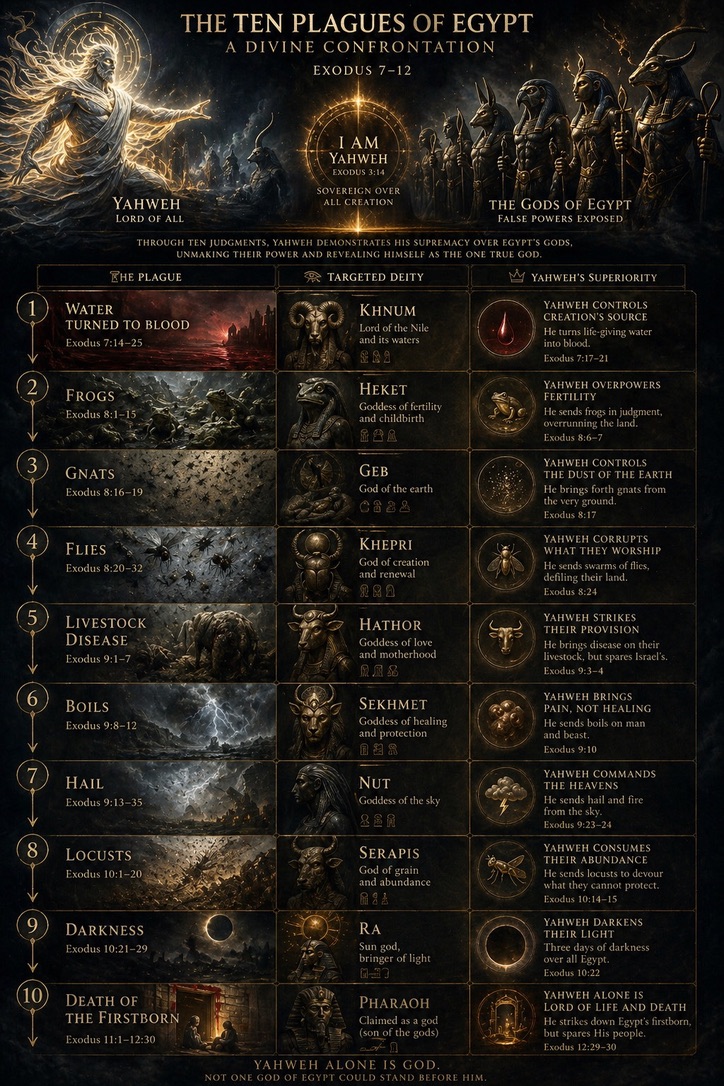
The plagues of Egypt (Exodus 7-12) represent far more than environmental catastrophes or political pressure. Within Michael Heiser’s divine council framework, the plagues function as a systematic theological dismantling of Egypt’s entire pantheon. Yahweh is not merely proving His power; He is publicly demonstrating His absolute sovereignty over creation and unmasking the impotence of Egypt’s gods before the heavenly council and all creation witnesses.
Key Framework: In Heiser’s reading, every functional domain of Egyptian cosmic order—water, fertility, the heavens, life itself—is controlled by assigned deities within their territorial authority. The plagues strip that authority away, revealing these gods as either powerless or subject to Yahweh’s command.
The Divine Council Theology Behind the Plagues
Yahweh’s Sovereignty and the Elohim Structure
Exodus 3:14 establishes Yahweh’s fundamental identity: “I AM WHO I AM.” This is not merely personal identity; it’s a declaration of absolute existence and authority. In the divine council framework, Yahweh sits at the apex of the heavenly assembly (Psalm 82, Daniel 7). The Egyptian gods—referred to collectively as elohim in some contexts—occupy subordinate positions within creation’s hierarchy, whether they acknowledge it or not.
Biblical Verification: Psalm 82 presents Yahweh standing in the divine council, condemning other gods for their injustice. This parallels the plague narrative: Yahweh is systematically proving that the gods Egypt worships have no actual authority.
Territorial Authority and Divine Domains
In the divine council model, each deity holds assigned dominion over specific cosmic domains: Khnum over water sources, Heket over fertility, Nut over the sky, Ra over light and order. The plagues target these domains directly, demonstrating that Yahweh—not these gods—holds ultimate authority over creation’s fundamental forces.
Biblical Verification: Exodus 7:17 states “I will strike the water of the Nile with the staff that is in my hand, and it will be turned to blood.” This is not a natural disaster; it is Yahweh’s direct intervention in a domain supposedly controlled by Khnum.
The Ten Plagues: A Divine Council Analysis
Plague 1: Water Turned to Blood
Scripture: Exodus 7:14-25
Targeted Deity: Khnum (Lord of the Nile; guardian of the Nile’s source)
The Confrontation: The Nile was Egypt’s lifeblood—economically, agriculturally, theologically. Khnum was believed to control the inundation that brought life to the land. By turning the Nile to blood, Yahweh demonstrates complete dominion over what Khnum supposedly governs.
Divine Council Implication: Khnum’s authority is exposed as illusory. The god cannot restore the Nile; only Yahweh can (Exodus 7:25, after seven days). This is a public declaration before the heavenly council and Egypt: Yahweh controls the source of life itself.
Pharaoh’s Response: Pharaoh’s magicians replicate the plague (Exodus 7:22), but notably, they cannot reverse it. They demonstrate magical mimicry, not actual divine authority.
Plague 2: Frogs
Scripture: Exodus 8:1-15
Targeted Deity: Hekat (Goddess of fertility and childbirth; also associated with frog-headed Heqet)
The Confrontation: Frogs, symbols of fertility and regeneration in Egyptian theology, become instruments of plague. Hekat’s domain—the power to bring forth life—is inverted into a curse. Life becomes pestilence.
Divine Council Implication: Fertility, one of Egypt’s most sacred domains, is shown to be under Yahweh’s control, not Hekat’s. The goddess cannot stop the plague or restore order.
Pharaoh’s Response: Again, the magicians replicate it (Exodus 8:7), but cannot reverse it. The pattern emerges: Egyptian magic can mimic but cannot control. Only Yahweh commands.
Plague 3: Gnats
Scripture: Exodus 8:16-19
Targeted Deity: Geb (God of the earth; controller of dust and all things born from soil)
The Confrontation: Dust becomes a plague. Geb, supposedly sovereign over the earth and its produce, is shown to be powerless over his own domain.
Divine Council Implication: The magicians now cannot replicate the plague (Exodus 8:18-19). This is the turning point. They acknowledge: “This is the finger of God.” The magicians recognize that Yahweh’s power operates in a different register than Egyptian magic. This is not sorcery—it is direct divine action.
Theological Shift: From this point forward, Pharaoh’s magicians fade from the narrative. They have no answer to Yahweh’s authority.
Plague 4: Flies
Scripture: Exodus 8:20-32
Targeted Deity: Khepri (God of creation, renewal, and transformation; often depicted as a scarab beetle)
The Confrontation: Swarms of flies corrupt creation and renewal. Khepri, the god of creative transformation, is shown as powerless to prevent or reverse the corruption of his own domain.
Divine Council Implication: Creation itself—one of the most sacred domains in Egyptian theology—is subject to Yahweh’s will, not Khepri’s. The god cannot protect Egypt from the desecration of what he supposedly oversees.
Escalation: Notice the escalation in Exodus 8:23: Yahweh now distinguishes between Egypt and Israel. The flies spare Goshen. This signals that Yahweh is not merely exercising power; He is exercising selective, sovereign judgment. He protects His people while destroying the land of those who reject Him.
Plague 5: Livestock Disease
Scripture: Exodus 9:1-7
Targeted Deity: Hathor (Goddess of love, motherhood, and fertility; protector of cattle and livestock)
The Confrontation: Egypt’s livestock—essential for agriculture, transport, and wealth—are struck with disease. Hathor, who was believed to protect herds and ensure their fertility, is powerless.
Divine Council Implication: Yahweh controls life and death, health and disease, in animal creation. Hathor’s protective authority is nullified.
Pharaoh’s Response: Pharaoh investigates (Exodus 9:7) and finds that none of Israel’s livestock have died. The distinction between Yahweh’s people and Egypt’s people is now undeniable. This is not random plague; it is covenantal judgment.
Plague 6: Boils
Scripture: Exodus 9:8-12
Targeted Deity: Sekhmet (Goddess of healing, medicine, and protection; the “eye of Ra”)
The Confrontation: This plague is particularly significant: Yahweh turns the very dust of Egypt into a plague of boils on man and beast. Sekhmet, the goddess specifically associated with healing and protection, cannot heal or protect. The goddess meant to ward off disease becomes its vector.
Divine Council Implication: Medical and protective magic—core domains of Egyptian priestly power—are rendered useless. Even the magicians themselves are afflicted and cannot stand before Moses (Exodus 9:11). Sekhmet’s authority is completely inverted: she is shown as impotent not just to heal, but to prevent the plague at all.
Theological Weight: This is the climax of Yahweh’s assault on Egyptian magic. The magicians exit the narrative entirely. They have no power.
Plague 7: Hail
Scripture: Exodus 9:13-35
Targeted Deity: Nut (Goddess of the sky; mother of the gods; controller of weather and atmospheric phenomena)
The Confrontation: Hail and fire fall from the sky—elements supposedly governed by Nut. The sky itself, considered the body of the divine mother of Egypt’s gods, is turned into an instrument of destruction.
Divine Council Implication: The heavens themselves obey Yahweh, not Nut. This is cosmic-level authority. Nut is not merely shown as powerless; she is shown as subject to Yahweh’s command over the very heavens.
Pharaoh’s Admission: In Exodus 9:27, Pharaoh admits: “Yahweh is righteous; I and my people are wicked.” This is a theological confession—he acknowledges Yahweh’s justice and his own culpability. Yet his heart hardens again (Exodus 9:35).
Divine Council Note: Yahweh explicitly states His purpose in Exodus 9:16: “But I have raised you up for this very purpose, that I might show you my power and that my name might be proclaimed in all the earth.” The plagues are not incidental; they are Yahweh’s method of broadcasting His sovereignty throughout creation and the heavenly council.
Plague 8: Locusts
Scripture: Exodus 10:1-20
Targeted Deity: Serapis (God of grain, abundance, and agricultural prosperity; protector of the harvest)
The Confrontation: Locusts consume every remaining plant and grain. Serapis, the god meant to ensure abundance and protect the harvest, is shown as powerless. Egypt’s food supply—the basis of its wealth and power—is obliterated.
Divine Council Implication: Yahweh controls abundance and scarcity, prosperity and famine. Serapis has no authority over what supposedly falls under his dominion.
Pharaoh’s Desperation: By Exodus 10:7, Pharaoh’s own officials are demanding he release Israel: “Do you not yet realize that Egypt is ruined?” The economic and social collapse is complete. Serapis has failed to protect the nation’s sustenance.
Plague 9: Darkness
Scripture: Exodus 10:21-29
Targeted Deity: Ra (Sun god; king of the gods; bringer of light and order; controller of ma’at—cosmic order)
The Confrontation: Three days of supernatural darkness engulf Egypt. Ra, the supreme sun god and symbol of Egyptian divine order, is eclipsed. The light Ra brings is extinguished.
Divine Council Implication: This is a direct assault on the highest god in the Egyptian pantheon. Ra is shown as powerless before Yahweh. If Ra—king of the gods—has no authority over the light, then no Egyptian god has any ultimate power.
Cosmic Significance: In Egyptian theology, Ra’s daily journey across the sky maintained ma’at (cosmic order). Darkness represented chaos, the victory of Apophis (the chaos serpent) over order. By bringing darkness, Yahweh demonstrates that the cosmic order itself is under His control, not Ra’s. He can suspend or invert the very foundations of Egyptian cosmology.
Pharaoh’s Final Offer: Exodus 10:24 shows Pharaoh willing to let the people go, but not their livestock. He still attempts to negotiate with Yahweh as an equal. Moses refuses (Exodus 10:25-29). Pharaoh hardens his heart completely.
Plague 10: Death of the Firstborn
Scripture: Exodus 11:1-12:30
Targeted Deity: Pharaoh himself (claimed as the son of Ra; a god incarnate)
The Confrontation: The firstborn of every household in Egypt dies—human and animal. This is not an assault on a departmental god; it is an assault on Pharaoh’s own divine status and on the concept of dynastic succession itself.
Divine Council Implication: Pharaoh claims to be a god—the living Horus, son of Ra. By striking down his firstborn and the firstborn of all Egypt, Yahweh demonstrates that Pharaoh is not a god. He has no power over life and death. His divine claims are false.
Covenantal Protection: Israel’s firstborn are spared through the Passover—the blood of the lamb on the doorpost marks them as Yahweh’s people (Exodus 12:12-13). This is the ultimate expression of covenantal distinction: Yahweh’s people are protected; those outside the covenant are judged.
Yahweh’s Declaration: Exodus 12:12 captures the theology perfectly: “On that same night I will pass through Egypt and strike down every firstborn of both people and animals, and I will bring judgment on all the gods of Egypt. I am Yahweh.”
Divine Council Proclamation: This is not a hidden act. It is a public judgment on all the gods of Egypt. Every household—every family—experiences the death of their firstborn. The heavenly council witnesses Yahweh’s absolute authority over life itself, a domain that belongs to no other god.
Theological Arc: The Dismantling of a Pantheon
Phase 1: Power (Plagues 1-3)
Yahweh demonstrates direct control over Egypt’s fundamental domains: water, fertility, earth. The magicians attempt to replicate these acts, but by Plague 3, they confess: “This is the finger of God.”
Phase 2: Escalation (Plagues 4-6)
Yahweh shifts to selective judgment, sparing Israel while destroying Egypt. The domain of magic itself is broken: the magicians are afflicted and removed from the narrative. Yahweh now operates without opposition.
Phase 3: Cosmic Authority (Plagues 7-9)
Yahweh demonstrates command over the highest levels of creation: the heavens (Nut), abundance (Serapis), and light itself (Ra). The cosmic order—ma’at—is shown to be under Yahweh’s authority, not the gods’.
Phase 4: Final Judgment (Plague 10)
Yahweh strikes Pharaoh’s own divine claim. The firstborn—the continuation of dynasty, the proof of life-giving power—are taken. Pharaoh, the “son of Ra,” is exposed as merely mortal and powerless.
The Heavenly Council Witnesses
In Heiser’s framework, the plagues are not merely for Egypt’s benefit or Israel’s deliverance. They are a cosmic announcement to the heavenly council itself. Every plague is a declaration: “Yahweh alone is God. No other divine being has authority comparable to mine.”
Biblical Verification:
- Exodus 9:16: Yahweh’s name will be “proclaimed in all the earth”
- Exodus 12:12: Judgment on “all the gods of Egypt”
- Romans 9:17 (Paul’s reflection on this passage): Pharaoh was raised up so that Yahweh’s name might be displayed
The plagues are cosmic theater. The heavenly council—the assembly of elohim—witnesses the hierarchy reestablished: Yahweh at the top, all other divine beings subordinate to His will.
Israel’s Covenantal Distinction
Throughout the plagues, Israel is progressively separated from Egypt:
- Plagues 1-6 affect both Egypt and Israel indiscriminately (or Israel must be warned to protect themselves)
- Plague 4 onward: Israel is explicitly spared (Exodus 8:23, 9:4, 10:23)
- Plague 10: Israel is protected through the Passover covenant
Covenantal Theology: This reveals the core purpose of the plagues. They are not random judgments; they are the establishment of covenant distinction. Israel becomes Yahweh’s people—protected, distinguished, claimed. Egypt remains outside the covenant and faces judgment.
Conclusion: Yahweh Alone
The ten plagues form a unified narrative arc within divine council theology: the systematic, public dismantling of Egyptian religious authority and the establishment of Yahweh’s absolute sovereignty over creation, the heavenly council, and human history.
Every plague targets a specific god. Every plague is unanswered by that god. And the final plague—the death of the firstborn—is answered only by Yahweh’s covenant: the blood of the lamb, marking His people for protection.
The Theological Declaration: “I am Yahweh, and there is no other. All the gods of Egypt are nothing before me.”
Exodus — Supplemental Notes
Personal study notes — Heiser framework
Hardening of Pharaoh’s Heart
This one used to bug me but it actually makes a lot of sense once you see the sequence.
Pharaoh hardens his OWN heart first — Exodus 8:15, 8:32, 9:34. He’s making his own choice. He’s not being set up. Then God hardens it further — Exodus 4:21, 7:3, 9:12, 10:1, 10:20, 10:27, 11:10. God isn’t creating the rebellion, He’s locking Pharaoh into the path Pharaoh already chose.
The way I think about it: you chose to go down this route, so now God is going to use that choice to destroy everything you believe in that is false. God basically says “you want to go this direction? Fine. I’m going to make sure you stay committed to it so my power gets fully revealed.” Every time Pharaoh refuses, the consequences compound. He dug his own hole and God made it deeper.
This isn’t God overriding free will — it’s God honoring the choice Pharaoh already made and using it for His purposes.
The Magicians — Real Power or Just Tricks?
These guys were NOT illusionists. They weren’t doing card tricks. The Hebrew calls them chartummim — sacred scribes, wise men. They had real power.
The evidence is right there in the text. They actually replicated the first three plagues. Turned water to blood (Exodus 7:22). Brought up frogs (Exodus 8:7). That’s not sleight of hand — that’s actual supernatural activity.
BUT — and this is the Heiser piece that makes it click — they weren’t getting this power from the Egyptian gods. They were operating through demonic power. Real entities, subordinate to Yahweh, who could mimic what He does but couldn’t reverse it or exceed His authority.
By Plague 3 (gnats) they hit a wall. They can’t replicate it and they say “This is the finger of God” (Exodus 8:19). They recognize they’re outmatched. And from that point they fade out of the story entirely — by Plague 6 they’re personally afflicted with boils and can’t even stand before Moses.
Real magic. Demonic in nature. But it only works until it doesn’t. Once Yahweh establishes His authority, their power becomes irrelevant.
The Flies / Locusts — Exodus to Revelation Connection
This one hit me while we were going through the plagues. When the flies came (Exodus 8:22-23), they didn’t touch Goshen where Israel was. God drew a line — His people were protected, everyone else got hit.
That same pattern shows up in Revelation 9:4 when the fifth seal opens and the demonic locusts pour out. They’re explicitly commanded not to harm anyone who has the seal of God on their forehead. Only the unsealed get attacked.
Same principle, two different testaments, different mechanisms. In Exodus it’s geographic — Israel lives in Goshen, so they’re in the protected zone. In Revelation it’s the seal of God marked on people individually. But the theology is identical: covenant distinction. God’s people are marked and protected. Everyone outside the covenant faces judgment.
The other piece worth noting — in both cases the locusts/flies are operating under divine command. In Exodus they’re Yahweh’s instrument. In Revelation the demonic locusts have a king (Abaddon) but they’re still constrained by God. Even demonic forces cannot cross the boundary of God’s seal. That’s a massive statement about His authority.
The Protection Motif — It’s Everywhere
Once I started seeing this pattern I couldn’t stop seeing it. God’s people are always marked and protected while judgment falls outside. The marker changes but the principle never does.
- Passover blood (Exodus 12:13) — blood on the doorpost, death passes over
- Noah’s ark (Genesis 7) — household sealed inside, judgment outside. The ark itself is the boundary
- Rahab’s scarlet cord (Joshua 2:18) — marks her house when Jericho falls. A foreigner protected by a visible marker
- The mark of Cain (Genesis 4:15) — interesting reversal here. God marks Cain for PROTECTION, not punishment. Even a murderer under God’s mark is untouchable
- Gideon’s fleece (Judges 6:36-40) — God separates and marks the chosen
- The temple veil / Christ’s body (Hebrews 10:19-20) — the veil separates holy from profane, but now believers have access through His blood
These aren’t random. Every single one of these is God saying “this person, this household, this people belongs to me and is under my protection.” The mechanism is different every time but the covenant logic underneath is always the same.
Something to come back to and dig deeper — there’s a whole study just in the protection markers themselves and what they represent covenantally.