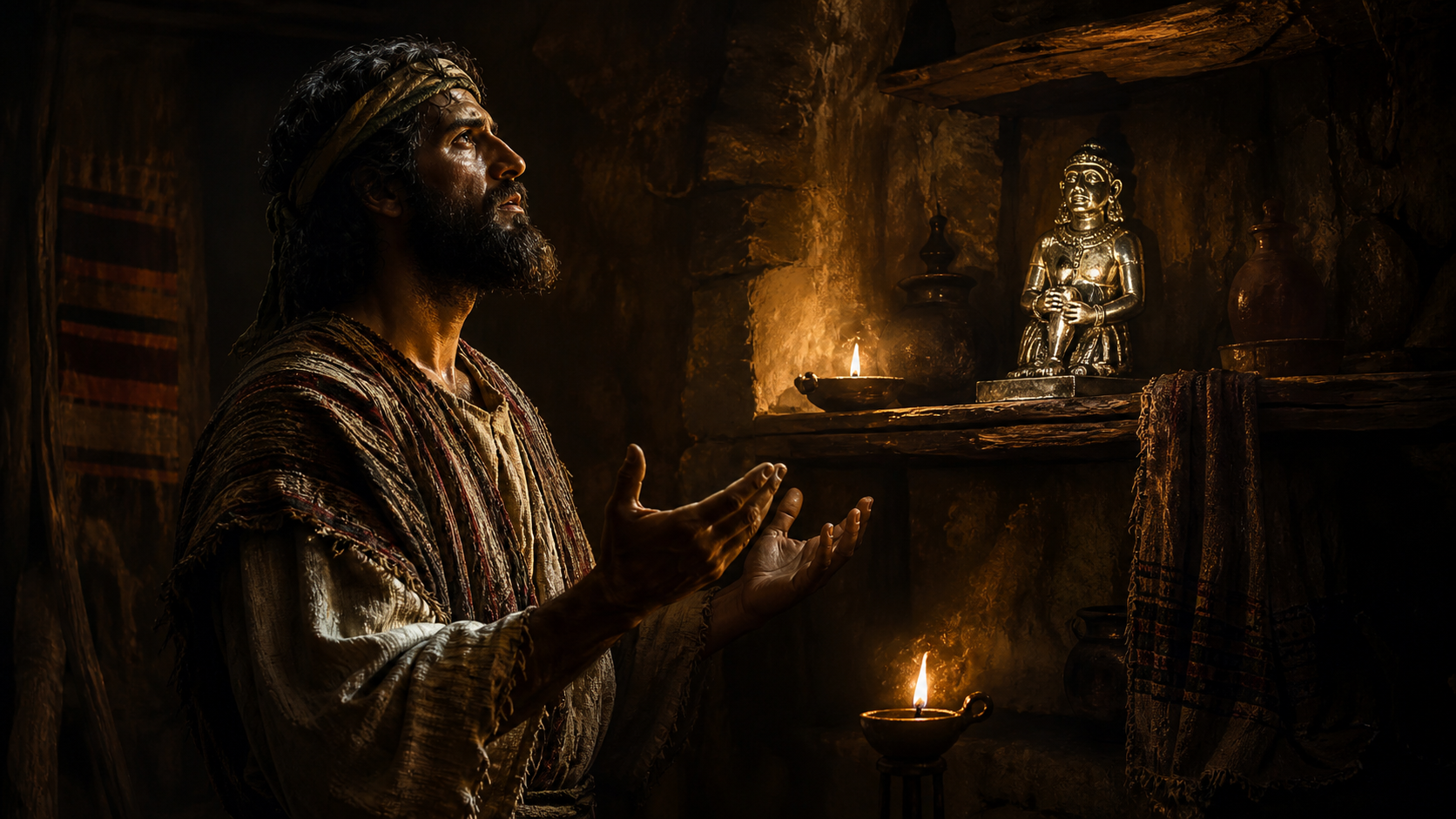
Judges 17–18 — Micah, Dan & the Idol
“In those days Israel had no king. Everyone did what was right in his own eyes.” — Judges 17:6; 21:25
Judges 17–18 opens the book’s appendix. These chapters portray the progressive Canaanization of Israel at three levels: the household (Micah), the priesthood (the unnamed Levite), and an entire tribe (Dan). No judge appears. No one calls on Yahweh.
The Corruption of the Household
Micah’s Name — Irony at Line One
The full form of Micah’s name — mîkāyĕhû — means “Who is like Yahweh?” The narrator uses this long form in vv. 1 and 4, then deliberately switches to the shortened mîkâ for the rest of the narrative, downplaying the Yahwistic element because what follows makes it embarrassing. The man whose name confesses Yahweh’s incomparability proceeds to build idols in direct defiance of Yahweh’s commands.
Four Positive Signals. Eight Problems.
- Micah confesses his theft
- Returns the silver to his mother
- Mother blesses him by Yahweh
- Silver “consecrated to the LORD”
- Confession motivated by fear of curse, not remorse
- Dedicated silver is tainted — stolen goods
- Silver goes to Micah’s house, not to Shiloh
- Only 200 of 1,100 shekels reach the silversmith
- Carving violates Exodus 20:4–5 outright
- Private shrine violates Deuteronomy 12
- Ephod and teraphim counterfeit authorized priestly instruments
- Son installed as priest — challenges the Aaronic order
The Corruption of the Priesthood
Five Damning Details Before He Speaks
| # | Detail | What It Means |
|---|---|---|
| 1 | He is a youth (naʿar) | Mosaic law set priestly service beginning at age 30. His youth compounds every irregularity that follows. |
| 2 | He is from Bethlehem in Judah | Repeated three times (vv. 7–9). Implicates Judah alongside Ephraim — this man is an embarrassment to both tribes. |
| 3 | He is a sojourner without roots | Echoes Deuteronomy 18:6 — a legitimate Levite going to serve at the central sanctuary. This man is the parody: he goes not to Yahweh’s chosen place but wherever he might find. |
| 4 | He is unnamed | Protects Moses’ memory in advance; also generalizes his behavior to the entire Levitical tribe as a class. |
| 5 | He has no theological agenda | Block: “shiftless… following the path of least resistance and waiting for an opportunity to open up.” |
Micah hires a youth to be his father but then treats him like one of his sons. The relationship is inverted. The Levite’s acceptance is not coerced — he is “blinded by his own ambition to the heterodoxy of the situation.” Instead of denouncing Micah (cf. Deuteronomy 13:6–11), he capitalizes on the opportunity.
The Corruption of the Tribe
A Parody of the Conquest
Block identifies Judges 18 as a deliberate parody of the spy mission traditions in Numbers 13–14 and Deuteronomy 1. The structure mirrors the original, but everything is inverted.
Jonathan Son of Gershom Son of Moses
The final reveal (18:30) is the narrator’s most devastating stroke. The unnamed Levite is identified as Jonathan, son of Gershom, son of Moses. The grandson of Israel’s greatest leader is the founding priest of Dan’s idolatrous shrine. The rabbis found this so offensive they altered the consonantal text, inserting a nun into mšh (“Moses”) to produce mnšh (“Manasseh”).
The narrator’s final note links the Dan shrine directly to Shiloh — where the legitimate house of God was operating throughout this entire period. The apostasy is not committed in ignorance of the alternative.
The Tribe of Dan — Arc Through Scripture
Silver & Gold — The Vertical Cosmology
The Silver Betrayal Pattern
| Text | The Insider | Silver’s Role | Consequence |
|---|---|---|---|
| Judg 16:5 | Delilah, within Israel’s intimate circle | 1,100 shekels per governor → delivers Samson to the Philistines | Israel’s champion destroyed |
| Judg 17–18 | Micah within Israel | 1,100 shekels (same sum) → becomes the idol, foundation of Dan’s apostasy | Tribal idolatry persisting to Assyrian exile |
| Matt 26 | Judas within the Twelve | Thirty pieces of silver → betrayal of the Messiah | Cosmic consequence |
What the Narrator Wants Us to See
The narrator’s final irony: the Danites succeed. They get their land, their shrine, their priest. Success is not a sign of righteousness. God does not stifle every corrupt scheme. The Canaanization of Israel is complete — not imposed from outside but chosen from within.
Within the Heiser Divine Council framework, Israel’s idolatry is not merely moral failure. It is active alignment with the spiritual powers behind the false gods. The “no king” refrain signals the collapse of the human governance structure through which Yahweh was meant to exercise his kingship. Israel — Yahweh’s inheritance among the nations — is dissolving back into the spiritual orbit of the nations assigned to lesser divine beings at Babel.
Commentary: Block, Daniel I. Judges, Ruth. New American Commentary. B&H, 1999. Logos Export · May 4, 2026.