
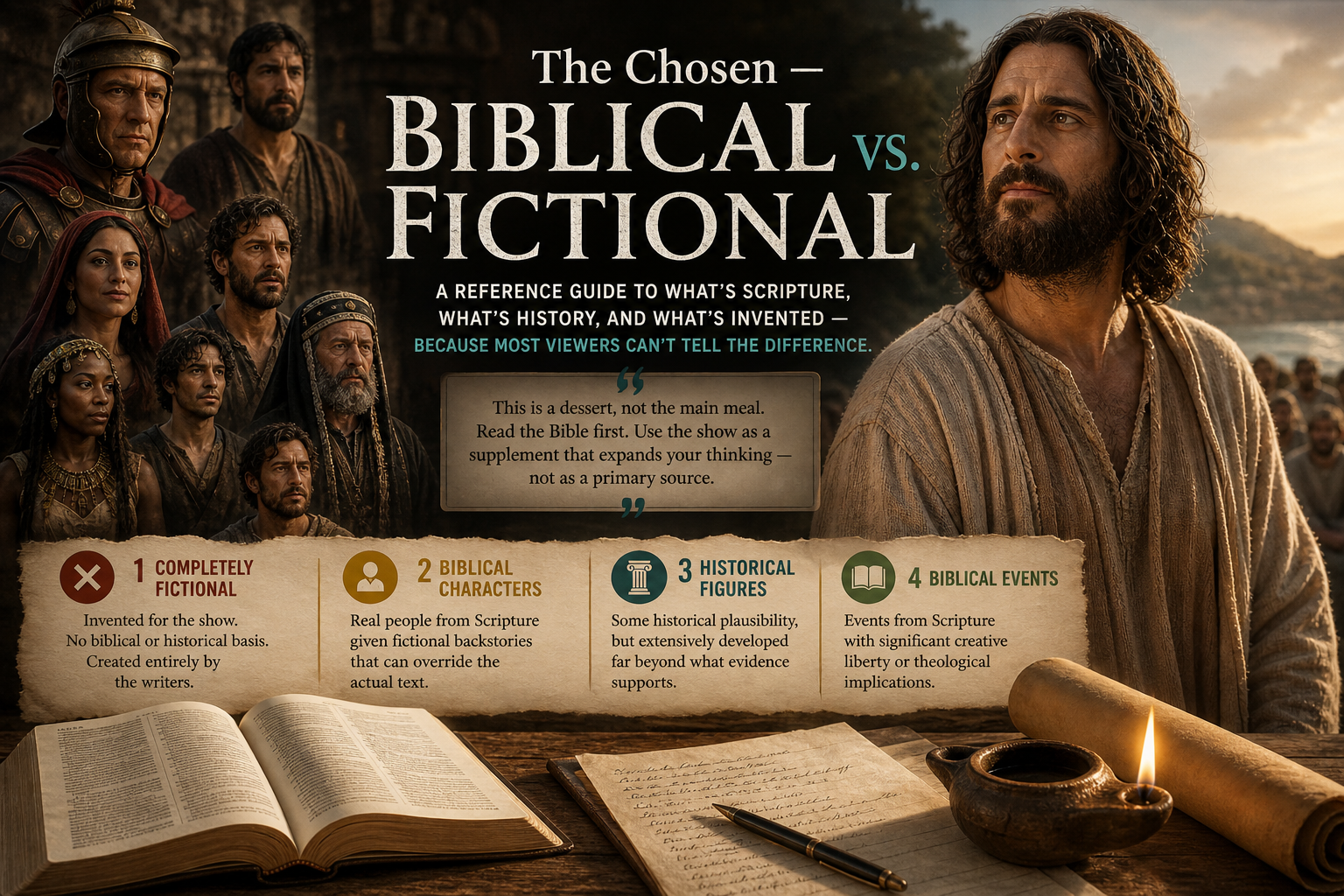
A Personal Note
I’ll be honest — I like this show. I think it’s genuinely good, and I’m glad it exists. For most of church history, Christian media meant flannel boards, low budgets, and productions so corny that nobody outside the church would touch them with a ten-foot pole. The Chosen changed that. It’s well-acted, it’s emotionally real, and it does something that most of us who grew up in church never had — it shows Jesus as fully human. Laughing. Getting frustrated. Tired at the end of a long day. That’s not a small thing. A lot of people spent decades seeing Christ as this untouchable divine figure behind stained glass, and this show cracked that open in a way that sent people back to their Bibles asking better questions.
Jonathan Roumie clearly took this role seriously. I’ve seen interviews where he talks about feeling completely unworthy to speak the words of Christ — that’s not an actor doing a job, that’s a man who understood the weight of what he was doing. I respect that.
That said — and this is why I put this reference together — the show is so well-made that it feels authoritative in a way that low-budget Christian films never did. The higher the production value, the easier it is to absorb fiction as fact without realizing it. I’ve had real conversations with people who didn’t know that certain characters or plotlines were completely invented. That’s not a criticism of Dallas Jenkins. It’s just the nature of the medium, and it’s something every viewer needs to go in aware of.
Watch it. Enjoy it. Let it spark something. Just don’t let it replace the text that it’s pointing toward.
Category One — Completely Fictional
Invented for the show. No biblical or historical basis. Created entirely by the writers.
Ramah
Thomas’s partner / female disciple. Entirely invented. In Scripture, “Ramah” is a place, not a person (1 Sam 1:19; Jer 31:15). Represents the unnamed women of Luke 8:1-3. Killed by Quintus in S4; Jesus declines to raise her, saying “it is not her time.”
Quintus
Roman Praetor of Galilee. No Gospel counterpart. A composite villain loosely inspired by Roman authority figures in the narrative. Loses his post after killing Ramah.
Atticus Aemilius
Roman intelligence agent. No biblical basis. Possibly invented to explain how the Gospel writers had knowledge of conversations among Roman and Jewish leaders that no disciple could have witnessed.
Shmuel
Hostile Pharisee / antagonist. Fictional. Created as an ongoing foil to Jesus and Nicodemus. The most openly hostile Pharisee in the show, with no Gospel parallel.
Tamar
Ethiopian female disciple. Not biblical. Added to represent the diversity of those drawn to Jesus, inspired by but not grounded in any specific scriptural figure.
Dasha
Eden’s mother / Peter’s mother-in-law. The Bible confirms Peter’s mother-in-law exists (Matt 8:14) — and that’s all it says. Name, characterization, and storyline are invented.
Yussif
Sympathetic Pharisee. Fictional. Serves as the reasonable counterpoint to Shmuel’s hostility. No Gospel counterpart.
Category Two — Biblical Characters Given Fictional Backstories
Real people from Scripture — substantially expanded with invented material that can override the actual text in a viewer’s imagination.
Eden
Simon Peter’s wife. Peter’s wife is biblically attested (1 Cor 9:5) but never named in Scripture. The show names her Eden, gives her a prominent multi-season role, and portrays her as more consistently faithful than Peter.
Matthew
Apostle / tax collector. Depicted as neurodivergent. No biblical evidence for this. Treated as plausible artistic license by the production’s theological consultants.
Mary Magdalene
Disciple. Scripture says Jesus cast out seven demons (Luke 8:2) — that’s nearly all we have. The show adds addiction, a Roman assault backstory, and Nicodemus’s failed exorcism attempt before Jesus succeeds.
Nicodemus
Pharisee. Appears in a single passage in John 3. The show builds an entire multi-season arc, inner life, family dynamics, and ongoing relationship with Jesus around those few verses.
Little James
Apostle (James son of Alphaeus). Appears in the Gospels only in the apostle lists. The show gives him a physical disability and a rich personal storyline — all invented.
Thomas
Apostle. Real apostle with a known scriptural character (John 11:16; 20:24–28). His entire romantic relationship with Ramah and the resulting grief arc are pure invention built around the historical figure.
Category Three — Historical Figures, Heavily Fictionalized
Some historical plausibility, but extensively developed far beyond what evidence supports.
Gaius
Roman centurion / Praetor. Likely adapted from the centurion of Matt 8 whose servant Jesus heals. The show gives him a name, a son named Ivo, and a full multi-season arc of gradual movement toward faith.
Peter’s Debt Crisis
Season 1 opening storyline. No biblical basis. Historically plausible under Roman taxation. Used as the entire dramatic framing device that leads to Peter following Jesus.
Photina
Samaritan woman at the well. Real encounter in John 4 — but the woman is unnamed in Scripture. “Photina” comes from early church tradition. The show gives her a significantly expanded storyline and ongoing presence.
Category Four — Biblical Events with Significant Creative Liberty
The most theologically important category — places Jesus in situations not found in the Gospels, or reframes how he behaves.
Mary’s Deliverance
Mary Magdalene’s exorcism (S1). The exorcism is in Luke 8:2. The show frames it with a full invented backstory and has Nicodemus attempt — and fail — the exorcism first, before Jesus succeeds. No biblical basis for Nicodemus’s involvement.
Sermon on the Mount
Matthew 5–7. The words of Jesus are taken directly from Scripture. But the show constructs a multi-episode buildup, crowd dynamics, disciple reactions, and backstage drama — all invented scaffolding around the actual text.
John 3 — Nicodemus
The “born again” encounter. Single chapter in Scripture. The show builds an entire season of relationship-building to contextualize it, which risks making viewers feel they understand Nicodemus’s inner life when the text gives almost nothing.
Ramah’s Death
Season 4, Episode 3 — most contested moment. Jesus present but declining to heal a dying person, saying “it is not her time.” This inverts the normal Gospel pattern. No parallel in Scripture. Several theologians have identified this as the show’s most theologically problematic creative choice.
Discernment Notes
- The show’s opening disclaimer states “Biblical events are condensed” — worth treating as a genuine warning, not boilerplate.
- Script consultants include Dr. Doug Huffman (Biola University) and a Messianic Jewish Rabbi. The production takes theological review seriously.
- The higher the production quality, the more authoritative it feels — which makes uncritical absorption more dangerous, not less.
- Emotional weight makes fiction feel true.
- The idolatry concern is real: Jonathan Roumie’s face becoming the face of Jesus competes with the actual text when reading the Gospels. This is not the actor’s fault. It is what the visual medium does.
- Most dangerous: not the invented characters (viewers can accept Ramah as a device) but the moments that subtly reframe how Jesus behaves — these are absorbed as Gospel witness by viewers with thin biblical literacy.
- The test: does watching it send you to the actual text with better questions, or does it substitute for the text?
Sources
- Is The Chosen Biblically Accurate? — Screen Rant
- How We Make Theological Decisions for Fictional Scenes — Religion News Service
- The Chosen: Fiction, Truth, or in Between? — Early Christian Texts
- Is Ramah from The Chosen in the Bible? — Favour Udelue Blog
- Quintus, Gaius, Atticus & the Romans in The Chosen — The Bible Artist
- What is The Chosen and is it Biblically Sound? — GotQuestions.org
- List of The Chosen Characters — Wikipedia
- Authenticity of Scripture Paramount to The Chosen’s Success — CBN
See also: How I Study the Bible