Tool Beta
The Ancient World Behind the Text: Ideas
The customs, offices and ideas a first reader knew without being told, what each meant then, and the nearest thing you already know.
Circumcision and becoming a Jew
Circumcision was the sign of God's covenant with Abraham and the mark of a Jewish man. A Gentile man who joined Israel was circumcised; the first great quarrel in the church was over whether Gentile believers had to be.
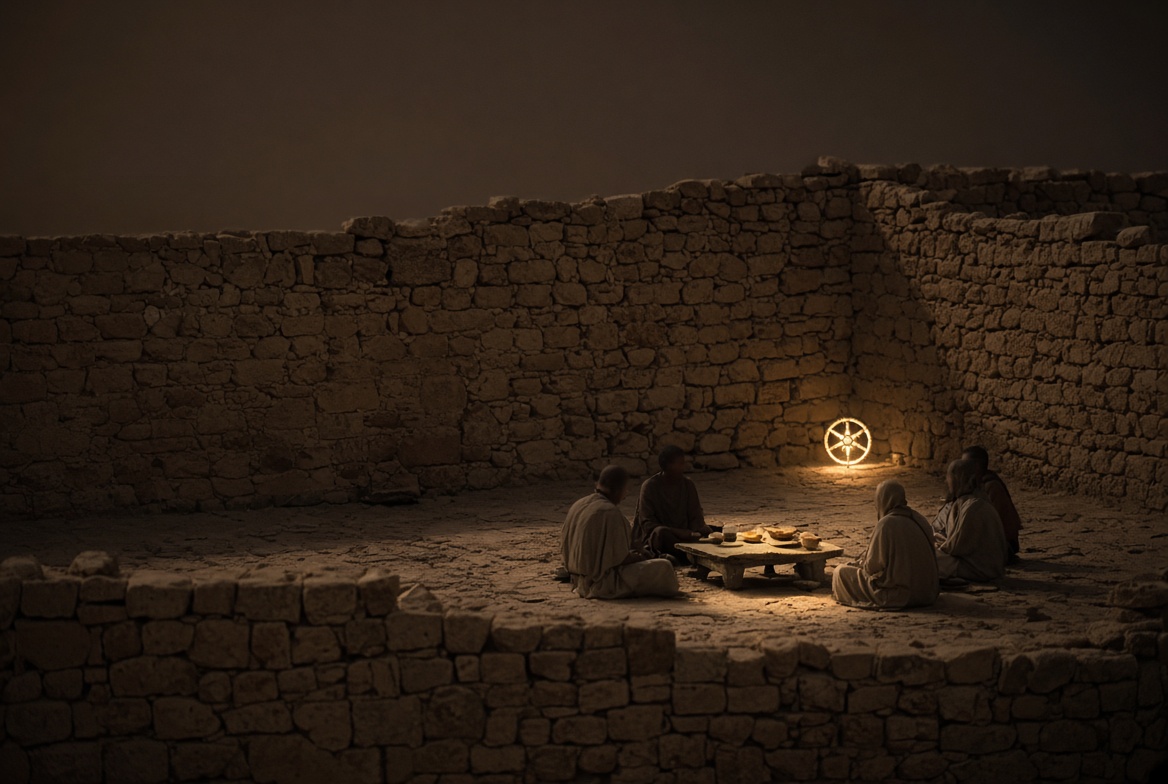
He had come to every service for years, but joining for real meant an operation no grown man looked forward to. God gave circumcision to Abraham as the sign of his covenant, and Jewish boys were circumcised as babies. A Gentile man who wanted to become a Jew had to be circumcised as an adult. Many Jews believed that good Gentiles could be saved without it, but almost no one thought a Gentile could belong to God's people Israel without converting. When Gentiles began to believe in Jesus, the church had to decide whether they must be circumcised first.
Circumcision was the badge of God's covenant with the Jews, required of anyone who belonged to God's people (Genesis 17:9-14). With the food laws and the purity rules, it made life in a Gentile community almost impossible for anyone who kept them (ESV Study Bible). Many Jews believed Gentiles were saved by keeping the laws God gave Noah, against idolatry, sexual immorality and the like. Others held that Gentiles had to convert. Men converted by circumcision, and for most of this group everyone was immersed. Even the lenient did not count an uncircumcised Gentile part of Israel. Only the strictest minority limited salvation to full converts (Keener). Josephus reported that some of his colleagues demanded circumcision of Gentiles who had fled to them, and that he forbade it. Hillel reportedly welcomed converts diplomatically. Shammai, whose stricter school probably dominated before AD 70, demanded the whole law from the start. Gentiles were thought continually impure, which is why converts were immersed. Timothy was the uncircumcised son of a Jewish mother and a Gentile father, so Jews would see him as a Gentile. A wife was expected to follow her husband's religion, so his father had probably refused it. Carson counts circumcision among the "features intrinsic to Judaism" that could not be required of all believers once Gentiles came in. Acts 15 and Galatians 2 record that tension. Attempts to restrict circumcision provoked revolts before and after Paul's time. Josephus says Antiochus "commanded them not to circumcise their sons". He adds that Jerusalem Hellenizers who wanted a gymnasium hid their circumcision, "that even when they were naked they might appear to be Greeks."
An analogy: a club that welcomes guests at every event but lets only initiated members vote. The argument starts when guests are found running the meetings without ever having been initiated.
Circumcision marked who belonged to Israel, so the demand in Acts 15:1 that Gentile believers be circumcised was a demand that they become Jews first. Paul resists it in Galatians 5:2-6 and speaks in Romans 2:25-29 of a circumcision of the heart.
Not a club rule that members can vote to change. Circumcision was a sign God gave in the covenant with Abraham, cut into the body and tied to belonging to Israel itself. Some Jews held that Gentiles had to take it to be saved. Nor was it a health practice: a rumor that Paul told Jews abroad to stop circumcising their sons alarmed Jerusalem.
What does Paul mean by works of the law, the phrase he sets against faith in Galatians 2:16? The cultural backgrounds notes report that some take it to mean distinctively Jewish customs, such as circumcision and the food laws, that had become identity markers. The notes themselves lean to all the Bible's laws, while allowing that the markers were probably most prominent in people's minds. Wright reads the practices that marked Jews off from their pagan neighbors: Sabbath, food laws and circumcision. "The works of Torah are sociocultural identity markers," he writes, not flags of moral achievement. The ESV Study Bible takes the phrase to cover "not only circumcision, food laws, and Sabbath, but any human effort" to be justified by obeying a moral law. The CSB Study Bible sees the same issue as Acts 15:1-5: works of the law, circumcision above all, added to what was required for justification.
- {"u":"https:\/\/jayms.com\/bible-study-tools-2\/ancient-world-passages\/acts-15-1-21\/","n":"Acts 15:1-21, The council in Jerusalem","s":"Teachers from Judea insist that Gentile believers must be circumcised to be saved. The apostles and elders meet in Jerusalem; Peter and James argue that God has accepted Gentiles as they are, and James proposes a few rules for them to keep.","r":"Acts 15:1-21"}
- {"u":"https:\/\/jayms.com\/bible-study-tools-2\/ancient-world-passages\/acts-21-17-26\/","n":"Acts 21:17-26, James, the rumors and the vow","s":"In Jerusalem James and the elders welcome Paul but warn him that thousands of believers zealous for the law have heard he teaches Jews abroad to abandon Moses. They ask him to pay for four men completing a vow and to purify himself with them in the temple.","r":"Acts 21:17-26"}
- {"u":"https:\/\/jayms.com\/bible-study-tools-2\/ancient-world-passages\/romans-2-17-29\/","n":"Romans 2:17-29, You who boast in the law","s":"Paul turns on an imagined Jewish teacher who boasts in the law yet steals, commits adultery and robs temples, so that God's name is blasphemed among the nations, and says true circumcision is of the heart.","r":"Romans 2:17-29"}
- {"u":"https:\/\/jayms.com\/bible-study-tools-2\/ancient-world-passages\/romans-4-1-25\/","n":"Romans 4:1-25, Abraham, father of the uncircumcised too","s":"Paul argues from Genesis 15:6 that Abraham was counted righteous by trusting God before he was circumcised, so he is the father of all who believe, circumcised or not.","r":"Romans 4:1-25"}
- {"u":"https:\/\/jayms.com\/bible-study-tools-2\/ancient-world-passages\/1corinthians-7-17-24\/","n":"1 Corinthians 7:17-24, Circumcised or not, slave or free","s":"Paul tells each believer to live the life the Lord assigned when he was called: the circumcised should not undo it, the uncircumcised should not seek it, and a slave should not be troubled, though he should take his freedom if he can.","r":"1 Corinthians 7:17-24"}
- {"u":"https:\/\/jayms.com\/bible-study-tools-2\/ancient-world-passages\/galatians-2-1-10\/","n":"Galatians 2:1-10, Titus, the pillars and the right hand of fellowship","s":"Fourteen years later Paul goes up to Jerusalem with Barnabas and the uncircumcised Titus; Titus is not made to be circumcised, and the leaders reputed to be pillars give Paul the right hand of fellowship, asking only that he remember the poor.","r":"Galatians 2:1-10"}
- {"u":"https:\/\/jayms.com\/bible-study-tools-2\/ancient-world-passages\/galatians-2-11-21\/","n":"Galatians 2:11-21, Peter leaves the table at Antioch","s":"At Antioch Peter, who had been eating with Gentile believers, draws back when people come from James, and Paul rebukes him in front of everyone, arguing that Jews and Gentiles alike are put right with God through Christ and faith, not by doing what the law requires.","r":"Galatians 2:11-21"}
- {"u":"https:\/\/jayms.com\/bible-study-tools-2\/ancient-world-passages\/galatians-5-2-12\/","n":"Galatians 5:2-12, Circumcision, the whole law and the knife","s":"Paul warns that a man who accepts circumcision is bound to keep the whole law and is cut off from Christ, asks who cut in on their race, and wishes that the agitators would go further with the knife.","r":"Galatians 5:2-12"}
- {"u":"https:\/\/jayms.com\/bible-study-tools-2\/ancient-world-passages\/galatians-6-11-18\/","n":"Galatians 6:11-18, Large letters in his own hand, and the marks of Jesus","s":"Taking the pen himself, Paul writes in large letters that the rivals want the Galatians circumcised so they can boast in their flesh and avoid persecution, while he boasts only in the cross; he blesses those who follow this rule and the Israel of God, and says he bears the marks of Jesus.","r":"Galatians 6:11-18"}
- {"u":"https:\/\/jayms.com\/bible-study-tools-2\/ancient-world-passages\/ephesians-2-11-22\/","n":"Ephesians 2:11-22, The dividing wall torn down, and a new temple","s":"Paul reminds Gentile believers that they were once far off, shut out of Israel's citizenship and covenants, and tells them Christ has broken down the dividing wall and built Jews and Gentiles into one household and one temple.","r":"Ephesians 2:11-22"}
- {"u":"https:\/\/jayms.com\/bible-study-tools-2\/ancient-world-passages\/philippians-3-1-11\/","n":"Philippians 3:1-11, Dogs, mutilators, and a pedigree counted as loss","s":"Paul warns against teachers who press circumcision, calling them dogs and mutilators, lists his own credentials as a born Jew, a Pharisee and a zealous persecutor, and counts them all loss for the sake of knowing Christ.","r":"Philippians 3:1-11"}
- {"u":"https:\/\/jayms.com\/bible-study-tools-2\/ancient-world-passages\/colossians-2-8-15\/","n":"Colossians 2:8-15, The philosophy, a cancelled IOU and a triumph","s":"Paul warns against a philosophy built on human tradition and the elements of the world, tells Gentile believers they have already been circumcised in Christ, and pictures God cancelling their debt at the cross and leading the powers captive.","r":"Colossians 2:8-15"}
- {"u":"https:\/\/jayms.com\/bible-study-tools-2\/ancient-world-passages\/titus-1-10-16\/","n":"Titus 1:10-16, The circumcision group, and Cretans always liars","s":"Many rebellious talkers and deceivers, especially of the circumcision group, are upsetting whole households for dishonest gain; Paul quotes a Cretan prophet who called Cretans always liars, and warns against Jewish myths and human commands, for to the pure all things are pure.","r":"Titus 1:10-16"}
- ESV Study Bible, study notes on Acts 15:1 and 21:21
- Craig S. Keener, The IVP Bible Background Commentary: New Testament, on Acts 15:1, 15:5, 15:8-9 and 16:1-5
- NIV Cultural Backgrounds Study Bible, notes on Acts 15:1, 15:5 and 16:3
- CSB Study Bible, notes on Acts 16:1-3 and 21:21
- D. A. Carson, A Quick Introduction to the New Testament, Longstanding Interpretive Traditions
- Craig S. Keener, The IVP Bible Background Commentary: New Testament, introduction to Galatians, The Issue
- Josephus, Antiquities of the Jews 12.5.1 and 12.5.4, trans. William Whiston
- NIV Cultural Backgrounds Study Bible, note on Galatians 2:16
- ESV Study Bible, study note on Galatians 2:16
- CSB Study Bible, Introduction to Galatians, Background
- N. T. Wright, Galatians, Commentary, The Great Transformation (2:15-21)









