Tool Beta
The Ancient World Behind the Text: Ideas
The customs, offices and ideas a first reader knew without being told, what each meant then, and the nearest thing you already know.
The Festival of Dedication
The eight-day winter feast of lights that remembered how Judas Maccabeus cleansed and rededicated the temple after Antiochus IV defiled it. It recalled liberation, and it called kings to mind.
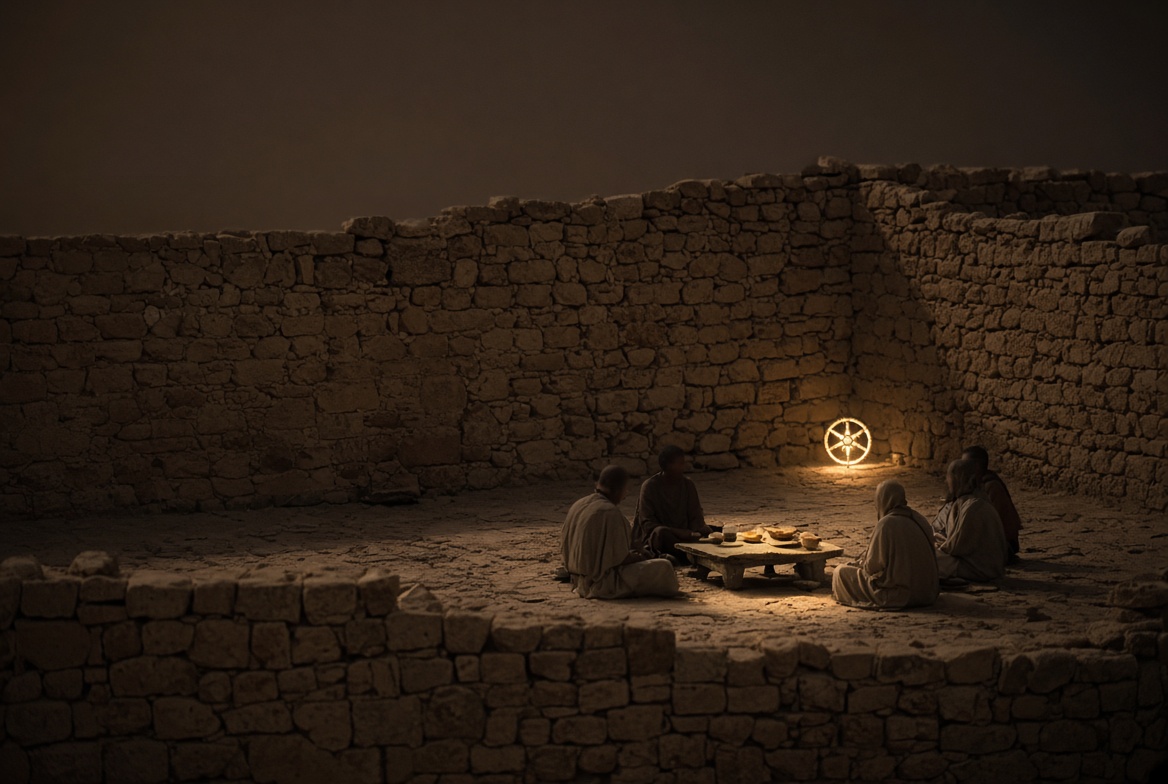
Every year the town lights candles on the night the tyrant's statue came down. In the 160s BC a Greek king, Antiochus IV, set up pagan worship in the temple and sacrificed pigs on its altar. Jewish fighters led by Judas Maccabeus took the temple back, cleansed it and dedicated a new altar. The yearly feast that remembered it lasted eight days in winter, with lamps lit in the temple. Nobody was required to travel for it, but it was a feast of freedom.
Josephus tells how Antiochus Epiphanes plundered the temple and forced pagan worship on the Jews, and that "when the king had built an idol altar upon God's altar, he slew swine upon it." Three years later, on the twenty-fifth of the month Casleu, Judas Maccabeus cleansed the temple, built a new altar and lit the lamps. The people made it a law to keep the restoration for eight days. Josephus adds, "And from that time to this we celebrate this festival, and call it Lights." The ESV and CSB Study Bibles date the desecration to 167 BC and the rededication to December 164 BC. It was not a required pilgrimage, but Keener writes that "the eight-day celebration of lights in the temple was beautiful." His notes say it drew pilgrims from Galilee and even from the Diaspora, though fewer than Tabernacles. Antiochus claimed to be divine, and a letter Josephus records from the people of Shechem addresses him as the god Epiphanes. Wright stresses kingship. By freeing and reconsecrating the temple, Judas and his family became kings and founded a dynasty that lasted about a hundred years. Herod the Great married one of its princesses to claim its line. So every Hanukkah, Wright says, people thought about kings and how they became kings.
An analogy: an independence day that remembers the night an occupying army was driven out of the capital's great hall. The lights are beautiful, and the speeches always turn to who will lead the nation now.
Dedication remembered a temple set apart again and a ruler who claimed to be a god, so words about who is set apart by God and who may be called God's Son, as in John 10:36, land at a pointed moment. The feast is named only in John 10:22.
Not a secular holiday. An independence day honors a state. Dedication remembered the temple cleansed and a new altar built after pagan sacrifice had defiled it, so its lamps were lit in God's house.
- {"u":"https:\/\/jayms.com\/bible-study-tools-2\/ancient-world-passages\/john-10-22-42\/","n":"John 10:22-42, In Solomon's Porch at the Festival of Dedication","s":"In winter, at the Festival of Dedication, the Judeans press Jesus to say plainly whether he is the Messiah. He says he and the Father are one, they pick up stones, and he answers from Psalm 82.","r":"John 10:22-42"}
- {"u":"https:\/\/jayms.com\/bible-study-tools-2\/ancient-world-passages\/john-12-12-19\/","n":"John 12:12-19, Palm branches and a donkey's colt","s":"The festival crowd goes out with palm branches, shouting Hosanna and hailing Jesus as King of Israel, and he rides in on a young donkey, as Zechariah had said Zion's king would come.","r":"John 12:12-19"}
- Josephus, Antiquities of the Jews 12.5.4, 12.5.5 and 12.7.6-7, trans. William Whiston
- Craig S. Keener, The IVP Bible Background Commentary: New Testament, on John 10:22
- NIV Cultural Backgrounds Study Bible, notes on John 10:22, 10:31 and 10:36
- ESV Study Bible, study note on John 10:22
- CSB Study Bible, note on John 10:22
- N. T. Wright, John for Everyone, Part One, comment on John 10:19-30









