Tool Beta
The Ancient World Behind the Text
Pick a passage anywhere in the New Testament. See the customs and ideas a first reader knew without being told.
Mark 11:12-25, The fig tree and the temple
Jesus curses a leafy fig tree with no fruit, overturns the tables in the temple, and the next morning the tree has withered.
Mark 11:12-25, in every translation this tool compares.
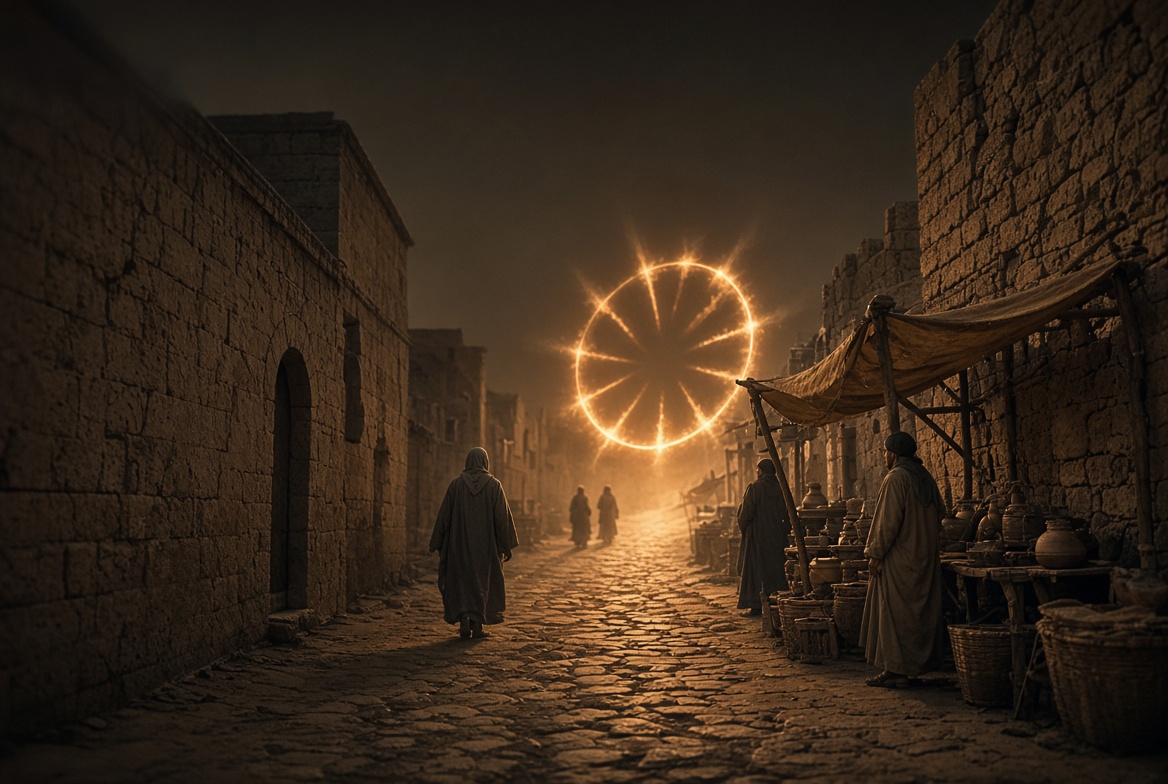
Mark frames the temple scene with the story of a fig tree, so the reader takes the two together. Jesus curses a fig tree that has leaves but no fruit, then disrupts the trade in the temple courts, and the next morning the tree is dead. The temple leaders now want him dead too.
- {"u":"https:\/\/jayms.com\/bible-study-tools-2\/ancient-world-ideas\/temple-and-courts\/","n":"The temple and its courts","s":"Herod's huge rebuilt temple in Jerusalem, believed to be God's dwelling, laid out in courts that kept Gentiles, women and Jewish men at set distances.","r":""}
- {"u":"https:\/\/jayms.com\/bible-study-tools-2\/ancient-world-ideas\/passover-pilgrims\/","n":"Passover and the pilgrim crowds","s":"The spring festival that retold God's rescue of Israel from Egypt. Jerusalem filled with pilgrims, and hopes of freedom ran high.","r":""}
- {"u":"https:\/\/jayms.com\/bible-study-tools-2\/ancient-world-ideas\/chief-priests-and-council\/","n":"Chief priests, elders and the council","s":"The Jerusalem aristocracy of priestly families and elders who ran the temple and the Sanhedrin and dealt with Rome.","r":""}
Keener notes that near the Mount of Olives fig trees could be in leaf at Passover with only green early figs, and a tree with leaves but no early figs would stay fruitless that year; he reads the curse as an acted parable framing the protest in the temple. The ESV Study Bible notes that the fig tree often stands for Israel in the Old Testament. Garland and Wilkins put the market in the Royal Stoa, a hall of 162 columns on the south side of the courts, not across the whole outer court. Money changers set up three weeks before Passover for the half-shekel tax, paid in Tyrian shekels bearing the god Melkart and an eagle (Garland). The cultural backgrounds article on Herod's temple gives the courts' dimensions, about 1,590 feet on the west side, and notes that the Sanhedrin's hall and a ritual bath lay to the south. Josephus tells of Jesus son of Ananus, whom the city's leaders handed to the governor for crying woe on the temple (Garland).
- NIV Cultural Backgrounds Study Bible, notes on Mark 11:13, 11:15, 11:16, 11:18 and 11:19
- N. T. Wright, Mark for Everyone, comment on Mark 11:12-25
- ESV Study Bible, study notes on Mark 11:13-14 and 11:15-17
- David E. Garland, Mark, in Zondervan Illustrated Bible Backgrounds Commentary, ed. Clinton E. Arnold, on Mark 11:15, sidebar Tyrian Shekels and on 11:28
- Michael J. Wilkins, Matthew, in Zondervan Illustrated Bible Backgrounds Commentary, ed. Clinton E. Arnold, on Matthew 21:12
- NIV Cultural Backgrounds Study Bible, article Herod's Temple