
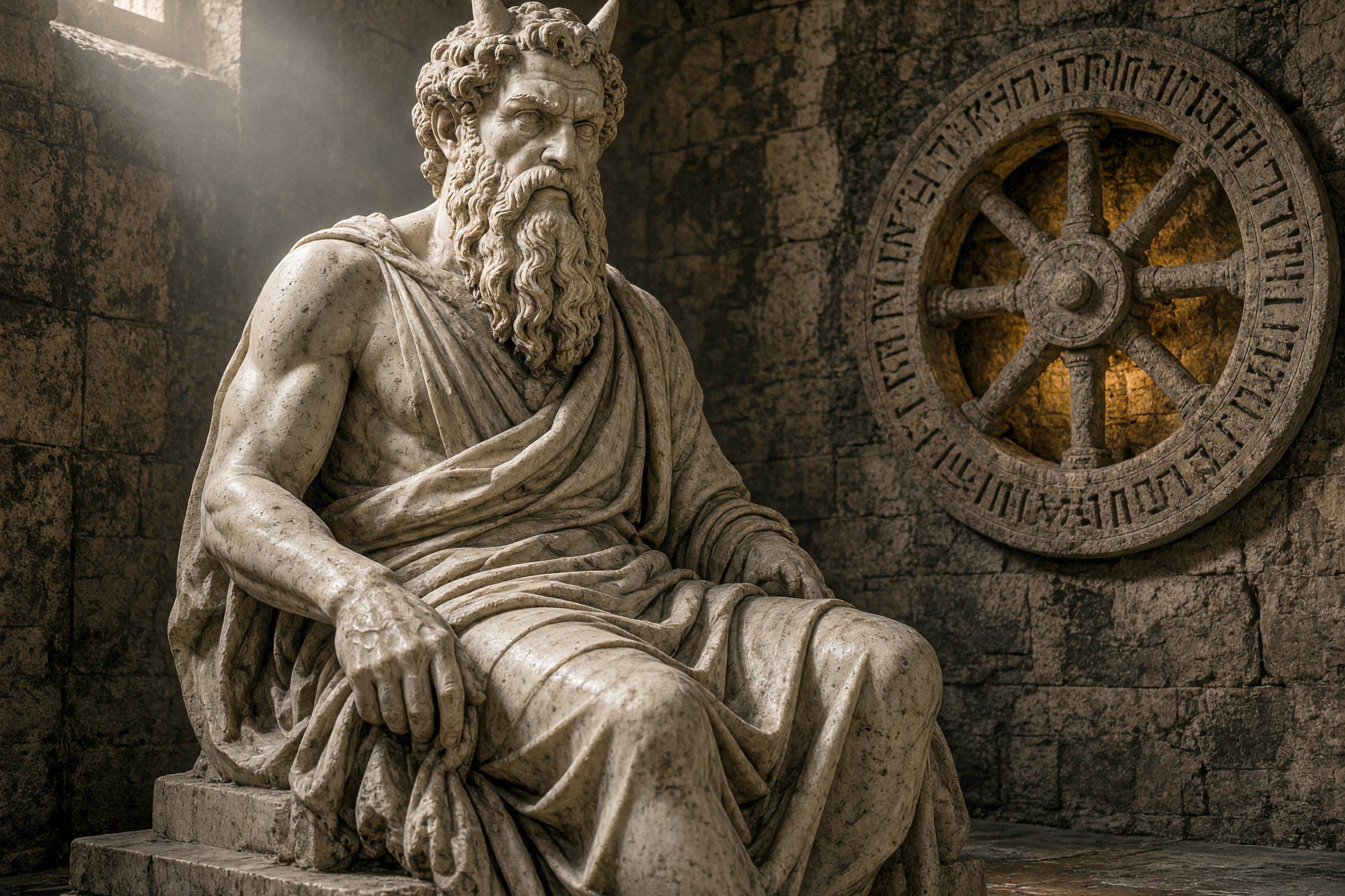
Who Was St. Jerome? Birth, Education, and Baptism
He was born around 347 in a town called Stridon, on the border between Dalmatia and Pannonia, in a country that no longer exists and a town nobody has been able to find since. His father Eusebius was a Christian and had money. That combination, provincial and Christian and able to pay, decided the shape of the next seventy years.

At about twelve he was sent to Rome, where he studied grammar and rhetoric under Aelius Donatus, the most famous grammarian of the age, whose textbooks would still be beating Latin into European schoolboys a thousand years later. Jerome learned to read the way that education taught people to read: closely, competitively, with an ear for the exact weight of a word and a taste for the kill. He never lost either habit.
He was baptized at nineteen or twenty, by Pope Liberius. He was not, at that point, anything anyone would have called a holy man, just a very well-educated young man with a Christian conscience and a library he was uneasy about loving.
Why Did Jerome Learn Hebrew?
There followed years of travel, north to Trier and then back to Aquileia, where he joined a circle of young intellectuals who had all decided at once that the way to be serious about God was to give things up. One of them was Rufinus, born at Concordia nearby and living the monastic life in the city. They became close friends, stayed that way for thirty years, and then spent twenty more tearing each other apart in print.
Around 374 he went out to the desert of Chalcis in Syria and lived as a recluse for four or five years.
Everyone who tells this story dwells on the asceticism. The consequential thing that happened there was duller: he started learning Hebrew.
Very few Christians in the Latin West did this. They read the Old Testament in Greek, or in Latin translated from Greek. The Septuagint was the Bible of the apostles, the Bible quoted in the New Testament, the Bible the churches actually used. Hebrew was hard, unfamiliar, and belonged to the people who had not accepted Jesus, so there was no obvious reason to bother with it. Jerome bothered. He found a Jewish teacher and ground through the alphabet in his thirties, in a desert, as a penance and a distraction, and the later history of the Western Bible turns on that decision.
The desert also gave him the story he would tell about himself for the rest of his life. In Letter 22, written years afterward to a young Roman woman named Eustochium, he describes a fever dream in which he is dragged before the judgment seat. Asked who he is, he says he is a Christian. The Judge answers: Ciceronianus es, non Christianus, you are a Ciceronian, not a Christian. He is scourged, and he swears on the spot never to read pagan books again.
He broke the oath immediately and permanently; his pages are stitched with Virgil and Cicero and Horace to the end. Whatever else the dream was, it was not a cure. It was a man naming the thing in himself he could not put down.
Rome, and the women
By 382 he was in Rome, and for three years he was as close to the center of Western Christianity as a man could get without being a bishop. Pope Damasus took him on as secretary and set him a limited, sensible task: clean up the Latin Gospels. The Old Latin versions had multiplied into a mess of variants, and somebody with Greek needed to bring order. Jerome did the Gospels. Then he kept going, and never stopped, and the commission got away from Damasus entirely.
The circle came together in the same years. A group of wealthy Christian women on the Aventine took Jerome as their teacher: Marcella, who had opened her house to the ascetic life and knew the Scriptures well enough that Jerome later forwarded bishops’ questions to her; Paula, a senatorial widow of enormous fortune; and Paula’s daughters Blesilla and Eustochium. He taught them Scripture. He taught them Hebrew. He wrote them letters that are, by any measure, the most alive thing he ever produced: intimate, funny, savage about their neighbors, utterly certain that giving away an inheritance was the only sane thing a rich Christian could do.
Rome did not like it. Old families watched their daughters refuse to remarry and their fortunes go to the poor, and they blamed the foreign priest.
Then Blesilla died.
She was twenty. She had been married about seven months and widowed, and after her conversion she took up fasting with an intensity her family found alarming. Within three or four months she was dead. Her mother collapsed at the funeral procession and had to be carried out unconscious, in front of the whole city.
Jerome wrote a letter of consolation. It is Letter 39, and it begins as a eulogy and turns, partway through, into a rebuke of Paula for grieving too much, because grief on that scale looked like an argument against everything he had been teaching.
He was defending the program over the woman in front of him.
Rome blamed the ascetic regimen, and behind it the man who had taught it. Damasus died at the end of 384, and with his patron gone Jerome had nothing between himself and the city’s anger. He left in August 385, and Paula and Eustochium sailed a month later. Jerome recorded the departure: Paula’s other daughter Rufina sobbing on the shore, her small son Toxotius stretching out his hands from the dock, and Paula keeping her eyes fixed on the sea.
He never saw Rome again.
What Is the Vulgate? Jerome’s Translation from the Hebrew
They met at Antioch and made their way to Palestine, settling at Bethlehem around 386. Paula’s money built two monasteries, one for men and one for women, and she ran the women’s house as abbess. Jerome took a cell in the men’s, and for the next thirty-four years he worked.
The work was enormous and it was mostly one thing. He was translating the Old Testament into Latin from the Hebrew.
He had a phrase for the principle: hebraica veritas, the Hebrew truth. The Hebrew text is the original and therefore the authority; the Greek is a translation and therefore derivative; where they differ, the Hebrew wins. Stated flatly like that it sounds obvious, which is a measure of how completely he won. In 390 it was close to scandalous.
The practice was messier than the slogan. Jerome worked with the Hexapla open beside him and leaned steadily on Aquila, Symmachus, and Theodotion, the later Greek translators who ran more literal than the Septuagint, treating their Greek as a reliable window onto the Hebrew. “From the Hebrew,” in his mouth, often meant through the Three. That qualification gets lost every time he is invoked as the Hebrew-first Father, and it explains some of his strangest renderings. He was going to find out that translating the Hebrew faithfully and translating it safely were not the same job.
The Pentateuch occupied him from about 398 to 404. Genesis was underway by 398 and finished around 401; Exodus came around 400; the preface to Joshua speaks of the Pentateuch as recently done, which puts the finish in 403 or 404. The Hebrew-based Old Testament was substantially complete around 405.
It was not adopted overnight. Jerome’s version circulated beside the older Latin translations for centuries before it became the dominant Bible of the West, and by the medieval period it was simply the Bible most Western Christians knew. More than a millennium after he began, the Council of Trent formally declared the Vulgate the authentic Latin edition for the Catholic Church.

Paula died on 26 January 404, in the middle of that work. Jerome wrote Letter 108 to console Eustochium, one of the longest things he ever wrote, part eulogy and part travelogue and part argument, ending with the epitaph he had cut into her grave.
Did Jerome Reject the Apocrypha? The Old Testament Canon
Somewhere around 391, prefacing his translation of Samuel and Kings, Jerome wrote what came to be called the Prologus Galeatus, the Helmeted Preface, armor for everything that followed. In it he laid out an Old Testament of twenty-two books, matching the Hebrew Bible, and said plainly that whatever falls outside that list is to be reckoned among the apocrypha. He named Wisdom, Sirach, Judith, Tobit, and 1 and 2 Maccabees.
The usual summary of his reasoning is that these books are not in the Hebrew Bible. That is not quite what he said, and the difference is worth holding onto.
He excluded 1 Maccabees even though he knew a Hebrew version existed, and he excluded Tobit even though it survived in Aramaic. So the test was not what language a book was written in. The test was whether the Jewish scholarly community received it as Scripture, which is a criterion about authority rather than about letters. In the fourth century, when Christian opinion of Jewish authority was not warm, that was a strange place to put the question.
He also translated Tobit and Judith anyway, prefacing them with disclaimers, and elsewhere used softer language: the church reads these for edification, not for establishing doctrine. Scholars have often read that softening as a change of mind. Edmon Gallagher argues otherwise, that Jerome held the same position throughout and simply pressed it harder in some places than others, as part of a long campaign to pull the church’s Old Testament back onto the Hebrew.
Whichever reading is right, the consequence is fixed. When Luther and Cajetan argued about the canon eleven centuries later, both of them reached for Jerome. The Protestant Old Testament substantially follows the list in the Helmeted Preface, and the question of which books belong in a Bible has never stopped being argued since.
Why Did Jerome and Augustine Argue?
The two greatest Latin Christians of the age wrote to each other for twenty years and never once managed to be comfortable about it.
Augustine started it, with letters that took years to arrive and sometimes circulated in Italy before reaching Bethlehem, so that Jerome kept hearing that Augustine was criticizing him in public. Jerome’s replies are magnificent and unkind. Augustine’s are patient in a way that is its own kind of pressure.
They fought about two things, and the first was the translation itself. Augustine did not want the Old Testament retranslated from Hebrew, and his objection was not textual. A Latin Bible built on the Hebrew would drift away from the Greek churches, and the two halves of Christendom would no longer be reading the same book. Worse, when a strange rendering came up, no one in the West would be able to check it, because there was nobody with the Hebrew. Jerome would become the sole arbiter of the Latin Bible, and the only people able to contradict him would be Jewish scholars, who could be produced by anyone to say anything. For Augustine, church authority came before textual authority.
To make it concrete, he told Jerome a story. A bishop in the North African town of Oea read Jonah 4 to his congregation from the new version. Where the people expected the gourd, cucurbita, the word they had heard all their lives, Jerome had written hedera, ivy. The congregation rioted. The bishop nearly lost his church over a plant.
Jerome’s reply is pure contempt: Augustine won’t even say what the word was, so as to leave him no defense; it is the old gourd business again; Aquila and the others read ivy; he had already dealt with this in his Jonah commentary, and anyone who cared could go read it.
Both of them were right about something. Jerome was right that the rendering was defensible. Augustine was right that people riot over what they are used to hearing, and that a translator who does not know this will get bishops hurt.
The second fight was the serious one. Following a reading that came down from Origen, Jerome held that Paul’s confrontation with Peter at Antioch was staged. Peter withdrew from the Gentile tables as a tactic; Paul rebuked him as a performance; the two of them had arranged it between them to make a point to the Judaizers. Nobody was actually in the wrong, because nobody was actually doing anything.
Augustine found this intolerable, and his reason went past the passage. If the apostles could stage a scene in Scripture and the text present it as real, then Scripture contains an agreed lie, and the whole edifice of biblical authority becomes negotiable, since anything inconvenient can be reclassified as a useful pretense. He insisted the disagreement was genuine: Peter was wrong, Paul said so, and the text means what it says.
Jerome did not withdraw. In Epistle 112 he answered on both fronts at once, holding his ground on the Antioch reading and defending the Hebrew-based translation in the same breath, and he never gave the point up.
The church did, though. Augustine’s reading is the one that survived, and Jerome’s now sits in the history of interpretation as a curiosity. What the fight was about underneath is the more interesting thing: the most learned exegete in the West thought the text needed rescuing from its own plain sense, and the bishop of Hippo told him that rescuing a text that way destroys it.
Rome falls
In August 410 Alaric’s Goths entered Rome. The city had not been taken by a foreign enemy in eight hundred years.
The news travelled slowly and arrived in pieces. Jerome had just finished eighteen books on Isaiah and was about to begin Ezekiel, a commentary he had promised to Paula and now owed to Eustochium, when word came that Pammachius was dead, and Marcella, and many others he had known.
Marcella was eighty-five. Soldiers convinced she was hiding gold beat her with cudgels; she had given everything away years before and had nothing to tell them. Other soldiers with more conscience got her and her companion Principia to the sanctuary at St. Paul’s, and she died the next day. Jerome wrote the account to Principia, who had been there.
He put down the Ezekiel commentary and could not pick it up. When he finally did, he opened it with an explanation:
I was so benumbed that I could think of nothing else, day or night, but the safety of all. I believed myself captive in the captivity of the saints, nor could I open my mouth until I learned something more certain.
And then, of the city itself: the brightest light of the world put out; the head of the Roman empire severed; the whole world killed in one city. Who would believe that Rome, built up by the conquest of the world, had fallen, that the mother of nations had become their tomb?
He was sixty-three years old, and everything he had come from was gone.
Why Does Michelangelo’s Moses Have Horns?
He worked on Ezekiel from about 410 to 415, and somewhere in the twelfth book, discussing the cloud and thick darkness of the temple vision, he reached for Moses climbing into the cloud on Sinai to see what the people below could not. Then, almost in passing, he wrote this:
…after forty days, the common crowd could not look on the face of Moses with their dim eyes, because it had been glorified, or, as the Hebrew has it, horned.
Quia glorificata erat, siue, ut in hebraico continetur, cornuta facies Moysi.
That sentence answers the most famous accusation ever made against him.
Everyone knows the charge. Exodus 34:29 says the skin of Moses’ face shone. Jerome’s Vulgate says cornuta esset facies sua, his face was horned. From there it runs into the Douay-Rheims, into medieval manuscripts, into Claus Sluter’s well at Dijon and Michelangelo’s Moses in San Pietro in Vincoli, and out into centuries of European art in which the lawgiver has horns. The standard explanation, repeated everywhere from Sunday school to Diarmaid MacCulloch’s A History of Christianity, is that Jerome confused two similar Hebrew words and made a comic blunder.

He didn’t.
The Hebrew form at Exodus 34 is ambiguous enough to have generated both traditions, the horned and the radiant, and Jerome was not the first translator to take the horn sense. Some Jewish exegetes had already chosen it. Aquila, the hyper-literal Greek translator, had rendered it keratōdēs, horned. Jerome, working with Aquila open in front of him and rabbinic teachers within reach in Bethlehem, followed the tradition he found and put cornuta into the Latin, and he names Aquila’s edition explicitly elsewhere.
In the Ezekiel commentary, a decade after making the translation, he tells us the sense he actually held, and the order of his words carries it: the face had been glorified, which is the meaning, or, as the Hebrew has it, horned, which is the literal thing the text says. He knew. He translated the difficult Hebrew form rather than quietly replacing it with the interpretation he preferred, and nine hundred years later someone was carving it in marble. Faithful and safe, again, turning out to be two different jobs.
What happened to the image afterward was not his doing either. Medieval artists took the horns various ways, some as a mark of divine encounter and glory, while in later medieval contexts horned imagery could be turned to hostile ends against Jews. Michelangelo’s Moses is not a caricature but a monumental prophet, and by 1515 the horns were simply what Moses looked like. A philological decision became an iconography, and the iconography went on acquiring meanings across a thousand years that the man who made the decision never chose.
The last years
He kept fighting. He had already turned on Rufinus, the friend of his youth, over Origen, a quarrel conducted in print, at length, with everything either man knew about the other deployed for maximum damage. He went after Helvidius over the perpetual virginity of Mary, Jovinian over the equality of marriage and celibacy, Vigilantius over relics, and finally Pelagius. The Pelagian controversy reached him physically, and his monasteries at Bethlehem were attacked in his old age.
Eustochium died in 419, the last of the Roman circle, the girl he had written Letter 22 to forty years before.
Jerome died on 30 September 420, at Bethlehem, somewhere in his mid-seventies. Paula’s granddaughter, Paula the Younger, closed his eyes. He was buried under the Church of the Nativity, a few feet from the work of thirty-four years, and his remains were later moved to Santa Maria Maggiore in Rome, the city that had thrown him out. Boniface VIII named him a Doctor of the Church in 1295.
Why Is St. Jerome Painted with a Lion and a Cardinal’s Hat?
Almost none of the popular image survives contact with the evidence.
The lion belongs to somebody else. That story, the great cat limping into the monastery with a thorn in its paw, healed and staying on as a tame companion, attaches to Gerasimus of the Jordan, an abbot who died in 475, a generation after Jerome. In later Latin, Jerome’s name appears as Geronimus. The names collided, both men belonged to the world of eastern monasticism, and the lion changed owners in one of the most successful cases of mistaken saintly identity in the history of art.
The cardinal’s hat is an anachronism. Every Renaissance painting that puts Jerome in red robes and a broad-brimmed hat is dressing him in an office that did not exist, since the cardinalate developed roughly three centuries after his death. He was a presbyter and a monk. The red hat belongs to the painters.
The blunder with the horns is handled above: not a stupid man confusing two words, but a genuinely difficult Hebrew form, an existing interpretive tradition, a deliberate choice, and a millennium of consequences.
The mild scholar in the study dies hardest. Caravaggio and Dürer give us a serene old man with a skull and a book. The letters give us someone who could not let anything go, who buried a friendship of thirty years in a public war over a dead Greek theologian, who rebuked a grieving mother at her daughter’s funeral for grieving wrong, and who wrote some of the cruellest Latin prose of the fourth century and then turned around and wrote some of its most beautiful. He knew it about himself, which is why the dream about Cicero mattered to him: he understood that his gifts and his worst instincts came out of the same place, and he never found a way to separate them.

What he actually did
He was not Augustine. His greatness was not systematic theology.
What he did was more specific and, in its way, harder to undo. At a moment when the entire Western church read its Old Testament through Greek, Jerome learned Hebrew in a desert in his thirties and spent the rest of his life insisting that the original was the authority. He produced a Latin Bible that the West read for a thousand years and drew its theology, its liturgy, its art, and its assumptions from. He argued that the Old Testament canon should be measured by the Hebrew Scriptures, lost that argument in his own church, and won it eleven hundred years later in someone else’s Reformation, on the far side of a schism he never imagined.
He was right about going back to the source. He was not always right about what the source meant. That distinction is the whole story.
He got things wrong, and some of them are still standing in marble in Rome. But the instinct behind the errors is the same instinct that produced the achievement: go back to the source, take what it actually says, and let the reader deal with the consequences.
I went looking for Jerome because his name kept turning up in everything I read about where the Bible came from, and I had no idea who he was. That happens constantly once you start pulling on the chain. I wrote about the habit here: The Names I Didn’t Know.
New field notes when they are ready, along with the research underneath them. No drip sequence, no course, nothing to buy.
Sources
- Jerome, Letters, Nicene and Post-Nicene Fathers, second series, vol. 6. Letter 22, Letter 39, Letter 108, Epistle 112.
- Jerome, Preface to Samuel and Kings (Prologus Galeatus). No verified link.
- Jerome, Commentary on Ezekiel, book 12. Fathers of the Church series. No verified link.
- Edmon L. Gallagher, Hebrew Scripture in Patristic Biblical Theory: Canon, Language, Text, Supplements to Vigiliae Christianae 114 (Leiden: Brill, 2012).
- Craig A. Evans, Of Scribes and Sages, vol. 1: Ancient Versions and Translations (London: T&T Clark, 2004). No verified link.
- F. F. Bruce, The Canon of Scripture (Downers Grove, IL: InterVarsity Press, 1988).
- William Smith and Henry Wace, eds., A Dictionary of Christian Biography (London: John Murray, 1877–1887), the “Hieronymus” article. No verified link.
- Philip Schaff, History of the Christian Church (New York: Scribner’s, 1910), vol. 3.
- Karlfried Froehlich, Biblical Interpretation in the Early Church (Philadelphia: Fortress, 1984). No verified link.
- Nick Needham, The Age of the Early Church Fathers, 2000 Years of Christ’s Power, vol. 1 (Christian Focus, 2016). No verified link.
- Diarmaid MacCulloch, A History of Christianity, cited as an example of the standard “Jerome blundered” explanation, not as support for it. No verified link.