
Series: What Is a King? · Part 6 of 6
Five Sections of Preparation
We have walked through five sections.
Section 1 walked through what kingship actually means: that the room defines the king, that King of Kings is a cosmic claim, that Christ wears gold because He bows to the Father.
Section 2 walked through what belonging means: that doulos Christou is the highest title in the tradition, that the autonomous self is the Kronos who eats his own children, that the hierarchy is the freedom.
Section 3 walked through what recognition feels like: Aragorn kneeling in a field at Minas Tirith, the imago Dei responding to a pattern it was made to recognize, the lump in your throat that arrives before the line is even spoken.
Section 4 walked through how the recognition gets hijacked: the serpent’s original counterfeit, the 99 percent rule, the Galatian heresy, the Chernobyl warning that if we hear enough lies, we no longer recognize the truth at all.
Section 5 walked through whose job is what: that you are responsible for the witness, not the unveiling, and that the weight you have been carrying for someone else’s conversion was never yours to carry.
That was preparation. This section is not preparation.
This section is the question.
We Are Between the Stages
From Section 3: Christ’s fulfillment encompasses two dimensions. He came once to suffer and die for sinners. He will return as conquering King. Same King. Two stages.
We are between those stages right now.
The first coming is history. The cross is in the past. The carpenter walked the dust of Galilee, healed the sick, ate with sinners, was crucified between thieves, was buried, and rose. That happened. It is over. It is done.
The second coming is coming.
And the window between those two stages is where every reader of this series is currently standing.
The rider on the white horse is Christ returning in glory.[1] He bears the titles Faithful and True, the Word of God, King of Kings, and Lord of Lords. His eyes of fiery flame signify penetrating knowledge and the justice flowing from his clear perception of reality.[2] The many royal crowns on His head indicate His reign over numerous nations, restoring kingship to its rightful ruler. He comes to judge and wage war in righteousness, prepared to vanquish every enemy and establish God’s reign on earth.[3]
The detail that lands hardest, the one I think about often: unlike apocalyptic accounts from that era, the redeemed saints accompanying Him carry no weapons. They wear only the righteousness of the saints. They come to witness rather than to fight. The Messiah-King wins victory through His spoken word.[4] The blood on His robe belongs to His enemies, not to those redeemed by Calvary’s blood.[1]
The first coming was the cross. The second coming is the consummation.
Every Knee
Paul saw the consummation clearly. He wrote it down in Philippians 2:9-11:
“Therefore God has highly exalted him and bestowed on him the name that is above every name, so that at the name of Jesus every knee should bow, in heaven and on earth and under the earth, and every tongue confess that Jesus Christ is Lord, to the glory of God the Father.”
Paul drew this language directly from Isaiah 45:23, positioning Christ within the identity of Yahweh himself.[5] This was a claim that to Paul’s Jewish contemporaries approached blasphemy unless true, and to Roman citizens directly challenged Caesar’s authority. Paul is not exaggerating. He is making the cosmic kingship claim explicit and putting his life behind it.
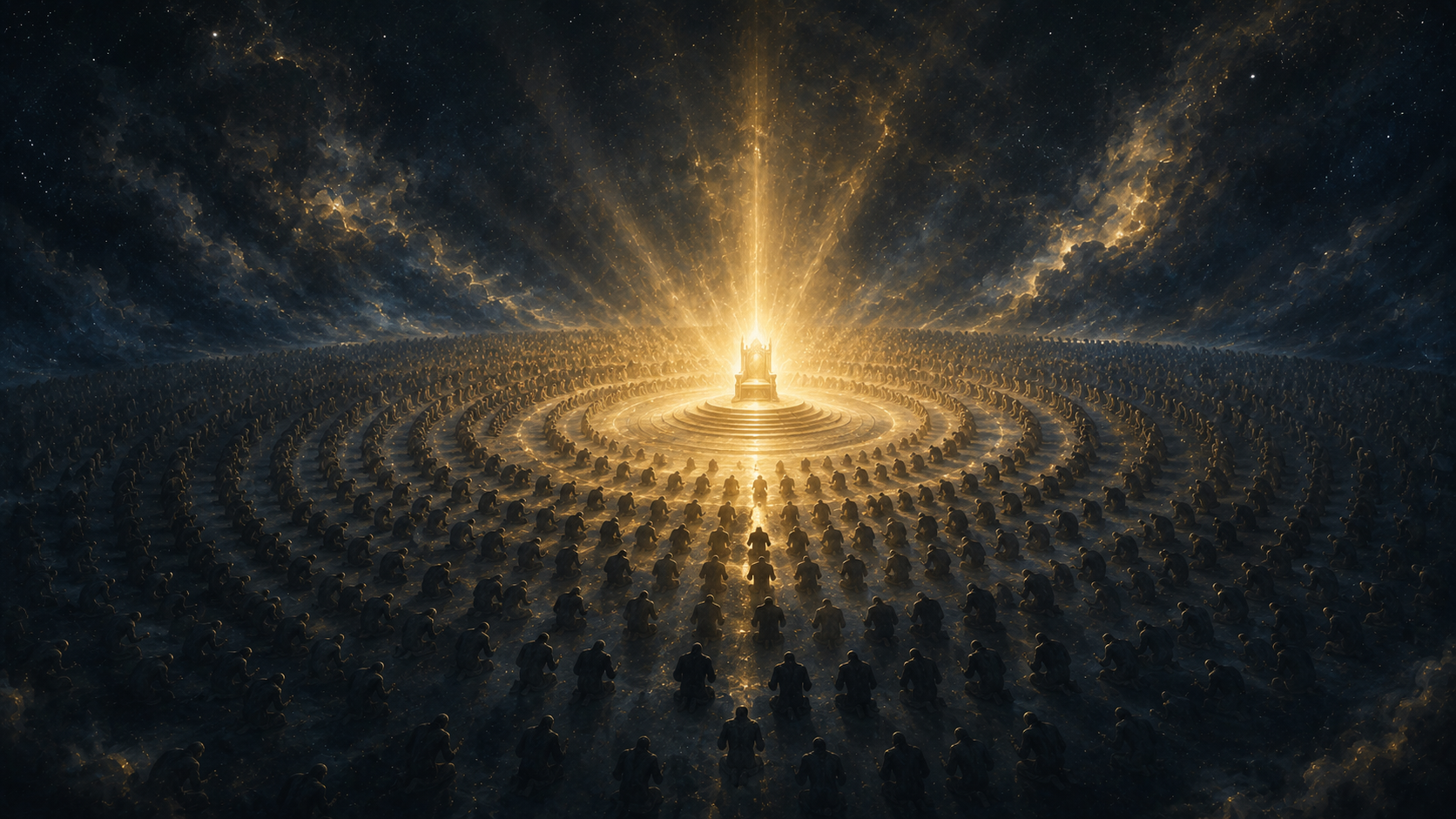
The passage describes not merely a future event but a cosmic reordering. Paul envisions a grand public ceremony of royal acclamation where all beings in the universe respond, with the Messiah displayed in formal ritual through the physical acts of bending knees and confessing with tongues.[6] The confession is not mental agreement. It is an oath of allegiance. The bending of knees and verbal acclamation together constitute a single declaration of loyalty.
Herman Bavinck captured the upshot in one sentence: “the history of the world therefore ends in unity of confession.”[7] Angels and devils, righteous and godless alike will acknowledge Christ as the only heir of all things. This is not coercion imposed externally. It is the culmination toward which all creation moves, the moment when reality finally aligns with truth.
Every Knee Means Every Knee
I want you to slow down here and let the cosmic scope of this land.
When Paul says every knee, he means every knee.
The elohim, the divine council members assigned over the seventy nations after Babel, the ones Heiser argues Christ outranks as King of Kings. They will bow.
The kings of the nations: every Caesar, every emperor, every president, every dictator, every figure who ever sat on a throne and demanded the room reorganize around him. They will bow.
The angels in heaven who have served faithfully from creation. They will bow.
The fallen ones: the demons, the rebellious bene elohim, the powers and principalities that infected the world from the beginning. They will bow.
The faithful saints: Moses, David, Elijah, Paul, the cloud of witnesses, every believer in every generation who ever wore the title eved Yahweh or doulos Christou. They will bow.
The enemies. Every soul who refused the gospel. Every voice that mocked. Every will that hardened. Every Denethor who saw the King and chose not to recognize Him. They will bow.
Some will bow in glad worship. Some will bow in terrible recognition of what they refused. The mechanism that recognized Aragorn in the field at Minas Tirith (the imago Dei response that even atheists feel without knowing why) will fire one more time, at cosmic scale, in front of the actual King.
There will not be a single soul in the universe whose knee does not bend.
The room reorganizes. Finally and completely. The history of the world ends in unity of confession.
That is what King of Kings actually means. Not a flowery devotional title. Not a metaphor. A literal cosmic reordering in which every authority that ever ruled, visible or invisible, human or angelic, divine council member or earthly emperor, bends to the rider on the white horse whose blood is on His robe and whose word is His weapon.
Would I Have Seen Him?
The question that has hung over this whole series is the haunting one I asked back in Section 3.
Would I have seen Him? If I had been a Jew or a Gentile in 30 AD, would I have recognized the carpenter as the Christ? Or would I have been Denethor, certain I knew what the King should look like, missing the King when He walked in the room?
The honest answer is: I do not know. None of us do. The disciples themselves did not see Him until the Father unveiled Him at the resurrection. Peter, who walked with Christ for three years, watched the miracles, heard the teaching. Even Peter could not arrive at “You are the Christ” through his own reasoning. “Flesh and blood has not revealed this to you, but my Father in heaven.” The unveiling was not Peter’s work.
Mine would not be either.
But here is the cut.
The question is not actually about 30 AD.
Will You Bow Now, Before You Have To?
The King is not absent. He is enthroned. He is reigning. He is unveiling Himself by the Spirit to those who turn toward Him. The veil that the god of this world places over the eyes of unbelievers is being lifted, today, in this hour, in living rooms and prison cells and hospital beds and cars on highways and quiet moments at three in the morning when nothing is left to hide behind. The Spirit is doing the work right now.
And the question every reader of this series has to answer in 2026 is the same question Gondor had to answer when the ranger walked in.
The same question Eve had to answer when the serpent spoke.
The same question Peter had to answer when Christ asked him “who do you say that I am?”
The same question Denethor had to answer when Aragorn arrived at Minas Tirith.
Will you bow now, before you have to?
Because every knee will bow eventually. Bavinck is right. The history of the world ends in unity of confession. The bending of knees is not optional. The recognition is not optional. The acknowledgment of who Christ is, was, and forever will be is not optional.
The only choice you actually have is when.
Bowing now is the freedom of the doulos who has chosen his King. It is the gold-crown move. The submission upward that produces the only authority worth having downward. It is Paul writing doulos Christou at the top of his letter and meaning it as the highest title he owns.
Bowing later is the bowing that comes when the rider on the white horse appears and there is no longer any veil left to hide behind. The recognition will fire then. It will be undeniable. The eyes of fiery flame will see right through every defense, every excuse, every constructed identity, every careful curation of self. Every knee will bend. Every tongue will confess. Even the ones who refused. Even the ones who mocked. Even the ones who lived their whole lives insisting they were autonomous, that they answered to nothing above them, that they did not need a King.
They will bow.
The difference is not whether you bow. The difference is the heart in which you bow.
What the World Does Not Yet Know
The watching world has lost the language for kingship. The 2026 American flips off the president and recognizes nothing higher. The structures that used to teach us what authority feels like (the family, the church, the trustworthy father, the just king) have been hollowed out, mocked, dismissed, infected.
But the imago Dei still knows.
It tears up at the Aragorn scene without knowing why. It feels the tug toward something it cannot name. It senses that the autonomous self is not actually free, that the voices promising liberation through unhindered self-expression are selling a Kronos throne that will eat its own children. It is being prepared, by means it does not understand, for the moment when the veil lifts and the King is finally, fully visible.
When that day comes, you will recognize Him. The mechanism that has been building in you your whole life, the one the serpent has been trying to hijack with counterfeits, the one the Spirit has been training through every honest moment of awe and every honest pull toward something higher, that mechanism will fire one last time, in front of the actual King, in front of the rider on the white horse, in front of the One whose name is above every name.
You will recognize Him then.
The question is whether you will recognize Him now. While there is still time to bow on purpose.
The Question, One More Time
Will you bow now, before you have to?
That is the only question this whole series has actually been asking. Everything else (the Hebrew, the Greek, the gold and silver, the elohim, Aragorn, the father, the witness, the serpent’s strategy, the recognition, the counterfeit, the unveiling) has been helping the question land.
The room is being reorganized even as I write this, even as you read it. The bowing is already underway in those whose veils the Spirit has lifted. The bowing will be universal at the moment Paul described.
The King is the King. The room is being reorganized. The choice is yours. The answer is going to be every knee anyway.
You might as well bow now.
Soli Deo Gloria.
Continues from Part 5: What Is a King? The Witness and the Unveiling · Start at Part 1: What Is a King? The Room Defines the King
All 6 parts in this series
- Part 1What Is a King? The Room Defines the King
- Part 2What Is a King? Slave to Christ
- Part 3What Is a King? The Return of the King
- Part 4What Is a King? The Counterfeit King
- Part 5What Is a King? The Witness and the Unveiling
- Part 6What Is a King? Will You Bow Now?You are here
New field notes when they are ready, along with the research underneath them. No drip sequence, no course, nothing to buy.
Footnotes
- Herbert Lockyer, All about the Second Coming, ed. Herbert Lockyer Jr. (Peabody, MA: Hendrickson Publishers, 1998), 177.
- Peter S. Williamson, Revelation, ed. Mary Healy, Catholic Commentary on Sacred Scripture (Grand Rapids, MI: Baker Academic, 2015), 312.
- Douglas Mangum, ed., Lexham Context Commentary: New Testament, Lexham Context Commentary (Bellingham, WA: Lexham Press, 2020).
- Ed Hindson, Future Glory: Living in the Hope of the Rapture, Heaven, and Eternity (Eugene, OR: Harvest Prophecy, 2021), 114.
- Chris Bruno, Sharing Christ in Joy and Sorrow: A Theology of Philippians, ed. Thomas R. Schreiner and Brian S. Rosner, New Testament Theology (Wheaton, IL: Crossway, 2025), 65–66.
- Gordon Zerbe, Philippians, ed. Douglas B. Miller et al., Believers Church Bible Commentary (Harrisonburg, VA; Kitchener, ON: Herald Press, 2016), 140.
- Donald K. McKim, Daily Devotions with Herman Bavinck: Believing and Growing in Christian Faith (Phillipsburg, NJ: P&R Publishing, 2023), 120.
Sources
- Herbert Lockyer. All about the Second Coming. Edited by Herbert Lockyer Jr. Peabody, MA: Hendrickson Publishers, 1998. https://www.amazon.com/About-Second-Coming-Herbert-Lockyer/dp/1565633350
- Peter S. Williamson. Revelation. Edited by Mary Healy. Catholic Commentary on Sacred Scripture. Grand Rapids, MI: Baker Academic, 2015. https://www.logos.com/product/145451/revelation
- Douglas Mangum, ed. Lexham Context Commentary: New Testament. Bellingham, WA: Lexham Press, 2020. https://www.logos.com/product/189120/lexham-context-commentary-new-testament
- Ed Hindson. Future Glory: Living in the Hope of the Rapture, Heaven, and Eternity. Eugene, OR: Harvest Prophecy, 2021. https://www.amazon.com/Future-Glory-Living-Rapture-Eternity/dp/0736983503
- Chris Bruno. Sharing Christ in Joy and Sorrow: A Theology of Philippians. Edited by Thomas R. Schreiner and Brian S. Rosner. New Testament Theology. Wheaton, IL: Crossway, 2025. https://www.crossway.org/articles/june-2025-new-releases/
- Gordon Zerbe. Philippians. Believers Church Bible Commentary. Harrisonburg, VA; Kitchener, ON: Herald Press, 2016. https://www.brethrenpress.com/product_p/9781513800332.htm
- Donald K. McKim. Daily Devotions with Herman Bavinck: Believing and Growing in Christian Faith. Phillipsburg, NJ: P&R Publishing, 2023. https://www.amazon.com/Daily-Devotions-Herman-Bavinck-Believing/dp/162995781X