
Series: Jesus and the Pharisees · Part 3 of 6
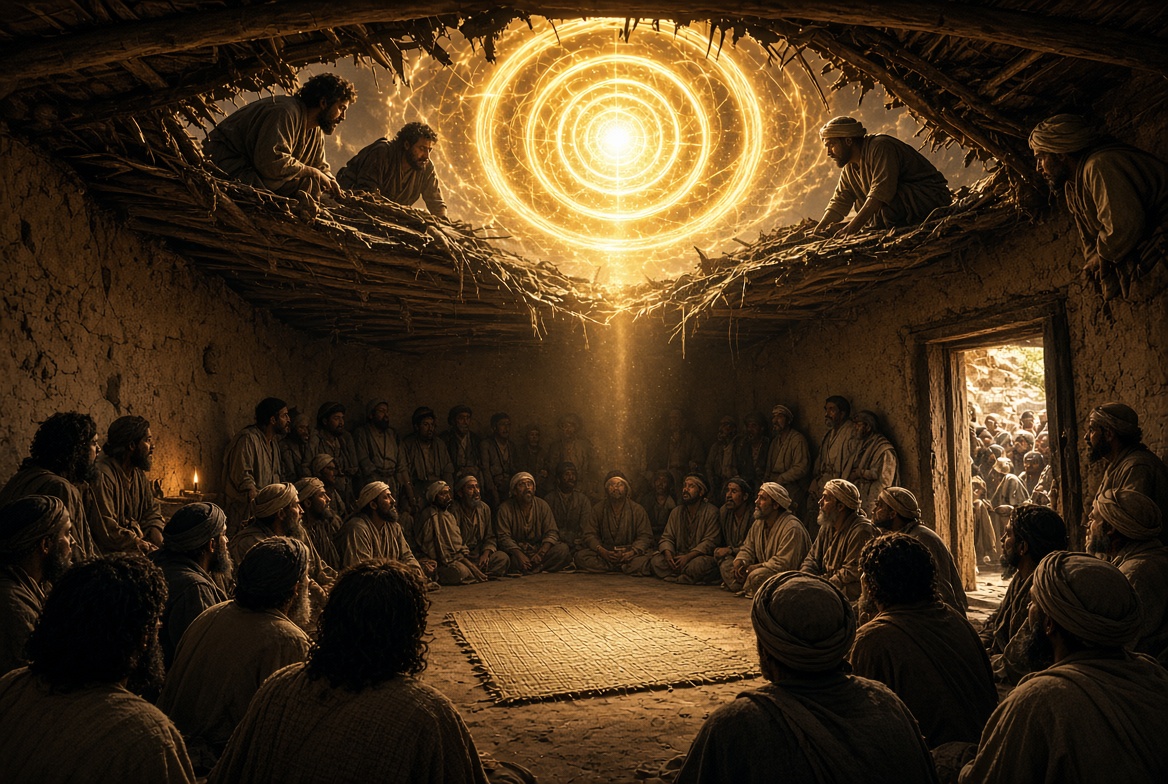
A man is lowered through a hole in a roof and told his sins are forgiven, which is not what anyone in the room came for.
That sentence starts an argument that runs the length of the Gospel and ends in front of the high priest.
Whose Roof Was It?
Probably Jesus’s own, and most readers never notice.
He had moved from Nazareth to Capernaum, and Mark says he was at home when the crowd gathered. So the unlucky householder whose roof got dug through that day was Jesus.
Wright suggests that opens a possibility for how the first words land. A man looks down through a new hole in his own ceiling and says, with a rueful smile, all right, I forgive you.
Something in the tone told them it was not about the roof. The forgiveness went further down than a domestic complaint, into the man on the mat, and the room got uneasy.
Why Was Forgiveness the Problem?
Because of who was allowed to declare it.
Only the priests could pronounce forgiveness in God’s name. If what this man needed was forgiveness, his friends should have carried him to the Temple in Jerusalem, not through the roof of a house in Capernaum.
So the objection is not petty. It is a question about jurisdiction, and the legal experts ask it correctly. Who can forgive sins but God alone?
Jesus does not deny the premise. He answers by demonstrating.
What Is the Argument From the Easier Saying?
That one claim can be checked and the other cannot.
Which is easier to say, your sins are forgiven, or get up and walk? Easier to say is the point. Anyone can announce forgiveness, because nothing visible follows. Tell a paralysed man to walk and the claim is tested in front of everyone within seconds.
So Jesus makes the invisible claim, then performs the visible one as evidence for it. The healing is not the subject. It is the receipt.
What Does Son of Man Mean Here?

Both a modest phrase and a very large one, and this passage uses the second.
In his own language it could simply mean I, or someone like me. Taken across Mark as a whole, Dan 7 is the key. There, one like a son of man represents God’s true people, is opposed by evil, and is vindicated by God and given authority.
In Daniel that authority is to dispense God’s judgment. Here, in what Wright calls a fascinating twist, it is authority to dispense God’s forgiveness.
Same office, opposite output.
Why Does This Story Point Forward?
Because Mark has built it as a signpost.
Wright reads the episode as a compressed version of the whole Gospel. Jesus teaching and healing. Jesus condemned for blasphemy. Jesus vindicated.
The charge raised here in a Capernaum living room is the charge Caiaphas will bring in chapter 14, and the same phrase about the son of man will be Jesus’s answer there.
And the paralysed man getting up points forward too, to the new life Jesus will have in the resurrection and will share with anyone who wants it.
Why Did the Reaction Run So Deep?
Because forgiveness is not a neutral proposition in a culture built on repayment.
In many places today forgiveness is read as weakness and revenge as a moral duty. Whole families and communities tear themselves apart on that principle, and it is the only language, people say, as they plant another bomb.
People who live that way tend to assume God lives that way too.
So an unexpected declaration of forgiveness sends shock waves out through the house, the village, the nation. It was not merely a theological crime. Wright’s line is worth keeping: the hole in Jesus’s roof was nothing compared to the hole he was tearing through an entire way of life.
Part of a series on the conflict with the Pharisees. See also Lord of the Sabbath.
Continues from Part 2: Clean and Unclean: Why Jesus Was Cryptic · Continues in Part 4: The Calling of Levi and the Party That Followed · Start at Part 1: Lord of the Sabbath: What the Conflict Was About
All 6 parts in this series
- Part 1Lord of the Sabbath: What the Conflict Was About
- Part 2Clean and Unclean: Why Jesus Was Cryptic
- Part 3The Paralytic and the Authority to ForgiveYou are here
- Part 4The Calling of Levi and the Party That Followed
- Part 5Beelzebul and Who Counts as Family
- Part 6The Yeast of the Pharisees and of Herod
New field notes when they are ready, along with the research underneath them. No drip sequence, no course, nothing to buy.
Footnotes2
- The easier-to-say argument is worth sitting with, because it concedes something. Jesus grants that a claim about forgiveness is unfalsifiable and that this is exactly why it is easy to make. He then supplies a falsifiable claim as evidence, which is a more rigorous move than most treatments of the passage notice.
- That the charge here is the charge at the trial is Mark's structure rather than a coincidence. Blasphemy in a living room, blasphemy before the high priest, and the same son of man phrase in both. The Gospel is built with that arc in it.
Sources
N. T. Wright, Mark for Everyone (SPCK, 2001), on Mark 2:1-12. Supports the identification of the house as Jesus's own, the reading of the first words as rueful, the Dan 7 background and the twist from judgment to forgiveness, the reading of the episode as a compressed version of the whole Gospel, and the observation about cultures built on revenge. Supplied in full.
The biblical texts cited: Mark 2:1-12, Matt 9:1-8, Luke 5:17-26, Dan 7:13-14, and Mark 14:62.
Where the sourcing stops: that the house was Jesus's own is an inference from Mark saying he was at home in Capernaum, and it is not stated outright. The reading of the opening words as wry is Wright's proposal about tone, which the text does not supply.


