
Series: The Birth of Jesus · Part 2 of 4
Isaiah made a set of promises to a city, and the Gospel writers report them landing somewhere else.
Once the promises are lined up against the birth accounts the correspondence is hard to miss, and so is the relocation.
What Did Isaiah Promise Jerusalem?
Light, glory, gifts from the east, and flocks.
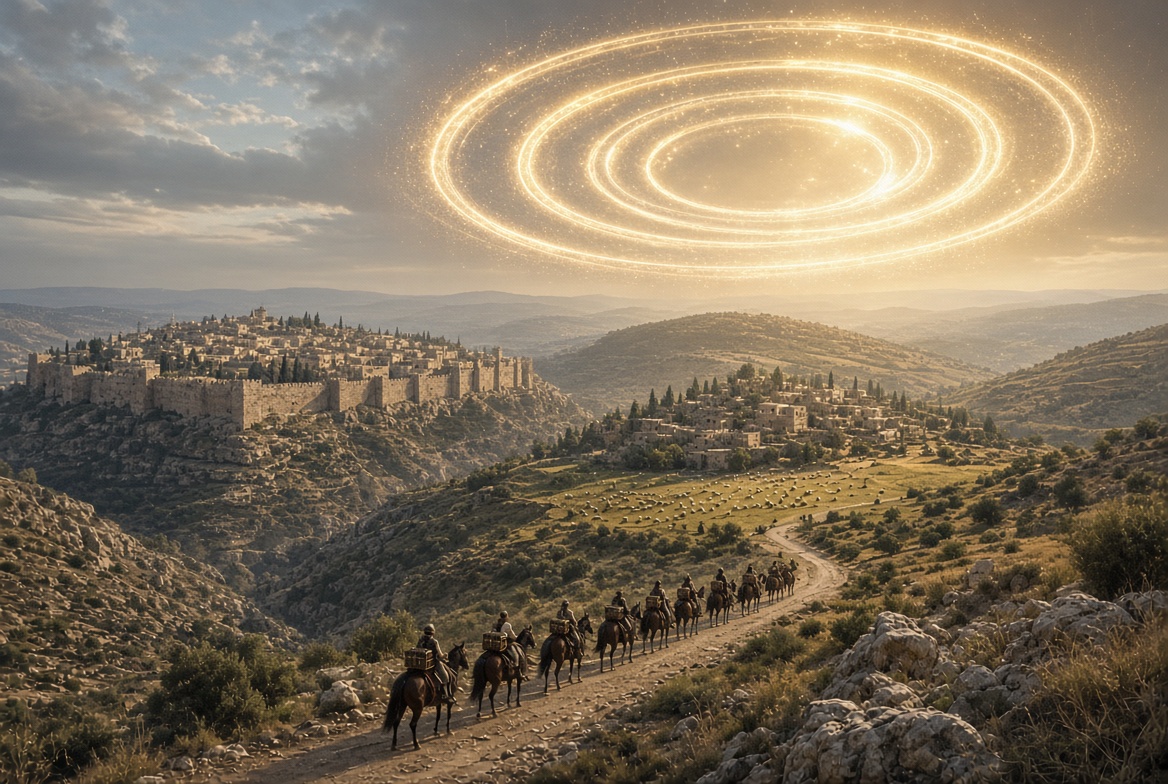
The city would have a great light shine on it and the glory of God rise upon it. Nations would come to that light. People from the east would arrive bearing gold and frankincense. And the flocks of the desert would be gathered to it.
Those are promises about a place. They are addressed to Jerusalem and they concern what Jerusalem would receive.
What Happens Instead?

The same list arrives at a child in a village.
A great light appears, and the glory of the Lord shines, over a field outside Bethlehem. Men from the east arrive with gold and frankincense, and Matthew names the third gift as myrrh. Shepherds come with their flocks.
Bailey’s summary of the effect is the line worth keeping. The hopes and dreams of all the years are shifted from Jerusalem to a child born in Bethlehem.
That relocation is doing theological work. The promises are not cancelled and they are not delivered to the address on the envelope.
Who Actually Came From the East?
Gentiles, and Bailey reads them as Arabs.
Gold and frankincense from the east is the Isaianic combination, and the regions producing frankincense lie south and east on the Arabian trade routes.
What matters more than the precise identification is the pairing that results. At the manger, Jewish shepherds and Gentile outsiders are in the same room adoring the same child.
That is the shape of the whole Gospel arriving in the first two chapters, and Matthew’s book will close by sending disciples to all nations.
Are the Oppressed Automatically the Good Guys?
No, and Bailey presses this harder than most treatments of the nativity would.
His first point from this material is that oppressors and oppressed are both sinners and both need the grace of the new Saviour.
The second follows from it. Suffering does not produce people without sin.
And the third is about the cost of saying so. The prophet needs courage to tell oppressed people about their sins and their need for grace, because the message is unwelcome and the messenger looks like he is siding with the powerful.
That is an uncomfortable set of claims and it belongs here, because the nativity is regularly used to underwrite the opposite assumption. A story about a poor family under an occupying power invites a reading in which poverty is innocence. Bailey declines it.
Why Does Matthew Include the Massacre?
To make Jesus the new Moses, and the parallel is constructed rather than incidental.
A ruler orders the killing of infant boys. One child escapes. That child later comes out of Egypt and leads his people to freedom.
Matthew builds the correspondence deliberately, which is also why he attaches the Hosea line about calling a son out of Egypt.
The other thing the episode establishes is the world Jesus was born into. Bailey notes that unspeakable brutality characterises the beginning and the end of his life, and that his ministry took place within and toward a violent world. The nativity is not an idyll interrupted later by a cross.
What Do Simeon and Anna Contribute?
A pairing, and a warning to Mary.
Bailey counts the concern for men and women together surfacing three times in the birth stories, and Simeon and Anna are the clearest instance. An old man and an old woman, both recognising the child, both in the temple, both given their own moment.
Simeon’s word to Mary is the one that carries forward. A sword will pierce her own soul too.
Bailey reads Mary as a model of discipleship on that basis. Through her suffering she participates in exposing the evil that needs to be redeemed, and Simeon says so before she has any idea what he means.
That is a heavier thing to hand a young mother in a temple than most nativity readings acknowledge, and Luke places it immediately after the songs of joy.
Part of a series on the nativity, following Bailey’s treatment. See also the genealogy and Joseph and what the nativity accounts record.
Continues from Part 1: The Genealogy and Joseph the Just Man · Continues in Part 3: The Birth of Jesus and the Missing Stable
All 4 parts in this series
- Part 1The Genealogy and Joseph the Just Man
- Part 2The Wise Men and the Vision of IsaiahYou are here
- Part 3The Birth of Jesus and the Missing Stable
- Part 4Herod, Simeon and Anna: The Brutal Frame
New field notes when they are ready, along with the research underneath them. No drip sequence, no course, nothing to buy.
Footnotes2
- The claim that suffering does not produce people without sin is the least popular sentence in this material and probably the most necessary. It cuts against a reflex that treats victimhood as a moral qualification, and it does so from within a story about a poor family under occupation, which is where the argument is hardest to dismiss.
- Simeon's warning arriving in the middle of the temple scene is a structural choice of Luke's. He has just given Mary the Magnificat and the shepherds and the angelic announcement. Then an old man tells her a sword is coming, and the narrative moves on without comment.
Sources
Kenneth E. Bailey, Jesus Through Middle Eastern Eyes: Cultural Studies in the Gospels (IVP Academic, 2008), chapters 3 and 4. Supports the alignment of the Isaianic promises with the birth accounts, the identification of the visitors from the east as Arabs, the argument that oppressors and oppressed alike need grace, the Moses parallel behind the massacre, and the reading of Mary as a model of discipleship through Simeon's words. Supplied in full.
The biblical texts cited: Isa 60:1-7, Matt 2:1-23, Luke 2:8-38, Exod 1:15-2:10, and Hos 11:1.
Where the sourcing stops: the identification of the magi as Arabs rather than Persians is Bailey's reading of the gifts and the trade routes, and other proposals are held. The number of visitors is nowhere stated and the traditional three is inferred from the gifts.