
Series: Jesus and Women · Part 3 of 4
The longest recorded conversation Jesus has with anyone is with a Samaritan woman, and it opens with him asking her for something.
Two details in the setup are usually read past, and together they change what kind of encounter this is.
Why Does He Have No Way to Draw Water?
Because his party took the bucket into town.
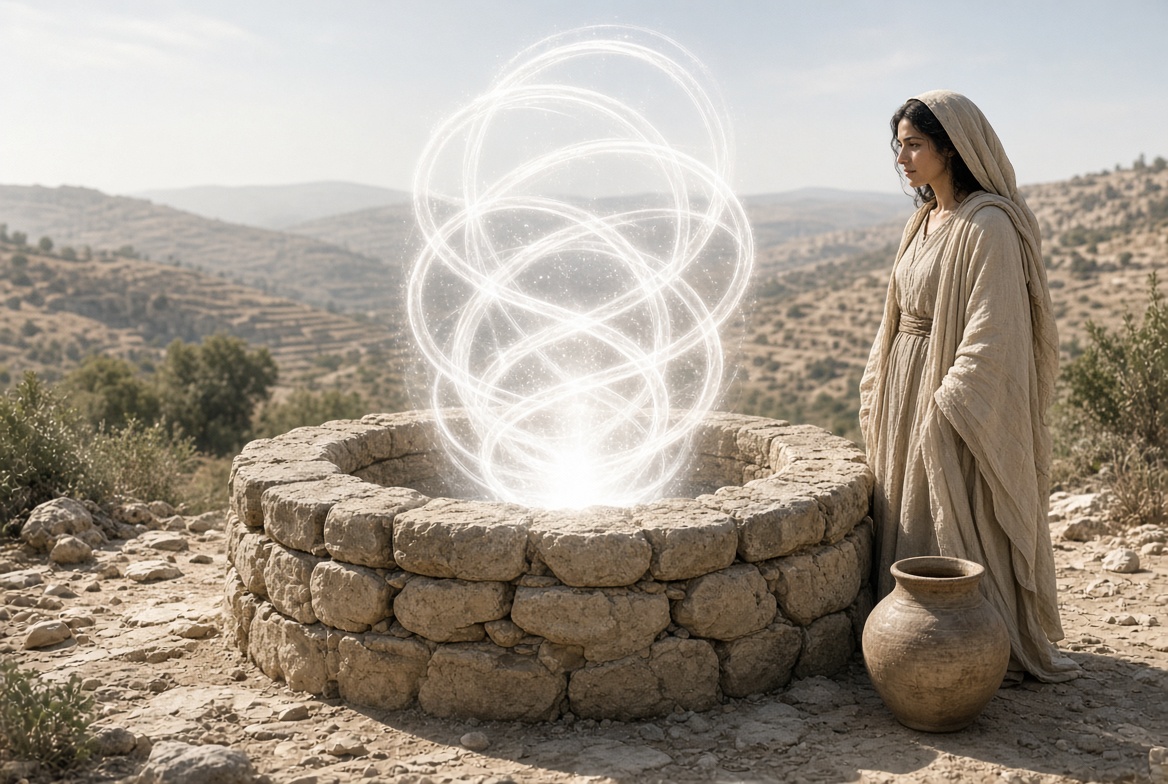
Wells in that region did not come equipped. Travellers carried their own leather bucket and rope, and the disciples had gone to buy food and taken theirs with them.
The text also says he sat on the well rather than beside it, which fits the large stone capstones that covered major wells.
So the picture is a man seated on the wellhead, thirsty, with no means of reaching the water beneath him, when someone arrives carrying exactly the equipment he lacks.
Bailey reads that as deliberate. Jesus empties himself to the point of needing the help of a foreign woman with a reputation, and in asking for it he models what incarnational mission looks like. The conversation begins from need rather than from authority, which is an odd way to open if the aim is to establish standing and an effective one if the aim is anything else.
What Barriers Are in Her First Reply?
Three, and she names them all in one sentence.
She asks how he, being a Jew, asks a drink of her, a woman of Samaria. Ethnic, religious and gendered, stacked into a single question.
The disciples confirm the last one on their return. John records that they were astonished to find him talking with a woman, and adds that none of them asked why. They noticed, they had opinions, and nobody said anything.
Why Does the Conversation Turn to Husbands?
Because he raises it, and what happens next is not what a modern reader expects.
He tells her to call her husband. She says she has none. He agrees, and lays out that she has had five and the man she is with now is not her husband.
Her response is not shame or defensiveness. She says he must be a prophet, and immediately raises the theological question that divided their two peoples: which mountain is the right place to worship.
That is often read as a change of subject to escape an uncomfortable topic. It reads better as a woman who has just concluded she is talking to someone who can answer the question her community had been arguing for centuries, and who asks it.
What Does He Tell Her About Worship?
That the question about mountains is about to stop mattering.
Not Gerizim, where the Samaritans worshipped. Not Jerusalem either. The hour is coming when true worshippers will worship the Father in spirit and in truth, and the Father seeks such worshippers.
Bailey’s reading of the scale of that is worth stating plainly. Jesus de-Zionises the tradition and declares the temple in Jerusalem obsolete, in a private conversation, to a Samaritan woman.
He also tells her that God is spirit, which is among the most direct statements about the divine nature anywhere in the Gospels.
The person receiving both of those is a woman with no standing, in a country his own people avoided, and John reports it without comment on the oddity.
Where Does the I Am Come?

At the end of that exchange, and it is the clearest self-disclosure to that point in the Gospel.
She says she knows the Messiah is coming and will explain everything. He answers that he, the one speaking to her, is he.
Nothing in the earlier chapters is that direct. Nicodemus, a teacher of Israel who came at night, did not receive it. She does, in daylight, at a well.
What Does the Samaritan Woman Do After the Conversation?
Leaves the water jar and goes back to the town.
The abandoned jar is a small detail with weight. She came for water, which was the entire purpose of a walk to a well, and she leaves the vessel behind and goes to fetch people instead.
Many Samaritans believe on the strength of her testimony, and then more believe after hearing him themselves. Bailey notes that she becomes an evangelist to her own community, and that she foreshadows the women who later testify to the men about the resurrection.
The pattern is the same both times. A woman is the first to know and the first to tell, and men come to see afterward.
What Is the Samaritan Woman’s Name?
John never gives her one. Photina comes from later church tradition, not from the text, and most viewers now meet her as a continuing named character with a household and a storyline. That is a reasonable thing for a drama to do and a bad thing to carry back into John 4 without noticing, which is why it helps to know which characters in The Chosen come from Scripture and which were built for the screen.
Part of a series on Jesus and women, following Bailey’s treatment. See also the Syrophoenician woman and the woman caught in adultery.
Continues from Part 2: The Syrophoenician Woman and the Hardest Line · Continues in Part 4: Jesus and Women: What Had Changed by His Day · Start at Part 1: The Woman Caught in Adultery: Where Was the Man?
All 4 parts in this series
- Part 1The Woman Caught in Adultery: Where Was the Man?
- Part 2The Syrophoenician Woman and the Hardest Line
- Part 3The Woman at the Well and the Man With No BucketYou are here
- Part 4Jesus and Women: What Had Changed by His Day
New field notes when they are ready, along with the research underneath them. No drip sequence, no course, nothing to buy.
Footnotes2
- Setting this conversation against the one with Nicodemus is what John appears to intend. A named teacher of Israel comes at night, cannot follow the argument, and leaves. An unnamed Samaritan woman meets him at noon, follows it all the way, and brings a town back with her. John places them two chapters apart and does not comment.
- That she leaves the jar is the sort of detail a fabricator would not think to include and a witness would not forget. Nothing depends on it theologically. It is simply what someone does when the errand they came for has stopped mattering.
Sources
Kenneth E. Bailey, Jesus Through Middle Eastern Eyes: Cultural Studies in the Gospels (IVP Academic, 2008), chapter 15. Supports the reading of the missing bucket and the seat on the wellhead as a deliberate position of need, the account of incarnational mission, the assessment that the temple is declared obsolete in this conversation, and the parallel between the woman's testimony and the women at the resurrection. Supplied in full.
The biblical texts cited: John 4:1-42 and John 3:1-21.
Where the sourcing stops: the reading of the woman's turn to the worship question as genuine inquiry rather than evasion is a judgment about her motive that the text does not state. Her marital history is reported without explanation in John and the common assumptions about it are inferences.