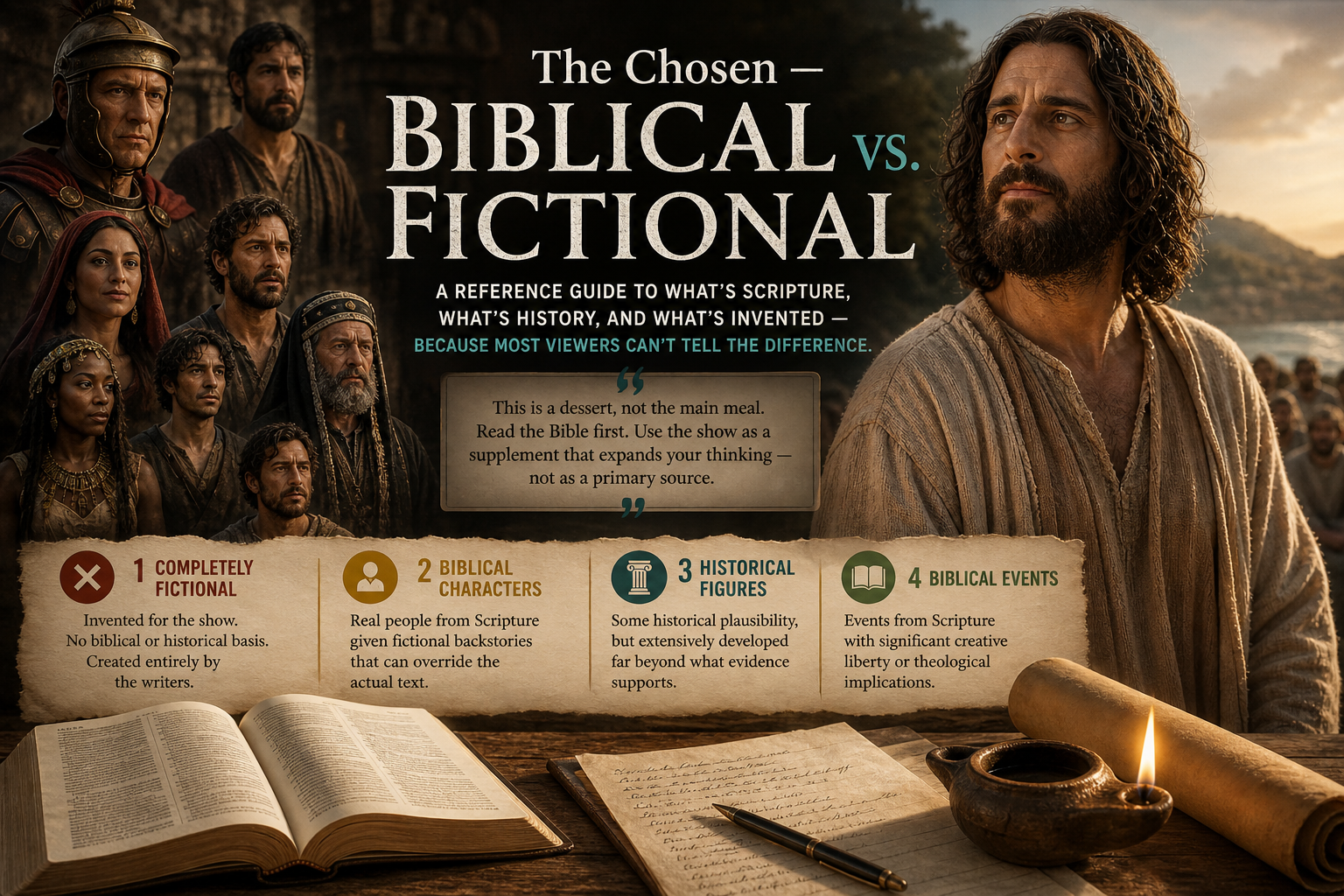

A Personal Note
I’ll be honest, I like this show. I think it’s genuinely good, and I’m glad it exists. For most of church history, Christian media meant flannel boards, low budgets, and productions so corny that nobody outside the church would touch them with a ten-foot pole. The Chosen changed that. It’s well-acted, it’s emotionally real, and it does something that most of us who grew up in church never had: it shows Jesus as fully human. Laughing. Getting frustrated. Tired at the end of a long day. A lot of people spent decades seeing Christ as this untouchable divine figure behind stained glass, and this show cracked that open in a way that sent people back to their Bibles asking better questions.
Jonathan Roumie clearly took this role seriously. I’ve seen interviews where he talks about feeling completely unworthy to speak the words of Christ. That’s not an actor doing a job, that’s a man who understood the weight of what he was doing. I respect that.
That said, and this is why I put this reference together, the show is so well-made that it feels authoritative in a way that low-budget Christian films never did. The higher the production quality, the easier it is to walk away remembering the show’s version instead of the text’s. That’s not a knock on the show. That’s how good storytelling works.
Watch it. Enjoy it. Let it spark something. Just don’t let it replace the text that it’s pointing toward.[1]
Which Characters in The Chosen Are Completely Made Up?
Invented for the show. No biblical or historical basis. Created entirely by the writers.
Ramah
Thomas’s partner / female disciple. Entirely invented. In Scripture, “Ramah” is a place, not a person (1 Sam 1:19; Jer 31:15). Represents the unnamed women of Luke 8:1-3. Killed by Quintus in S4; Jesus declines to raise her, saying “it is not her time.”
Quintus
Roman Praetor of Galilee. No Gospel counterpart. A composite villain loosely inspired by Roman authority figures in the narrative. Loses his post after killing Ramah. Season 4 strips him of his office and demotes him, and he does not appear in Season 5 at all.
Atticus Aemilius
Roman intelligence agent. No biblical basis. Possibly invented to explain how the Gospel writers had knowledge of conversations among Roman and Jewish leaders that no disciple could have witnessed. The real answer to that question is a matter of dating and sources, worked through in when the New Testament was written. In Season 5 he follows the story to Jerusalem and moves to the center of Holy Week, standing his soldiers down during the Temple cleansing and pushing back on Pilate.
Shmuel
Hostile Pharisee / antagonist. Fictional. Created as an ongoing foil to Jesus and Nicodemus. The most openly hostile Pharisee in the show, with no Gospel parallel.
Tamar
Ethiopian female disciple. Not biblical. Added to represent the diversity of those drawn to Jesus, inspired by but not grounded in any specific scriptural figure.
Dasha
Eden’s mother / Peter’s mother-in-law. The Bible confirms Peter’s mother-in-law exists (Matt 8:14), and that’s all it says. Name, characterization, and storyline are invented.
Adnan
Yussif’s father. Invented. A wealthy Jerusalem man written as a friend and business partner of Lazarus. In Season 4 he comes to Bethany to mourn with Mary and Martha, follows Mary out to the tomb, and ends up a witness when Lazarus walks out. John does say many of the Jews who had come to Mary saw it and believed (John 11:45), but he names none of them.
Zebadiah and Gedera
Sanhedrin members. Invented. Zebadiah is a Pharisee of the House of Shammai and Gedera a Sadducee, both introduced in Season 4 and given larger parts in the council scenes of Season 5. Apart from the high priests, Nicodemus and Joseph of Arimathea, the Gospels name nobody on the council during these days.
Shoshana
Caiaphas’s wife. Invented. The show makes her the daughter of Annas, which follows from John 18:13 calling Caiaphas the son-in-law of Annas, but Scripture never mentions her. Her brother Ananus appears in Season 5 as well. Josephus does record a son of Annas named Ananus, who became high priest decades later, but he has no Gospel scene.
Which Real Bible Characters Were Given Invented Backstories?
Real people from Scripture, substantially expanded with invented material that can override the actual text in a viewer’s imagination.
Eden
Simon Peter’s wife. Peter’s wife is biblically attested (1 Cor 9:5) but never named in Scripture. The show names her Eden, gives her a prominent multi-season role, and portrays her as more consistently faithful than Peter. What the text does record about the man she was married to is in the post on Peter’s life and death.
Matthew
Apostle / tax collector. Depicted as neurodivergent. No biblical evidence for this. Treated as plausible artistic license by the production’s theological consultants. What the Gospels do give is a man whose job made him a traitor, a thief and unclean in one, covered in the post on Matthew the tax collector.
Mary Magdalene
Disciple. Scripture says Jesus cast out seven demons (Luke 8:2); that’s nearly all we have. The show adds addiction, a Roman assault backstory, and Nicodemus’s failed exorcism attempt before Jesus succeeds. For how the Gospels actually handle the women around Jesus, see what had changed by his day.
Nicodemus
Pharisee. Appears three times, all in John: the night conversation in John 3, a short defense of Jesus before the council in John 7:50-52, and the burial in John 19:39, where he brings the myrrh and aloes. The show builds an entire multi-season arc, inner life, family dynamics, and ongoing relationship with Jesus around those few verses.
Little James
Apostle (James son of Alphaeus). Appears in the Gospels only in the apostle lists. The show gives him a physical disability and a rich personal storyline, all invented. Which James this is, and how he differs from the other two, is sorted out in the post on the three Jameses.
Thomas
Apostle. Real apostle with a known scriptural character (John 11:16; 20:24–28). His entire romantic relationship with Ramah and the resulting grief arc are pure invention built around the historical figure. The Gospels say nothing at all about his personal life, and what they do say is in the post on Thomas and the India tradition.
Judas Iscariot
Apostle / treasurer. Real. John gives him the money bag and calls him a thief (John 12:6), and says the devil had already put the betrayal in his heart (John 13:2). The show gives him a business background, a mentor, and a motive the text never offers: he wants Jesus on the throne and grows angry when Jesus refuses it. By the end of Season 4 he is pressing Yussif and Shmuel to back a new Davidic kingdom. In Scripture the ones still asking about restoring the kingdom to Israel are the faithful eleven, after the resurrection (Acts 1:6).
Caiaphas
High priest. Real. Son-in-law of Annas (John 18:13) and the man who told the council it was better for one man to die for the people (John 11:49-50). The show brings him in during Season 4 and builds his household, his dealings with Pilate and Herod, and a run of council meetings, most of which have no Gospel scene behind them. John’s point is that Caiaphas prophesied without knowing it (John 11:51); the Season 6 previews have him quote the prophecy as if he understood it.
Malchus
Servant of the high priest. Real, and named exactly once, as the man whose ear Peter cuts off (John 18:10). Season 5 makes him Caiaphas’s chief servant and gives him a friendship with John that starts over an oil delivery to the high priest’s house. The hook is John 18:15-16, where the other disciple is known to the high priest and gets Peter through the door. The friendship itself is invented.
Claudia
Pilate’s wife. Real but unnamed. Her one appearance is the dream and the warning she sends Pilate in Matt 27:19. The name Procula comes from the Gospel of Nicodemus in the fifth century, and “Claudia” was attached even later. The show gives her a recurring place at Pilate’s side in Season 5.
Matthias
The Watcher. Real. Chosen by lot to replace Judas (Acts 1:23-26) and never mentioned again. The show turns him into a man who silently watches Jesus for two seasons, revealed in Season 5 as someone Nicodemus sent to observe. Acts sets the qualification as a man who had been with the group from John’s baptism onward (Acts 1:21-22), and the show’s late arrival sits awkwardly against that.
Lazarus
Friend of Jesus. Real (John 11; John 12:1-2). John calls him the one Jesus loved (John 11:3). The show makes him a Bethany businessman and a childhood friend of Jesus, and stages the raising in Season 4. The childhood friendship and the business are added.
Simon of Cyrene
The man made to carry the cross. Real (Mark 15:21). Season 5 introduces him early as a man from Cyrene selling birds in the Temple market, so viewers already know him before the road to Golgotha. Mark gives only his hometown and the names of his sons.
Jesse and Veronica
Healed followers. Both healings are real and both people are unnamed in the text. Jesse is the paralytic at the pool of Bethesda (John 5:1-9); the show names him, makes him Simon the Zealot’s brother, and keeps him with the disciples. Veronica is the woman with the twelve-year bleeding (Mark 5:25-34). The Acts of Pilate calls her Bernice, the root of the later name, and the show puts her home at Caesarea Philippi, where Eusebius reports a tradition about her.
Which Parts of The Chosen Are Historically Plausible but Not Biblical?
Some historical plausibility, but extensively developed far beyond what evidence supports.
Gaius
Roman centurion / Praetor. Adapted from the centurion of Matt 8 whose servant Jesus heals, and Season 4 makes the identification explicit when he kneels and asks Jesus to heal the boy. The show gives him a name, a son named Ivo, a promotion to Praetor when Quintus falls, and a full multi-season arc of gradual movement toward faith.
Yussif
Sympathetic Pharisee, very likely Joseph of Arimathea. Yussif is the same name as Joseph, and the show has spent five seasons building him toward that role. His family runs a construction business and a stone quarry out of Jerusalem (Season 3). He uses his father’s wealth to take a seat on the Sanhedrin (Season 4). In Season 5 he defends Jesus on the council and agrees with Nicodemus to keep his loyalty hidden. The Gospels’ Joseph is a rich council member and a disciple in secret for fear of the leaders, and he buries Jesus with Nicodemus (Mark 15:43; Matt 27:57; John 19:38-39). The show has not named him as Joseph yet, and Season 6 covers the burial.
Peter’s Debt Crisis
Season 1 opening storyline. No biblical basis. Historically plausible under Roman taxation. Used as the entire dramatic framing device that leads to Peter following Jesus.
Photina
Samaritan woman at the well. Real encounter in John 4, but the woman is unnamed in Scripture. “Photina” comes from early church tradition. The show gives her a significantly expanded storyline and ongoing presence. What the text gives is one conversation, and it is the longest one Jesus has with anybody: the woman at the well and the man with no bucket.
Which Bible Scenes Does The Chosen Change?
Places Jesus in situations not found in the Gospels, or reframes how he behaves.
Mary’s Deliverance
Mary Magdalene’s exorcism (S1). The exorcism is in Luke 8:2. The show frames it with a full invented backstory and has Nicodemus attempt (and fail) the exorcism first, before Jesus succeeds. No biblical basis for Nicodemus’s involvement.
Sermon on the Mount
Matthew 5–7. The words of Jesus are taken directly from Scripture. But the show constructs a multi-episode buildup, crowd dynamics, disciple reactions, and backstage drama, all invented scaffolding around the actual text. The text itself, taken section by section, starts with the Beatitudes.
John 3: Nicodemus
The “born again” encounter. One night conversation in Scripture, with two short appearances later in John. The show builds an entire season of relationship-building to contextualize it, which risks making viewers feel they understand Nicodemus’s inner life when the text gives almost nothing.
Ramah’s Death
Season 4, Episode 3: most contested moment. Jesus present but declining to heal a dying person, saying “it is not her time.” This inverts the normal Gospel pattern. No parallel in Scripture. Several theologians have identified this as the show’s most theologically problematic creative choice.
Which Roman Characters in The Chosen Are Real?
The Romans sit in three different categories above, so here they are together. Gaius is the only one with a plausible root in the Gospels: the centurion of Matt 8 whose servant Jesus heals, which Season 4 confirms, though the name, his son Ivo, and the long turn toward faith belong to the show. Quintus, Praetor of Galilee, has no Gospel counterpart at all; he is a composite, built to give Roman power a face the story can push against. Atticus Aemilius is invented outright, and if there is a reason for him beyond drama it is structural: someone has to have overheard the conversations between Roman and Jewish leaders that no disciple was in the room for.
What Will The Chosen Season 6 Cover?
Season 6 covers the roughly twenty-four hours of Good Friday, from the arrest to the cross. The first three episodes arrive on Prime Video on November 15, 2026, then one a week through December 6, and the finale opens in theaters on March 12, 2027. Season 7, the last, is the resurrection. The previews released so far show Annas questioning Jesus, Malchus and Judas in the high priest’s courtyard, Pilate offering the crowd Barabbas, and the scourging. Two things in them already pull away from the text. Peter is shown trying to spread the word that night, where every Gospel has him denying he knows Jesus (Luke 22:54-62), and Caiaphas cites his own prophecy as if he meant it. The burial falls inside this season too, which is where the Yussif question should get its answer.
Is The Chosen Biblically Accurate?
- The show’s opening disclaimer states “Biblical events are condensed,” worth treating as a genuine warning, not boilerplate.
- Script consultants include Dr. Doug Huffman (Biola University) and a Messianic Jewish Rabbi. The production takes theological review seriously.
- The higher the production quality, the more authoritative it feels, which makes uncritical absorption more dangerous, not less.
- Emotional weight makes fiction feel true.
- The idolatry concern is real: Jonathan Roumie’s face becoming the face of Jesus competes with the actual text when reading the Gospels. This is not the actor’s fault. It is what the visual medium does.
- Most dangerous: not the invented characters (viewers can accept Ramah as a device) but the moments that subtly reframe how Jesus behaves; these are absorbed as Gospel witness by viewers with thin biblical literacy.
- The test: does watching it send you to the actual text with better questions, or does it substitute for the text?
New field notes when they are ready, along with the research underneath them. No drip sequence, no course, nothing to buy.
Footnotes1
- Updated October 22, 2026, to cover Seasons 4 and 5 and the Season 6 previews. Yussif moved out of the invented list and into the plausible section, now that the show has built him toward Joseph of Arimathea. The Nicodemus entries were corrected after a reader pointed out that he appears in John 7:50-52 and John 19:39 as well as John 3. Gaius, Quintus and Atticus brought up to date. New entries: Adnan, Zebadiah and Gedera, Shoshana, Judas Iscariot, Caiaphas, Malchus, Claudia, Matthias, Lazarus, Simon of Cyrene, Jesse and Veronica, and a Season 6 section.
Sources22
- Is The Chosen Biblically Accurate?, Screen Rant
- How We Make Theological Decisions for Fictional Scenes, Religion News Service
- The Chosen: Fiction, Truth, or in Between?, Early Christian Texts
- Is Ramah from The Chosen in the Bible?, Favour Udelue Blog
- Quintus, Gaius, Atticus & the Romans in The Chosen, The Bible Artist
- What is The Chosen and is it Biblically Sound?, GotQuestions.org
- List of The Chosen Characters, Wikipedia
- Authenticity of Scripture Paramount to The Chosen's Success, CBN
- Yussif, Jairus & Shmuel in The Chosen, The Bible Artist. Yussif's Jerusalem family business and his Season 5 arc
- The Chosen Season 4 Episode 2: Recap, Review & Analysis, The Bible Artist. Yussif takes a Sanhedrin seat on his father's wealth
- The Chosen Season 4 Episode 7: Recap, Review & Analysis, The Bible Artist. Adnan and the raising of Lazarus
- The Chosen Season 4 Episode 8: Recap, Review & Analysis, The Bible Artist. Judas and the Davidic kingdom
- The Chosen S4E4 "Calm Before" Recap, TV Tropes. Gaius as the centurion, Quintus demoted
- The Chosen Season 5 Episode 2: Recap, Review & Analysis, The Bible Artist. Malchus and John
- The Chosen Season 5 Episode 6: Recap, Review & Analysis, The Bible Artist. Matthias revealed as the Watcher
- The Chosen Episode Guide: Season 5, Episode 4, Trinity Walla Walla. Gedera and Ananus as non-biblical
- Why Did Judas Betray Jesus?, ChurchLeaders. Jenkins and Luke Dimyan on Judas's motive
- Pontius Pilate's Wife, Wikipedia. Where the names Procula and Claudia come from
- Saint Veronica, Wikipedia. Bernice in the Acts of Pilate, Eusebius on Caesarea Philippi
- Notes on The Chosen Season 6, Peter T. Chattaway. What the Season 6 previews show
- The Chosen Releases Official Trailer for Season 6, Catholic World Report. Season 6 release dates
- Josephus, Antiquities of the Jews 20.9.1. Ananus son of Annas as high priest. Free in Whiston's translation, and in most Logos libraries.









