
Series: Jesus and Women · Part 1 of 4
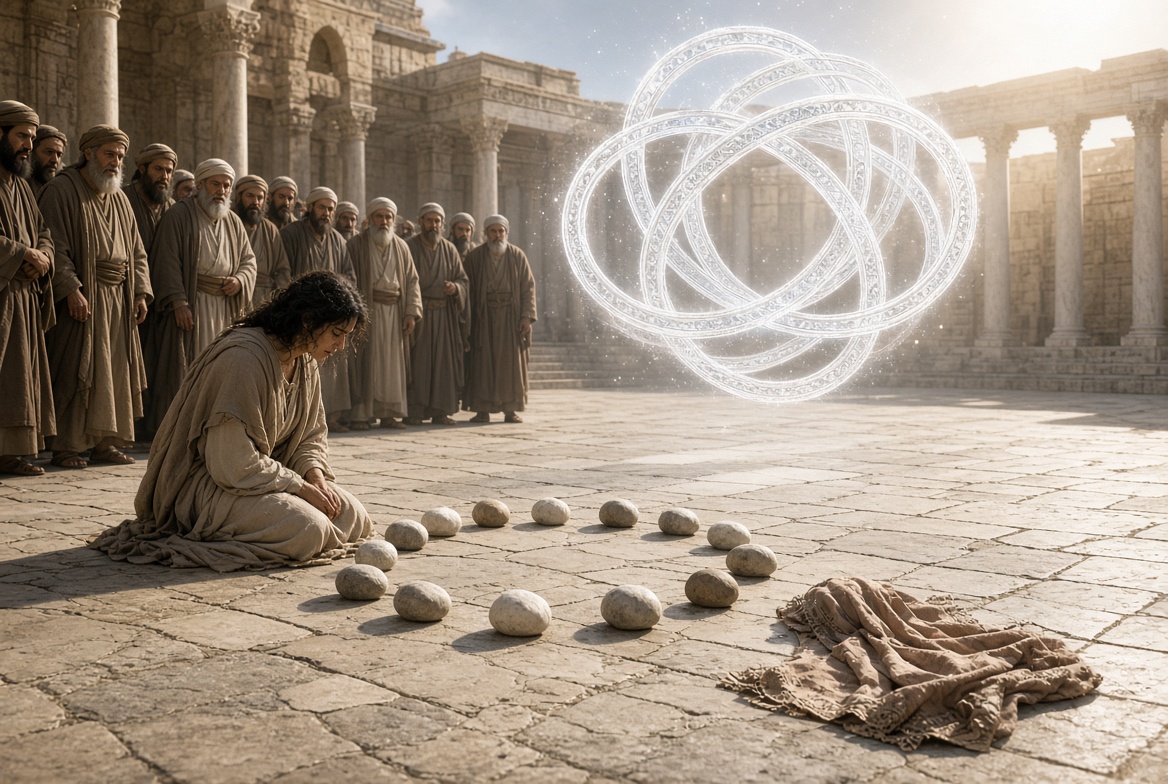
They say she was caught in the act, which takes two people.
They brought one. That single omission tells you what the scene is about, and it is not adultery.
What Were the Accusers Doing?
Using a woman as a device to trap Jesus, and Bailey does not soften it.
The law matters to them and the person does not. She is a pawn in a power play, brought forward to discredit Jesus and reassert their own authority. For the men in that courtyard, turf outranks truth, justice and people, in that order.
Notice the selection. They did not bring a murderer or a thief. They brought a woman taken in a sexual offence, which allowed them to combine sex, sin, a public humiliation and a double standard in one exhibit.
The man disappeared. Nobody looked for him and nobody in the story asks.
And there is no attempt anywhere in the passage to help her. The only plan on the table is to use her and then kill her, and her humiliation along the way is treated as irrelevant.
What Was the Trap?
A question with no safe answer, which is why it was worth a woman’s life to them.
Say stone her and he contradicts everything he has taught about mercy, and he also collides with Roman authority over capital punishment. Say release her and he can be charged with setting aside the law of Moses.
The trap is well built. What breaks it is that he refuses to answer on their terms, writes on the ground, and returns a sentence that puts the qualification for throwing the first stone back onto the throwers.
Where Did the Crowd Go?
Home, and Bailey’s observation about this is worth the whole passage.
The day before, the crowd had protected Jesus. Guards sent to arrest him could not carry out the order because a solid mass of supporters made it impossible.
Then the temple authorities themselves arrive, a real confrontation develops, and the crowd evaporates. Bailey’s phrase is like dew on a hot summer morning.
Nothing changed about Jesus between the two days. What changed was the level of danger, and the people who had been shielding him could smell it. Better to go home. Better not to get involved, never mind who gets hurt.
Why Does John 8 End Without Telling Us What She Did?
Because the woman never answers, and the silence is doing work.
We are told she is not condemned and told to go and sin no more. We are not told what she did next.
She also knows something the reader knows. Jesus has just made an enemy of the temple authorities on her account, in public, and she has watched him do it.
Whether the knowledge of what that cost him became anything in her life is left open. Bailey reads the missing ending as an invitation to the reader to finish the play, which is a pattern across the Gospel stories and not an oversight.
Is This Passage Actually in the Bible?

That question has a real answer and it does not settle the passage.
The earliest and best Greek manuscripts of John do not contain it. The two great fourth-century codices lack it. No Greek father comments on it for roughly the first thousand years, and several read straight from John 7 into John 8 as though nothing sits between.
And when it does appear it moves. Some manuscripts place it where we expect. Others put it after John 7:36, or at the end of John, or in Luke after 21:38. A passage that belongs in a book does not migrate inside it, and certainly not into a different book.
So it is almost certainly not part of what John wrote.
That is a separate question from whether it happened. A number of serious scholars hold that the episode preserves a genuine memory circulating independently before it found a written home, and it reads like him: the refusal to answer on the terms offered, the sentence that dismantles the accusers without excusing the accused.
Both things can be true. It is not securely Johannine and it may well be very old, and a teacher who presents only one half of that has not dealt with the passage.
Part of a series on Jesus and women, following Bailey’s treatment. See also the woman in the house of Simon the Pharisee.
Continues in Part 2: The Syrophoenician Woman and the Hardest Line
All 4 parts in this series
- Part 1The Woman Caught in Adultery: Where Was the Man?You are here
- Part 2The Syrophoenician Woman and the Hardest Line
- Part 3The Woman at the Well and the Man With No Bucket
- Part 4Jesus and Women: What Had Changed by His Day
New field notes when they are ready, along with the research underneath them. No drip sequence, no course, nothing to buy.
Footnotes2
- The absent man is the fastest way into this passage and it requires no scholarship to see. Leviticus 20:10 specifies both parties. The accusers cite the law of Moses and then arrive having enforced half of it, which tells you the law was not what they were interested in.
- That the crowd protected him one day and vanished the next is a detail with no theological payload and considerable human weight. Bailey draws the ordinary conclusion, which is that support which costs nothing is not support, and that most people can tell when the price is about to change.
Sources
Kenneth E. Bailey, Jesus Through Middle Eastern Eyes: Cultural Studies in the Gospels (IVP Academic, 2008), chapter 17. Supports the reading of the woman as a pawn in a power play, the significance of the absent man and the choice of offence, the disappearance of the crowd between the two days, and the treatment of the missing ending as an invitation to the reader. Supplied in full.
The biblical texts cited: John 7:53-8:11, John 7:44-46, and Lev 20:10.
Where the sourcing stops: the manuscript evidence summarised here is standard textual criticism rather than drawn from Bailey, who treats the passage as a unit without settling its origin. Whether the episode preserves an independent early memory is a genuine scholarly question and is not resolved here.