
Series: Jesus and the Pharisees · Part 5 of 6
Two verdicts arrive in the same passage. His family says he is out of his mind. The scribes from Jerusalem say he is possessed.
Mark wraps one around the other deliberately, and the reply redefines who belongs to him.
What Does His Family Say?
That he has lost his senses, and they come to take charge of him.
Mark 3:21 is blunt about it. When his own people heard, they went out to seize him, because they were saying he was beside himself.
That is not hostility from strangers. It is a family intervention, and it is the frame Mark builds the rest of the scene inside.
What Do the Scribes Say?
That he is working for the other side.
Their charge is that he has Beelzebul and casts out demons by the ruler of the demons. Notice what that concedes. Nobody disputes that the exorcisms happen. The argument is about the source of the power, not the fact of it.
Wright presses that further than I would have. The charge is evidence, as sober history, that Jesus was doing something extraordinary. Nobody asks how does he do it while standing beside an ordinary house or listening to an amateur struggle through an easy piece of music. The question only gets asked of someone whose work demands an explanation.
And the early church would not have invented the detail that people accused their Lord of being in league with the devil. Embarrassing material tends to be evidence that something happened.
What Is the Argument About a Divided House?
That the accusation collapses under its own weight, and Jesus sends it straight back.
If Satan casts out Satan, he is divided against himself and cannot stand. Wright’s illustration is the useful one. A man building a house does not call in a contractor and authorise him to demolish parts of it. If the adversary wants more control over people, handing someone the power to release large numbers of them is not a plan.
There is a second counter-question underneath it. Other Jewish exorcists were working with some success. Are they in league with the devil too?
Then the image of the strong man, and this is where the passage turns from defence to claim. Nobody plunders a strong man’s house without first tying him up. So the exorcisms are not the campaign, they are the aftermath of one. Wright reads them as a sign of something already done, which sends the reader back to the wilderness temptation.
That reframes every exorcism in the Gospel. Not isolated mercies. A burglary in progress in a house whose owner is already bound.
And Wright draws a sobering point out of it for anyone who wants to do the same work. The order runs victory over temptation first, plunder second.
What Is the Unforgivable Sin?
Attributing the work of the Spirit to an unclean spirit, and the context is what defines it.
Mark says plainly why Jesus said it. Because they were saying he has an unclean spirit.
So the sin named here is not a general category of especially bad behaviour and it is not blasphemous words spoken in a moment of rage or despair. It is watching God’s Spirit set someone free and calling that work demonic.
Wright’s explanation of why it cannot be forgiven is better than the usual one, because it is mechanical rather than arbitrary. Look at the work of the Spirit, declare it the devil’s doing, and it is not simply that you will not be forgiven. You cannot be, because you have cut off the channel forgiveness travels along. Declare the last remaining bottle of water poisoned and you have sentenced yourself to thirst.
That also disposes of the pastoral problem. Anxiety about having committed it is fairly good evidence of not having done so, and the men in this scene were not troubled in the slightest.
What remains serious is the decision itself. It is still possible to look at Jesus and conclude he must have been mad, or worse. If the kingdom really was arriving in him, refusing to recognise it means cutting yourself off from its effects, and forgiveness is chief among them.
Who Is His Family?
Whoever does the will of God, and the scene is staged to say it.
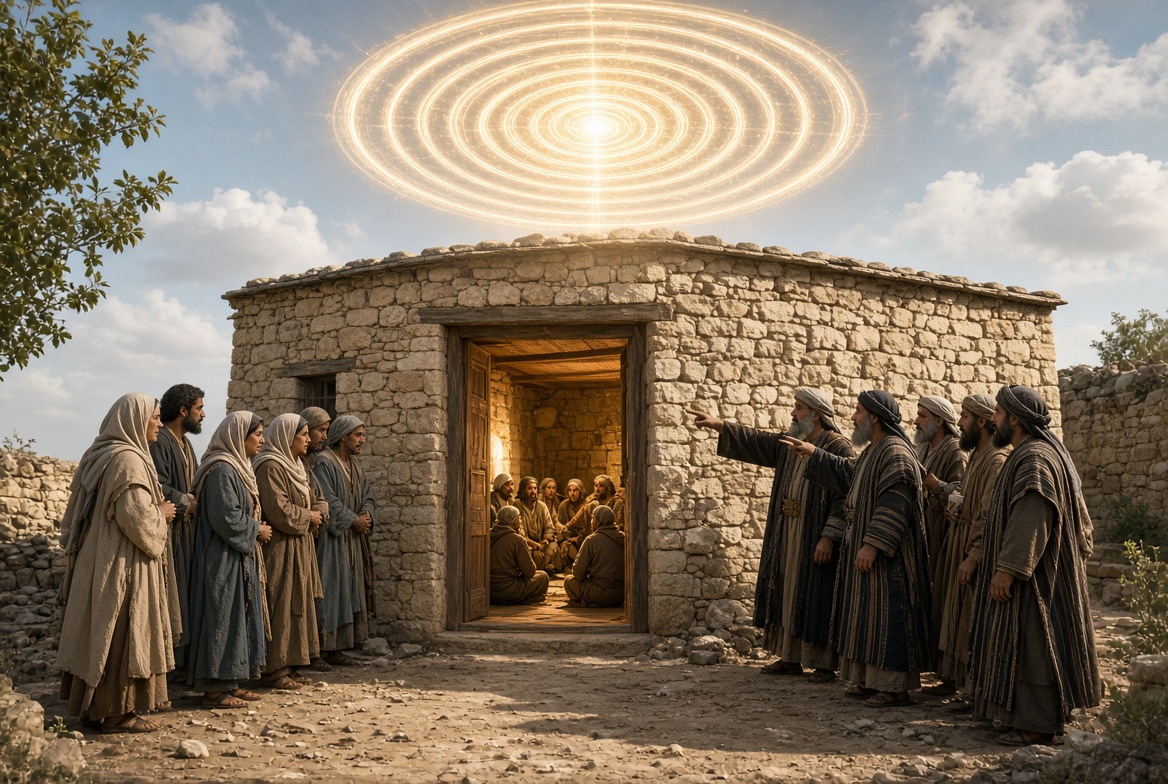
His mother and brothers arrive and stand outside, sending word in. Jesus looks around at those sitting in a circle about him and says here are my mother and my brothers, and whoever does the will of God is my brother and sister and mother.
Matthew’s wording of that verse is the definition his Gospel uses again at the judgment scene, where the criterion is how people treated the least of these my brothers. The phrase is not vague. It was defined here.
Why Are the Two Verdicts Together?
Because they are the same mistake at different volumes.
The family concludes he is unbalanced. The scribes conclude he is demonised. Both are looking at the same behaviour and both are explaining it as a disorder rather than as the arrival of something.
And Mark closes the scene by seating a new family in a circle on the floor, which is his answer to both. The people outside are related to him by blood. The people inside are related to him by obedience.
Part of a series on the conflict with the Pharisees. See also the calling of Levi and the sheep and the goats, which turns on the definition given here.
Continues from Part 4: The Calling of Levi and the Party That Followed · Continues in Part 6: The Yeast of the Pharisees and of Herod · Start at Part 1: Lord of the Sabbath: What the Conflict Was About
All 6 parts in this series
- Part 1Lord of the Sabbath: What the Conflict Was About
- Part 2Clean and Unclean: Why Jesus Was Cryptic
- Part 3The Paralytic and the Authority to Forgive
- Part 4The Calling of Levi and the Party That Followed
- Part 5Beelzebul and Who Counts as FamilyYou are here
- Part 6The Yeast of the Pharisees and of Herod
New field notes when they are ready, along with the research underneath them. No drip sequence, no course, nothing to buy.
Footnotes2
- That the opposition concedes the exorcisms is the most useful observation available on this passage. Nobody in the scene argues that nothing happened. The whole dispute is about attribution, which tells you what was and was not in question at the time.
- The strong man image is easy to read past and it reorganises the Gospel. If the binding has already happened, then every subsequent exorcism is not a fresh battle but the removal of goods from a house whose owner is already tied up.
Sources
N. T. Wright, Matthew for Everyone, Part One: Chapters 1-15 (SPCK, 2002), on Matt 12:22-32 and 12:33-42. Supports the argument that the charge is historical evidence of extraordinary works, the observation that the early church would not have invented it, the house-and-contractor illustration, the counter-question about other Jewish exorcists, the reading of the strong man as already bound, and the mechanical explanation of why the blasphemy cannot be forgiven. Supplied in full.
The biblical texts cited: Mark 3:20-35, Matt 4:1-11, Matt 12:22-50, Luke 11:14-23, and Matt 25:40.
Where the sourcing stops: the reading of the family's verdict and the scribes' verdict as one mistake at different volumes is my own framing of Mark's arrangement rather than a claim in either commentary.