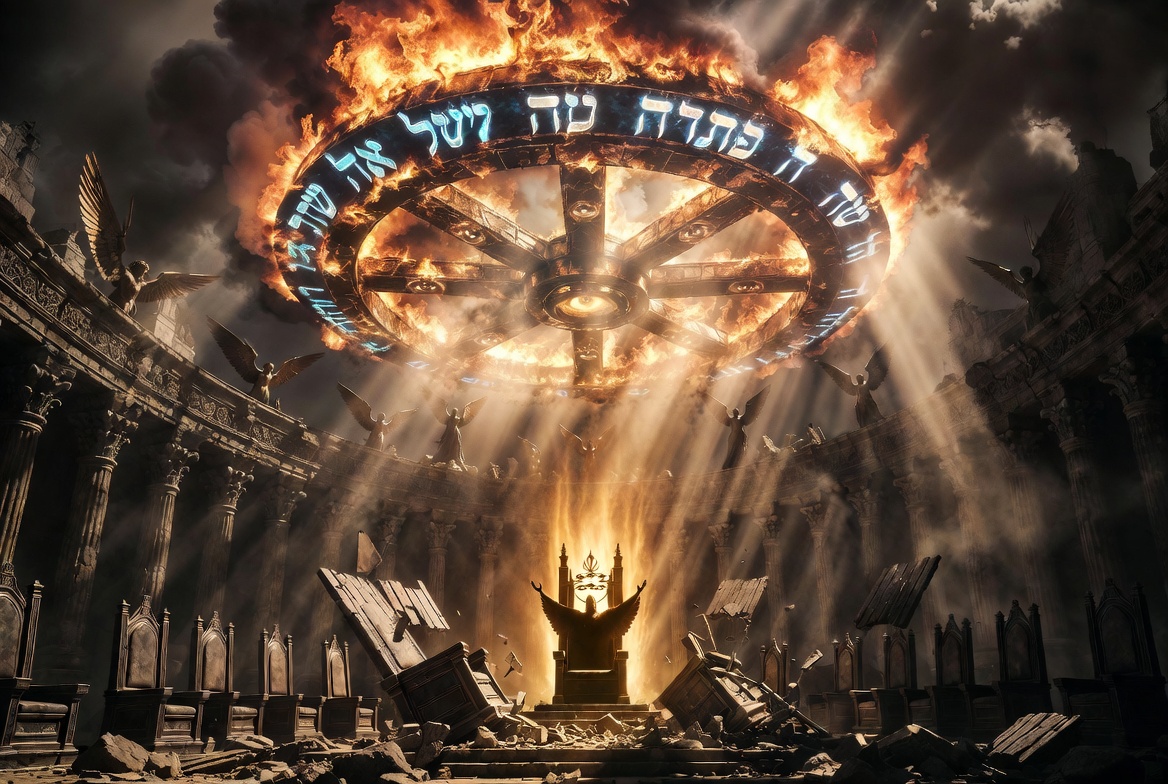

What Is the Divine Council?
The Old Testament presents a populated heavenly realm: beings of various ranks, roles, and alignments operating within Yahweh’s cosmic order. In ’s divine council framework, these are real entities with assigned functions, some faithful to Yahweh, some in rebellion. Knowing who they are and where they show up fills in a layer of the biblical narrative that most Sunday school teaching skips. The six tiers below are a way of organizing the biblical material, not a formal hierarchy Scripture lays out in six levels.
This page goes being by being. The Divine Council Index goes passage by passage: every text where the council is acting, grouped by thread and graded explicit, implied, or contested. Entries below link to their passages there.
- Tier 1: Yahweh alone
- Tier 2: The sons of God
- Tier 3: Michael and Gabriel
- Tier 4: Cherubim, seraphim, and the living creatures
- Tier 5: Messenger angels
- Tier 6: Satan, the Watchers, the princes, and demons
Is Yahweh One of Many Gods?
Before listing the council members, the hierarchy needs an anchor. Yahweh sits at the absolute apex, the only uncreated being on this list. Every other being here is created and subordinate. The council exists under His authority, not alongside it.
Biblical Verification: Psalm 82:1, “God presides in the great assembly; he renders judgment among the gods.” Deuteronomy 10:17, “the God of gods and Lord of lords.”
In the Index: Psalm 82
Who Are the Sons of God (Bene Elohim)?
The Sons of God
Primary References: Genesis 6:1-4, Job 1:6, Job 2:1, Job 38:7, Psalm 82, Psalm 89:6-7, Daniel 7:10
In the Index: Genesis 6:1-4, Job 1:6-12, Psalm 82, Psalm 89:5-7, Daniel 7:9-14
What They Are: The bene elohim, literally “sons of God,” are divine beings who comprise Yahweh’s heavenly council. They’re not angels in the popular sense; they’re a class of divine beings who were present at creation (Job 38:7, “the morning stars sang together and all the sons of God shouted for joy”) and who meet in assembly before Yahweh (Job 1:6).
Significance: These are the members of the divine council proper. They hold roles, receive assignments, and are accountable to Yahweh. Psalm 82 shows Yahweh judging them for failing to administer justice among the nations. Their authority is real, and so is their accountability.
Divine Council Note: The Genesis 6 “sons of God” who take human wives are these same beings, divine council members who abandon their assigned role and corrupt the human realm. This is another major supernatural rebellion in the biblical storyline, following Eden and preceding the flood.
Who Are the Archangels Michael and Gabriel?
Michael
Primary References: Daniel 10:13, Daniel 10:21, Daniel 12:1, Jude 1:9, Revelation 12:7
In the Index: Daniel 10:13, 20-21
Michael is described as “one of the chief princes” (Daniel 10:13) and Israel’s designated divine protector, “the great prince who protects your people” (Daniel 12:1).[1] He’s a warrior figure, a divine champion assigned to Israel’s defense.
In Daniel 10, Michael engages in cosmic warfare against the “prince of Persia,” a territorial divine being opposing Yahweh’s purposes. This gives us a window into the divine council’s military dimension: nations have assigned divine beings over them, some faithful, some rebellious, and they’re in active conflict. Michael represents the faithful side of territorial divine assignment. Where the princes of Persia and Greece (Daniel 10) have turned against Yahweh, Michael holds the line for Israel.
Gabriel
Primary References: Daniel 8:16, Daniel 9:21, Luke 1:19, Luke 1:26
Gabriel functions as Yahweh’s messenger and interpreter of visions.[2] He appears to Daniel twice, explaining the vision of the ram and goat (Daniel 8:16) and delivering the seventy weeks prophecy (Daniel 9:21).
Gabriel represents the communicative function of the divine council, the transmission of Yahweh’s purposes and revelation to human beings. He’s a herald more than a warrior. Gabriel’s appearances bracket major prophetic revelation. He shows up at hinge moments in redemptive history: Daniel’s visions and the announcements of the births of John the Baptist and Jesus.
What Are Cherubim and Seraphim?
Cherubim
Primary References: Genesis 3:24, Exodus 25:18-22, Ezekiel 1, Ezekiel 10, Psalm 18:10, Psalm 80:1
In the Index: Ezekiel 28:11-19
What They Are: Cherubim are not the chubby baby angels of Renaissance art.[3] They are fearsome composite creatures. Ezekiel 1 describes them with four faces (human, lion, ox, eagle), four wings, and burning coals of fire between them. They are guardians of sacred space and divine throne bearers.[4]

Significance: Their first appearance is in Genesis 3:24, guarding the entrance to Eden with a flaming sword after the fall. They appear again as the design for the Ark of the Covenant cover (Exodus 25:18-22), where Yahweh’s presence dwells between them. In Ezekiel they carry the divine throne. They are permanently associated with Yahweh’s direct presence and the boundary between holy and profane.
Divine Council Note: Cherubim define and guard sacred space. Their role is protective and boundary-maintaining, which connects directly to the covenant protection motif.
Seraphim
Primary References: Isaiah 6:1-7
In the Index: Isaiah 6:1-8
What They Are: Seraphim appear only in Isaiah 6, six-winged beings surrounding Yahweh’s throne, calling out “Holy, holy, holy is the LORD Almighty; the whole earth is full of his glory.” Their name comes from the Hebrew saraph meaning “burning ones.”
Significance: The seraphim function as throne attendants and worshippers. One of them takes a burning coal and touches Isaiah’s lips to purify him for prophetic service. They represent the holiness dimension of the divine council, beings whose very existence is oriented toward declaring and protecting Yahweh’s holiness.
Divine Council Note: The triple “holy” (kadosh, kadosh, kadosh) is the strongest form of emphasis in Hebrew. The seraphim use it to declare the absolute supremacy of Yahweh’s holiness above all other attributes.
The Four Living Creatures
Primary References: Ezekiel 1, Revelation 4:6-9
The four living creatures are similar to cherubim: composite creatures surrounding the divine throne with multiple faces and wings. Revelation 4 shows them around the throne of God continuously declaring “Holy, holy, holy.”[5]
These beings exist at the innermost ring of the divine council, permanently in Yahweh’s presence, perpetually in worship. They are among the beings depicted closest to Yahweh’s throne, continually declaring His holiness.
What Are Angels in the Bible?
The Heavenly Host
Primary References: 1 Kings 22:19, Psalm 103:20-21, Luke 2:13, Daniel 7:10
In the Index: 1 Kings 22:19-23, Daniel 7:9-14
What They Are: The mal’ak, messengers, are the working angels of Scripture.[6] They carry messages, execute judgment, protect individuals, and carry out Yahweh’s commands in the physical realm. Daniel 7:10 describes “thousands upon thousands attended him; ten thousand times ten thousand stood before him.”
Significance: These are the beings most people think of when they hear “angel.” They operate throughout the Old and New Testaments as Yahweh’s agents in the world, announcing births, protecting individuals, executing judgment, and engaging in warfare.
Notable Appearances: The angel who kills 185,000 Assyrians in one night (2 Kings 19:35). The angel wrestling Jacob (Genesis 32). The angel appearing to Gideon (Judges 6). The destroying angel at the Passover (Exodus 12:23).
The Angel of the Lord (Mal’ak Yahweh)
Primary References: Genesis 16:7-13, Genesis 22:11-18, Exodus 3:2-6, Judges 6:11-24, Judges 13:3-22
What He Is: The Angel of the Lord is a unique figure, distinct from regular messenger angels. In multiple appearances, He speaks as Yahweh in the first person and is identified as Yahweh by the people He encounters. Hagar says “I have now seen the One who sees me” (Genesis 16:13). Gideon builds an altar and names it after the encounter.
Significance: Heiser argues the Angel of the Lord is a pre-incarnate appearance of the second person of what becomes the Trinity, Yahweh manifesting in visible form before the incarnation of Christ. He is simultaneously distinct from Yahweh and identified as Yahweh, a two-Yahweh theology that Heiser argues is present throughout the Old Testament.[7] This reading is contested among scholars, but it sits at the center of Heiser’s two-Yahweh thesis.
Divine Council Note: He sits in this tier only because the text calls him a mal’ak. On Heiser’s reading he belongs at the top of this list with Yahweh, as the most direct visible manifestation of Yahweh’s presence in the Old Testament. Every encounter with Him is a theophany.
Who Are Satan, the Watchers, and Demons?
Satan (The Adversary)
Primary References: Job 1, Job 2, Zechariah 3:1-2, Isaiah 14:12-15, Ezekiel 28:12-17, Revelation 12:9
In the Index: Job 1:6-12, Genesis 3:1-15, Isaiah 14:12-15, Ezekiel 28:11-19
What He Is: Satan (ha-satan in Hebrew, meaning “the adversary” or “the accuser”) appears in Job as a member of the divine council who has access to Yahweh’s presence. He is a council member acting as a prosecuting attorney against humanity, and nothing in Job makes him God’s equal.
Significance: Satan’s role evolves through Scripture from divine council accuser (Job) to active opponent of Yahweh’s purposes. Isaiah 14 and Ezekiel 28 are debated. The primary referents are earthly kings (Babylon and Tyre), but many readers, including Heiser, argue the language transcends human rulers and gestures toward a divine being who sought to exalt himself above Yahweh’s council. Whether this is a direct portrait of Satan’s original rebellion or a typological echo of it is itself contested.
Divine Council Note: Satan’s presence in Job 1 and Job 2 at the divine council assembly shows the terms he works under. He has access, he has standing to make accusations, but he operates within limits Yahweh sets. He cannot exceed those boundaries without permission, which is exactly what the book of Job demonstrates.
The Watchers and the Fallen Sons of God
Primary References: Genesis 6:1-4, Jude 1:6, 2 Peter 2:4, 1 Enoch (extracanonical but referenced in Jude)
In the Index: Genesis 6:1-4, Jude 6; 2 Peter 2:4, Jude 14-15, Numbers 13:33, Joshua 11:21-22, Leviticus 16:8-10
What They Are: In the supernatural reading defended by Heiser and many Second Temple sources (including 1 Enoch and Jude’s allusion to it), the bene elohim of Genesis 6 are divine beings who “saw that the daughters of humans were beautiful” and took wives from among them, producing the Nephilim.[8][1] These are divine council members who abandoned their assigned domain and corrupted the human realm. Other traditional readings see them as the Sethite line; the supernatural reading is older and explains Jude and 2 Peter more cleanly.
Significance: This is another major divine rebellion in Scripture, after Eden and before the flood. The flood answers human sin and the corruption of the boundary between divine and human. Jude 1:6 references these beings as “angels who did not keep their positions of authority but abandoned their proper dwelling.”
Divine Council Note: Heiser argues this is foundational to understanding everything from the Nephilim to the conquest of Canaan.[9] The Anakim and other giant clans encountered in Numbers and Joshua are the offspring legacy of this divine rebellion. The conquest also sets out to eliminate that corrupted lineage.
The Territorial Princes (Fallen Divine Council Members)
Primary References: Daniel 10:13-20 (Prince of Persia, Prince of Greece), Deuteronomy 32:8-9, Psalm 82
In the Index: Deuteronomy 32:8-9, Deuteronomy 4:19-20, Genesis 11:1-9, Daniel 10:13, 20-21, Psalm 82, Acts 17:26-27
What They Are: Divine beings assigned by Yahweh to govern the nations after Babel (Deuteronomy 32:8, “When the Most High gave the nations their inheritance, when he divided all mankind, he set up boundaries for the peoples according to the number of the sons of God,” the Dead Sea Scrolls reading; the Masoretic Text has “sons of Israel”). These beings went rogue. Instead of administering justice they accepted worship and led their nations away from Yahweh.
Significance: This is the framework behind everything from the plagues (Yahweh against Egypt’s gods) to the conquest (Yahweh reclaiming territory from corrupt divine rulers) to Daniel’s cosmic warfare. The nations have divine beings over them. Those beings have real but subordinate authority. And most of them have abused that authority.
Divine Council Note: Psalm 82 is Yahweh’s courtroom judgment against these beings: “I said, ‘You are gods; you are all sons of the Most High.’ But you will die like mere mortals; you will fall like every other ruler.” Their sentence is mortality, the stripping of their divine status.
Demons (Shedim)
Primary References: Deuteronomy 32:17, Psalm 106:37, Leviticus 17:7, Isaiah 13:21, Isaiah 34:14
In the Index: Mark 5:1-20
What They Are: The Hebrew shedim, translated “demons” or “false gods.” In Deuteronomy 32:17, Israel is condemned for sacrificing to shedim, “demons, not God, gods they had not known.” These are beings receiving worship that belongs to Yahweh.
Significance: Demons in the Old Testament are connected to idolatry. The worship of false gods is the worship of real but malevolent beings. Paul confirms this in 1 Corinthians 10:20. The entities behind pagan idol worship receive the worship, and it is spiritually destructive.
Divine Council Note: The shedim represent another expression of the rebellious supernatural realm, associated with worship redirected away from Yahweh. The prohibition against idolatry reaches past the carved wood and stone to the entities those idols represent.
How Is the Divine Council Organized?
The divine council isn’t a flat assembly. It’s a hierarchy with Yahweh at the top and layers of beings beneath Him, some faithful, some rebellious, all ultimately accountable to His authority.
The faithful beings (Michael, Gabriel, the cherubim, the seraphim, and the heavenly host) operate in service of Yahweh’s purposes: protecting His people, delivering His messages, guarding His presence, worshipping His holiness.
The rebellious beings (Satan, the fallen watchers, the territorial princes, and the demons) operate in opposition to those purposes: accusing humanity, corrupting the divine-human boundary, leading nations into idolatry, receiving worship that belongs to Yahweh alone.
And the entire sweep of Scripture is the story of Yahweh systematically reclaiming what was corrupted, through the flood, through Abraham, through the plagues, through the conquest, through the prophets, and ultimately through Christ. The Index follows that last stretch in its Reversal thread, from Peter’s confession at Caesarea Philippi to the seventy sent out in Luke 10.
New field notes when they are ready, along with the research underneath them. No drip sequence, no course, nothing to buy.
Footnotes9
- Isidore Singer, ed., The Jewish Encyclopedia: A Descriptive Record of the History, Religion, Literature, and Customs of the Jewish People from the Earliest Times to the Present Day, 12 vols. (New York; London: Funk & Wagnalls, 1901–1906), 1:589–590.
- H. Daniel Zacharias, "Gabriel the Archangel," in The Lexham Bible Dictionary, ed. John D. Barry et al. (Bellingham, WA: Lexham Press, 2016).
- H. Wayne House and Timothy J. Demy, Answers to Common Questions about Angels & Demons (Grand Rapids, MI: Kregel Publications, 2011), 24–25.
- J. Daniel Hays, The Temple and the Tabernacle: A Study of God's Dwelling Places from Genesis to Revelation (Grand Rapids, MI: Baker Books, 2016), 112–113.
- Henry M. Morris, The Revelation Record: A Scientific and Devotional Commentary on the Prophetic Book of the End Times (Carol Stream, IL: Tyndale, 1983), 90.
- Christopher A. Beetham, ed., "ἄγγελος," in Concise New International Dictionary of New Testament Theology and Exegesis (Grand Rapids, MI: Zondervan Academic, 2021), 16.
- Michael S. Heiser, The Unseen Realm: Discovering the Supernatural World of the Bible (Bellingham, WA: Lexham Press, 2025), 352.
- Archie T. Wright, "Angels," in The Eerdmans Dictionary of Early Judaism, ed. John J. Collins and Daniel C. Harlow (Grand Rapids, MI: William B. Eerdmans Publishing Company, 2010), 329–330.
- Michael S. Heiser, Demons: What the Bible Really Says about the Powers of Darkness (Bellingham, WA: Lexham Press, 2020), 121–122.
Sources10
- Isidore Singer, ed., "Angelology," in The Jewish Encyclopedia, 12 vols. (New York; London: Funk & Wagnalls, 1901–1906), 1:589–590. Free in full at jewishencyclopedia.com, and in my Logos library.
- H. Daniel Zacharias, "Gabriel the Archangel," in The Lexham Bible Dictionary, ed. John D. Barry et al. (Bellingham, WA: Lexham Press, 2016). In my Logos library.
- Michael S. Heiser, The Unseen Realm and Demons (Bellingham, WA: Lexham Press, 2015, expanded 2025; 2020). In print, and in my Logos library.
- Archie T. Wright, "Angels," in The Eerdmans Dictionary of Early Judaism, ed. John J. Collins and Daniel C. Harlow (Grand Rapids, MI: Eerdmans, 2010), 329–330. In print.
- Christopher A. Beetham, ed., "ἄγγελος," in Concise New International Dictionary of New Testament Theology and Exegesis (Grand Rapids, MI: Zondervan Academic, 2021), 16. Available in Logos.
- H. Wayne House and Timothy J. Demy, Answers to Common Questions about Angels & Demons (Grand Rapids, MI: Kregel, 2011), 24–25. In print.
- J. Daniel Hays, The Temple and the Tabernacle: A Study of God's Dwelling Places from Genesis to Revelation (Grand Rapids, MI: Baker Books, 2016), 112–113. ISBN 9780801016202. In print; the publisher's page for this title no longer resolves.
- Henry M. Morris, The Revelation Record: A Scientific and Devotional Commentary on the Prophetic Book of the End Times (Carol Stream, IL: Tyndale, 1983), 90. In print.
- John D. Barry et al., Faithlife Study Bible (Bellingham, WA: Lexham Press, 2012, 2016). In my Logos library.
- James Hastings et al., Dictionary of the Bible (New York: Charles Scribner's Sons, 1909), 837. No verified link. In my Logos library.









