Tool Beta
The Ancient World Behind the Text: Ideas
The customs, offices and ideas a first reader knew without being told, what each meant then, and the nearest thing you already know.
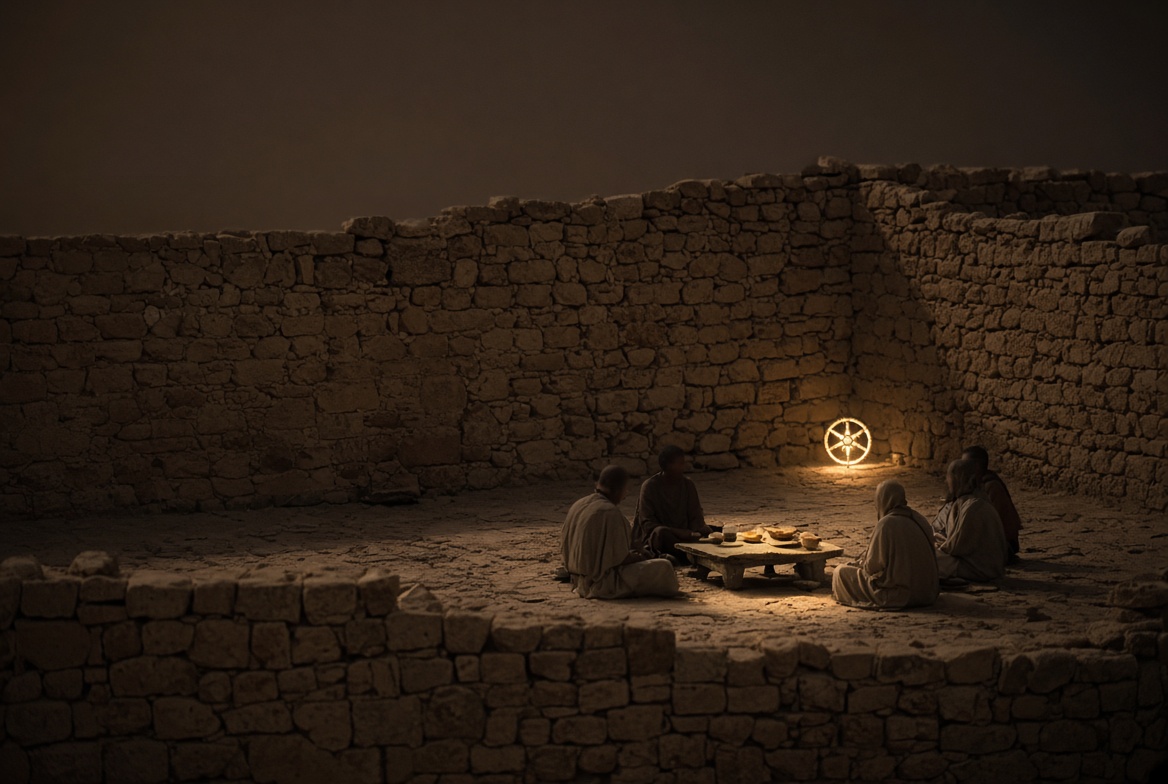
Reclining at table
At banquets men lay on couches, propped on the left elbow, and where you lay showed your rank.
At the formal dinner, the place cards told you exactly where you stood. At a feast, Jesus and his guests did not sit upright on chairs. They lay on couches around low tables. Where you lay, close to the host or near the door, showed how important you were.
Jewish people could sit for other meals, but at banquets men reclined, as Greeks did (Keener). They propped themselves on the left elbow and kept the right hand free to reach the food. The ESV Study Bible describes the formal layout. Couches stood around three sides of the room, with the host in the center and the most honored guests on either side of him. Each guest's feet pointed to the wall and his head to the tables. Reclining with someone signaled acceptance. Across the Mediterranean world guests at banquets were usually placed by social rank. At Herod's fortress of Machaerus archaeologists found two banquet halls, and as at Greek banquets men and women dined apart. At Passover, Wright says, people reclined because "free people didn’t just sit, they reclined." Dinners at patrons' homes and probably at social clubs ran far into the night with heavy drinking. Hosts poured libations to the gods at the start. The cultural backgrounds article on the triclinium describes the Roman dining room. Couches stood on three sides of a low table, three to a couch at a dinner party of nine. Each diner lay on his left side with his head near the table, so the head of one lay near the chest of the next. Pliny speaks of lying in another's bosom, and Livy says the lesser guest's head lay near the greater's torso. Many Jews had adopted the style by New Testament times.
An analogy: a head table at a formal banquet, with seats assigned by rank. Everyone knows who is at the center, who is beside him, and who got the seat by the kitchen.
Reclining marks a meal as a feast, so where people lie and who lies beside whom says something about rank and acceptance, as in Mark 2:15. The same posture pictures the coming banquet, where many recline with Abraham in Matthew 8:11. In Luke 14:7-11 guests reach for the places of honor.
Not chairs in a row facing the room. Guests lay on couches on their left sides, so one diner's head rested near the next one's chest, and closeness at table was literal. Lying down was not lazy, as it sounds to us; it was the formal posture of a feast, and ordinary meals could be eaten sitting.
- {"u":"https:\/\/jayms.com\/bible-study-tools-2\/ancient-world-passages\/matthew-14-1-12\/","n":"Matthew 14:1-12, John beheaded at a birthday feast","s":"Herod the tetrarch hears about Jesus and thinks John has risen. Matthew tells how Herod, bound by an oath at his birthday, had John beheaded.","r":"Matthew 14:1-12"}
- {"u":"https:\/\/jayms.com\/bible-study-tools-2\/ancient-world-passages\/matthew-26-17-30\/","n":"Matthew 26:17-30, The Passover and the cup","s":"Jesus eats the Passover with the Twelve in the city, names the one who dips with him as his betrayer, gives the bread and the cup new meaning, and vows not to drink wine again until the kingdom.","r":"Matthew 26:17-30"}
- {"u":"https:\/\/jayms.com\/bible-study-tools-2\/ancient-world-passages\/mark-2-13-22\/","n":"Mark 2:13-22, Levi and the party","s":"Jesus calls a tax collector from his booth and eats with tax collectors and sinners. He is questioned about eating with them and about not fasting.","r":"Mark 2:13-22"}
- {"u":"https:\/\/jayms.com\/bible-study-tools-2\/ancient-world-passages\/mark-6-14-29\/","n":"Mark 6:14-29, Herod's banquet and John's death","s":"Herod hears of Jesus and thinks John has risen. Mark then tells how Herod, at his birthday banquet, had John beheaded.","r":"Mark 6:14-29"}
- {"u":"https:\/\/jayms.com\/bible-study-tools-2\/ancient-world-passages\/mark-14-1-11\/","n":"Mark 14:1-11, Perfume at Bethany","s":"Two days before Passover, at dinner in Bethany, a woman pours costly perfume on Jesus' head. He says she has anointed him for burial, and Judas goes to the chief priests.","r":"Mark 14:1-11"}
- {"u":"https:\/\/jayms.com\/bible-study-tools-2\/ancient-world-passages\/mark-14-12-31\/","n":"Mark 14:12-31, The Passover meal","s":"Jesus eats the Passover with the Twelve, names a betrayer at the table, gives the bread and the cup new meaning, and warns that all will scatter.","r":"Mark 14:12-31"}
- {"u":"https:\/\/jayms.com\/bible-study-tools-2\/ancient-world-passages\/luke-7-36-50\/","n":"Luke 7:36-50, A sinful woman at Simon's table","s":"At a Pharisee's banquet a woman known as a sinner weeps over Jesus' feet, wipes them with her hair and anoints them. Jesus answers his host's silent objection with a story of two debtors.","r":"Luke 7:36-50"}
- {"u":"https:\/\/jayms.com\/bible-study-tools-2\/ancient-world-passages\/luke-14-1-14\/","n":"Luke 14:1-14, Dropsy at a Pharisee's table, and guests who cannot repay","s":"On a Sabbath at the house of a leading Pharisee, Jesus heals a man with dropsy, tells the guests not to grab the best places, and tells the host to invite people who cannot invite him back.","r":"Luke 14:1-14"}
- {"u":"https:\/\/jayms.com\/bible-study-tools-2\/ancient-world-passages\/luke-16-19-31\/","n":"Luke 16:19-31, The rich man and Lazarus","s":"A rich man feasts every day while a beggar named Lazarus lies at his gate. Both die; Lazarus is carried to Abraham's side, and the rich man finds himself in torment in Hades.","r":"Luke 16:19-31"}
- {"u":"https:\/\/jayms.com\/bible-study-tools-2\/ancient-world-passages\/john-12-1-11\/","n":"John 12:1-11, Mary's nard and loosened hair","s":"Six days before Passover, at a dinner in Jesus' honor in Bethany, Mary pours a pound of costly nard on his feet and wipes them with her hair. Judas objects, and Jesus says she has kept it for the day of his burial.","r":"John 12:1-11"}
- {"u":"https:\/\/jayms.com\/bible-study-tools-2\/ancient-world-passages\/john-13-1-30\/","n":"John 13:1-30, Washing the disciples' feet, and the morsel for Judas","s":"At supper before Passover Jesus takes off his outer clothes, ties a towel around himself and washes his disciples' feet. Then he hands Judas the dipped morsel, and Judas goes out into the night.","r":"John 13:1-30"}
- {"u":"https:\/\/jayms.com\/bible-study-tools-2\/ancient-world-passages\/1corinthians-8-1-13\/","n":"1 Corinthians 8:1-13, Knowledge, idols and the weak","s":"Answering those who know that an idol is nothing, Paul agrees there is one God and one Lord but warns that their freedom to eat sacrificial food, even in an idol's temple, can destroy a weaker believer.","r":"1 Corinthians 8:1-13"}
- {"u":"https:\/\/jayms.com\/bible-study-tools-2\/ancient-world-passages\/1corinthians-11-17-34\/","n":"1 Corinthians 11:17-34, The Lord's Supper in a rich man's house","s":"Paul rebukes the church because at the Lord's Supper some go hungry while others eat their fill and get drunk, retells the tradition of the Last Supper, and tells them to wait for one another.","r":"1 Corinthians 11:17-34"}
- {"u":"https:\/\/jayms.com\/bible-study-tools-2\/ancient-world-passages\/1peter-4-1-11\/","n":"1 Peter 4:1-11, The neighbors' parties and their abuse","s":"Armed with Christ's attitude, the readers have done with the life of the Gentiles, its debauchery, drinking parties and idolatry, and their old companions are surprised and heap abuse on them; they will give account to God. The end of all things is near, so they must be sober, love one another, be hospitable without grumbling, and use their gifts as stewards of God's grace.","r":"1 Peter 4:1-11"}
- NIV Cultural Backgrounds Study Bible, notes on Mark 6:22, 6:24, 14:3 and 14:18, and note on Matthew 23:6
- ESV Study Bible, study note on Mark 2:15-16
- N. T. Wright, Mark for Everyone, comment on Mark 14:12-25
- Craig S. Keener, The IVP Bible Background Commentary: New Testament, on Matthew 8:11
- Craig S. Keener, The IVP Bible Background Commentary: New Testament, on 1 Peter 4:3
- NIV Cultural Backgrounds Study Bible, note on 1 Peter 4:3
- NIV Cultural Backgrounds Study Bible, article Triclinium









