Tool Beta
The Ancient World Behind the Text: Ideas
The customs, offices and ideas a first reader knew without being told, what each meant then, and the nearest thing you already know.
The household and its head
A household gathered family, slaves, freed slaves and workers under one head, and it was expected to follow that head's religion. When the head turned to a new god, the house often came too.
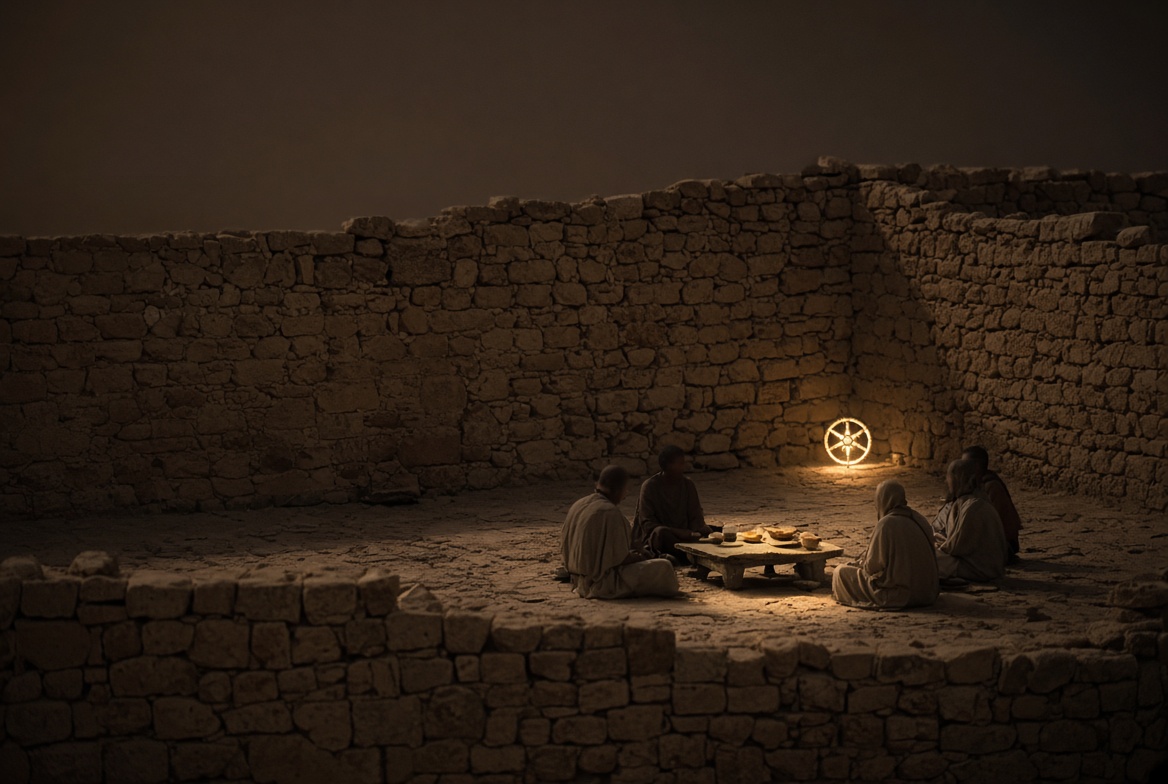
When the owner of the farm decided the family would join a different church, the farmhands and their children came along too. An ancient household was bigger than a family. Under one head it could take in a wife, children, slaves, freed slaves and workers. The head was expected to lead them in religion, and most of the time they followed his choice of gods. Homes had shrines to household spirits. So when the head of a house came to faith, it was natural for the whole household to hear the message and be baptized.
Ancient households usually followed the religion of their head. They did not always, but it was the norm, and a husband was often embarrassed when his wife or children did not. Romans expected the head to lead his household in worshiping Rome's gods, and wives were expected to take their husband's religion (Keener). A household could include servants, freed persons or workers. Lydia apparently headed her own, which could mean she was widowed, divorced or a prosperous freedwoman. Keener thinks her household was mainly servants, or that she had a husband who left her religion alone. The CSB Study Bible observes that household baptisms recur in Acts without saying who was included. Wright and Bird describe the lares, household spirits honored at a home shrine called a lararium. Wright pictures Ephesian families setting a silver Artemis in a little shrine of its own. Homes also hosted gatherings. Churches met in houses for their first three centuries, and synagogues sometimes began in homes. A host answered for his guests as if they were his own household, as Jason did at Thessalonica. House meant both household and building, and the word Paul uses for administration was used for running a household. Stewards, often slaves or freedmen, ran wealthy homes and carried great responsibility and prestige. Writers sometimes derived a father's authority from God's. The Roman father held authority over all his descendants as long as he lived. A newborn became a legal person only when the father recognized it. The ESV Study Bible notes that slaves were counted part of the family.
An analogy: a family firm in a small town, where the owner's choice of bank, pew and holiday table is taken to bind relatives and staff alike. A worker who chooses differently stands out.
Because a household followed its head, Lydia's conversion in Acts 16:15 brings her house with her, and Paul recalls baptizing the household of Stephanas in 1 Corinthians 1:16. Ephesians 2:19 calls Gentile believers members of God's household, the same word that then turns into God's temple.
Not an employer the staff can leave. A worker who disagrees with the boss can quit. In an ancient household slaves were property, and a Roman father held legal authority over his descendants for life, so the head's religion carried a weight no modern owner's has.
Whether household baptisms included children. The ESV Study Bible says Christians disagree over whether infants were included; Keener notes that if the Philippian jailer was a retired soldier he might have had young children, but says this cannot prove infant baptism; the CSB Study Bible reasons from Lydia's case that those baptized were old enough to respond for themselves.
- {"u":"https:\/\/jayms.com\/bible-study-tools-2\/ancient-world-passages\/acts-16-11-15\/","n":"Acts 16:11-15, Lydia at the place of prayer","s":"In Philippi, a Roman colony, Paul finds women gathered by the river on the Sabbath. Lydia, a dealer in purple cloth from Thyatira, believes, is baptized with her household and insists that the missionaries stay at her house.","r":"Acts 16:11-15"}
- {"u":"https:\/\/jayms.com\/bible-study-tools-2\/ancient-world-passages\/acts-16-25-40\/","n":"Acts 16:25-40, The jailer and the Roman citizens","s":"At midnight an earthquake opens the prison. The jailer, about to kill himself, believes with his household; next day Paul reveals that he and Silas are Roman citizens beaten without trial, and the magistrates come to apologize.","r":"Acts 16:25-40"}
- {"u":"https:\/\/jayms.com\/bible-study-tools-2\/ancient-world-passages\/2corinthians-12-11-18\/","n":"2 Corinthians 12:11-18, Not a burden: parents save for their children","s":"Paul says the Corinthians forced him to play the fool; the signs of an apostle were done among them, and his only fault was not to burden them, since parents save up for their children, not children for their parents.","r":"2 Corinthians 12:11-18"}
- {"u":"https:\/\/jayms.com\/bible-study-tools-2\/ancient-world-passages\/ephesians-3-1-13\/","n":"Ephesians 3:1-13, The prisoner, the steward and the mystery shown to the powers","s":"Paul, a prisoner for the sake of the Gentiles, breaks off to explain the stewardship of grace given him: the mystery, now revealed, that Gentiles are co-heirs, made known through the church even to the rulers in the heavenly realms.","r":"Ephesians 3:1-13"}
- {"u":"https:\/\/jayms.com\/bible-study-tools-2\/ancient-world-passages\/ephesians-3-14-21\/","n":"Ephesians 3:14-21, Kneeling before the Father of every family","s":"Paul kneels in prayer before the Father of every family, heavenly and earthly, and asks that they be strengthened by the Spirit and grasp the vast dimensions of Christ's love, closing with praise.","r":"Ephesians 3:14-21"}
- {"u":"https:\/\/jayms.com\/bible-study-tools-2\/ancient-world-passages\/ephesians-5-21-33\/","n":"Ephesians 5:21-33, Wives and husbands in the household code","s":"Paul opens the household code with submitting to one another, asks wives to submit to their husbands as to the Lord, and asks husbands to love their wives as Christ loved the church, washing her and presenting her radiant.","r":"Ephesians 5:21-33"}
- {"u":"https:\/\/jayms.com\/bible-study-tools-2\/ancient-world-passages\/ephesians-6-1-9\/","n":"Ephesians 6:1-9, Children, fathers, slaves and masters","s":"The household code goes on to children and fathers, then to slaves and masters, asking something of each side and reminding masters that they and their slaves have the same Master in heaven.","r":"Ephesians 6:1-9"}
- {"u":"https:\/\/jayms.com\/bible-study-tools-2\/ancient-world-passages\/1timothy-3-1-13\/","n":"1 Timothy 3:1-13, Overseers, deacons and the women","s":"Paul lists what is required of an overseer, above reproach, faithful in marriage, hospitable, able to teach, managing his household well, and then of deacons and of the women, who must also be worthy of respect.","r":"1 Timothy 3:1-13"}
- {"u":"https:\/\/jayms.com\/bible-study-tools-2\/ancient-world-passages\/1timothy-3-14-16\/","n":"1 Timothy 3:14-16, God's household and the hymn","s":"Paul writes so that, if he is delayed, Timothy will know how people ought to behave in God's household, the church of the living God, and quotes what seems to be a hymn about Christ.","r":"1 Timothy 3:14-16"}
- {"u":"https:\/\/jayms.com\/bible-study-tools-2\/ancient-world-passages\/titus-1-1-9\/","n":"Titus 1:1-9, Elders in every town, and God's steward","s":"Paul greets Titus, whom he left in Crete to put in order what was unfinished and to appoint elders in every town, and lists what an elder must be: blameless, faithful to his wife, with believing children, a steward of God's household, hospitable and able to hold to sound teaching.","r":"Titus 1:1-9"}
- {"u":"https:\/\/jayms.com\/bible-study-tools-2\/ancient-world-passages\/titus-2-1-10\/","n":"Titus 2:1-10, Older men, older women, young wives and slaves","s":"Titus is to teach what fits sound doctrine to each group in the household of faith, older men, older women, younger women, younger men and slaves, so that outsiders have no cause to speak against God's message and the teaching about God is made attractive.","r":"Titus 2:1-10"}
- {"u":"https:\/\/jayms.com\/bible-study-tools-2\/ancient-world-passages\/hebrews-3-1-4-13\/","n":"Hebrews 3:1-4:13, Moses the servant, and the rest still open","s":"Moses was faithful in God's house as a servant; Jesus is faithful over it as the Son. Psalm 95's warning not to harden hearts as in the wilderness still speaks today, because the rest God promised was never reached under Joshua and remains open for God's people.","r":"Hebrews 3:1-4:13"}
- {"u":"https:\/\/jayms.com\/bible-study-tools-2\/ancient-world-passages\/1peter-3-1-7\/","n":"1 Peter 3:1-7, A wife who does not share her husband's gods","s":"Wives are to submit to their husbands so that husbands who do not believe may be won without a word, by their conduct. Their beauty should be a gentle and quiet spirit rather than braided hair and gold, like Sarah, who obeyed Abraham and called him lord. Husbands must be considerate and honor their wives as co-heirs of the gracious gift of life.","r":"1 Peter 3:1-7"}
- NIV Cultural Backgrounds Study Bible, notes on Acts 16:15, 16:31 and 18:7, and on 1 Corinthians 1:16
- Craig S. Keener, The IVP Bible Background Commentary: New Testament, on Acts 16:1-5, 16:15, 16:31-32, 16:33-34, 17:9 and 18:6-7
- ESV Study Bible, study notes on Acts 16:15 and 16:33
- CSB Study Bible, note on Acts 16:15
- N. T. Wright and Michael F. Bird, The New Testament in Its World, ch. 7, The Greco-Roman Context of the Early Church
- N. T. Wright, Paul: A Biography, ch. 10, Ephesus I
- Craig S. Keener, The IVP Bible Background Commentary: New Testament, on Ephesians 3:1-2, 3:15 and introduction to 6:1-4
- NIV Cultural Backgrounds Study Bible, notes on Ephesians 2:19 and 3:2
- ESV Study Bible, study note on Ephesians 6:5









