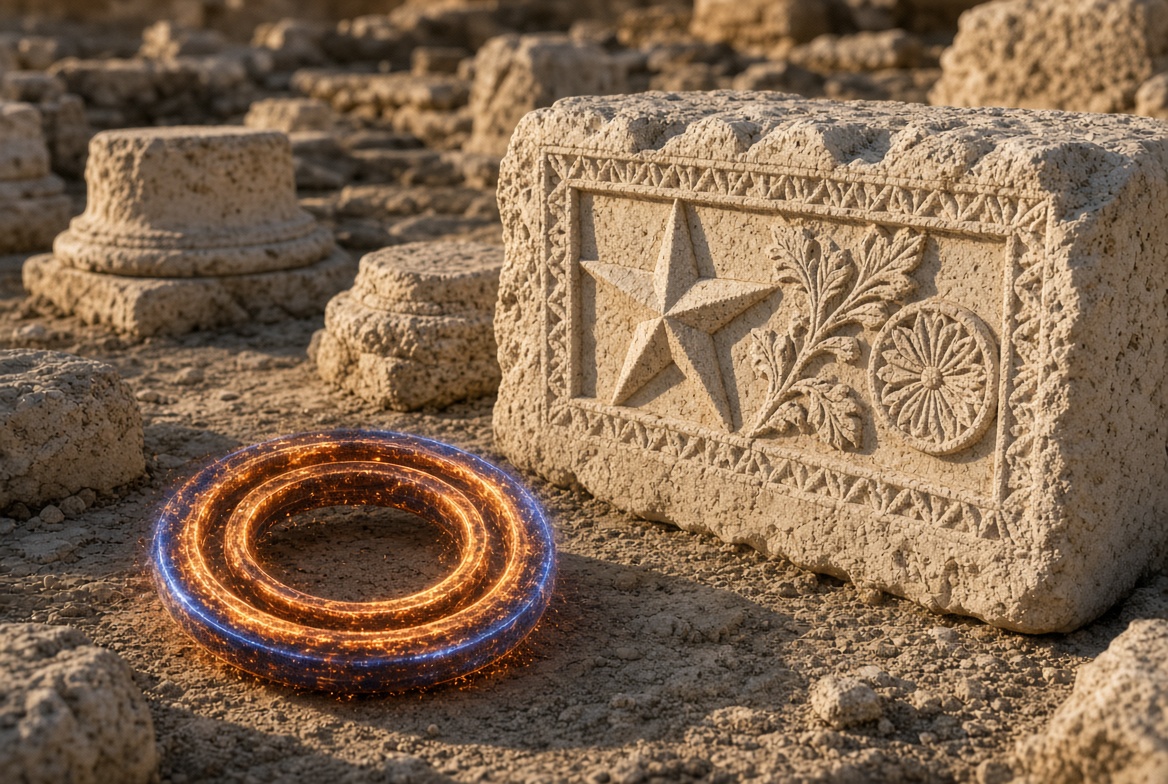

In the synagogue at Capernaum, the town Jesus made his base in Galilee, the stone frieze carries a pentagram, a six-pointed star, and a swastika, carved side by side as decoration and dated by the Encyclopaedia Judaica to the second or third century.[1] To that congregation they were ornament, and possibly protection; Avraham Negev reads the two stars on the frieze as apotropaic, the pentagram called the Seal of Solomon and the hexagram the Shield of David.[2] Today one of those reads as Satanism, one as the flag of Israel, and one as the Third Reich.

That frieze is the whole point of this follow-up to Guess My Names. The devil got a name that was never his and a costume that came from the opera house. His symbols went the same way: most of what now reads as satanic spent centuries meaning something else, and some of what we hang in our houses without a thought is exactly what Israel’s prophets were tearing down.
What Did the Pentagram Originally Mean?
The five-pointed star drawn in one continuous line is very old and was mostly a good sign. Lucian, writing in the second century, says the followers of Pythagoras opened their letters with a wish for health and used the interlaced triple triangle, the pentagram, as a password they called by that name: Health.[3]
It shows up in Jerusalem too. In the Hellenistic period, into the second century BCE, storage jars handled by the Judean administration were stamped with a pentagram and the letters of the city’s name, yršlm, one letter between each point.[4] What the star meant on that stamp is still debated, but it sat beside the city’s name on the city’s jars.[4]
Then Solomon. The Testament of Solomon, a Greek work from the early Christian centuries, tells how Solomon prayed for help against a demon troubling the temple workers, and the archangel Michael brought him a ring with an engraved stone. The engraving, Michael tells him, is a pentalpha, a five-pointed star, and with it Solomon binds the demons and puts them to work building the temple.[5] The Talmud tells a darker version. The demon king Ashmedai talks Solomon into taking off his chains and lending him the ring, then flings the king four hundred parasangs away and takes his place (b. Gittin 68a–b).[6] The Jewish Encyclopedia records that Arab tradition gave the name Solomon’s seal to the six-pointed star, while Western legend gave it to the pentacle, the pentangle of Solomon, believed to drive demons away.[6] The Encyclopaedia Judaica notes that in later Jewish magic the “seal of Solomon” could mean either the five-pointed or the six-pointed star, and the two were used almost interchangeably on amulets.[1] So the star of Solomon was a star for driving demons out, not calling them in.
Christians kept it on the same side. In the fourteenth-century English poem Sir Gawain and the Green Knight, Gawain rides out with a gold pentangle on a red shield. The poet says Solomon devised the figure as a sign of truth, and spends two full stanzas explaining it: five points, each standing for a set of five, including the five wounds of Christ and the five joys of Mary, joined in one line with no beginning and no end.[7] On a Christian knight’s shield the pentagram was a confession of faith.

When Did the Pentagram Become a Satanic Symbol?
The flip is recent, and it was done by occultists rather than by the church.
The French occultist Éliphas Lévi, in his Dogme et rituel de la haute magie (1854–56), taught that the direction matters: one point up is the figure of a man, spirit ruling the elements; two points up is the horned goat, the sign of evil.[8] Lévi also gave us the drawing everyone now calls Baphomet, a winged goat-headed figure he labeled the Sabbatic Goat, as the book’s frontispiece.[9] The name itself is older and has nothing to do with goats. Baphomet appears in a crusader’s letter in 1098 as a garbled form of Mahomet, Muhammad, and in 1307 it was one of the charges Philip IV’s prosecutors brought against the Knights Templar, that they worshiped a bearded head by that name.[9] Lévi took an accusation from a show trial, put a goat’s head on it, and published it.
In 1897 Stanislas de Guaita printed the image that finished the job: a goat’s head drawn inside an inverted pentagram, ringed with Hebrew letters. The Church of Satan adopted a version of it in the late 1960s, put it on the cover of The Satanic Bible, and it has been the default Satanist sign ever since.[10]
So the pentagram as the devil’s sign is roughly 150 years old. Its career as Solomon’s seal, a Pythagorean greeting, Jerusalem’s stamp, and a knight’s confession of Christ’s wounds runs well over two thousand.
Are the Upside-Down Cross, 666, and Horns Satanic?
Where Does the Upside-Down Cross Come From?
The inverted cross shows up on heavy metal album covers as the anti-Christian symbol. Its origin is a Christian martyr. The earliest source is the apocryphal Acts of Peter, from the second century, where Peter asks to be crucified head downward and explains the request with strange symbolism about Adam and birth. Most scholars treat Peter’s crucifixion in Rome as secure and the upside-down detail as less certain.[11] Origen repeats it, and Eusebius preserves Origen’s account.[12] By Jerome’s time the reason had settled into humility: Peter asked for it, “asserting that he was unworthy to be crucified in the same manner as his Lord.”[13] I covered what we know and do not know about Peter’s death in Who Was the Apostle Peter?
What Does 666 Mean in Revelation 13:18?
The number in Revelation 13:18 is real, but it is a puzzle John expects his readers to solve, not a curse that leaks out of license plates. Some early manuscripts read 616 instead, and the oldest copy we have of that verse, a papyrus from Oxyrhynchus from around the late third century, has 616. Peter Williams notes that both numbers can be reached from the name Nero Caesar written in Hebrew letters, one spelling with a final n and one without, though 616 can be reached other ways as well.[14] R. H. Charles, writing in 1920, read 666 as Nero Caesar and called 616 poorly attested.[15] That was long before P115 came to light, and it is now the oldest witness we have.
What Do Horns Mean in the Bible?
Horns are the devil’s trademark now, and in the Bible they mean strength, mostly God’s. The altar had horns on its four corners (Exodus 27:2), a man fleeing for his life grabbed them (1 Kings 1:50), Hannah sings that her horn is exalted in the LORD (1 Samuel 2:1), and David calls God the horn of his salvation (Psalm 18:2). Moses even got horns by accident. When he came down from Sinai his face was shining, Hebrew qāran, a verb from the same root as qeren, horn. The Septuagint, the Syriac, and the Targum all took it as shining. Jerome’s Vulgate rendered it cornuta, horned, and the standard Hebrew lexicon notes the possible background in Mesopotamian horned caps, where the horns looked like rays of divine light.[16] After Jerome, artists put horns on Moses for a thousand years, which is why Michelangelo’s statue of him has them.[17] The first post covered how the devil got his horns; it was not from Scripture.
Is the Goat a Symbol of Satan in the Bible?
The goat-demons, śĕʿîrîm, are real in the Old Testament (Leviticus 17:7), and the goat sent away “for Azazel” on the Day of Atonement carries Israel’s sin into the wilderness (Leviticus 16:8–10). But the goat is also a clean animal and a standard sacrifice; the other goat on the Day of Atonement is the sin offering (Leviticus 16:9). The image of the devil as a goat came through medieval art and Pan, not through the sacrificial system.
Which Symbols Did the Bible Condemn as Idolatry?
Run the question the other way. Which symbols would an Israelite prophet have read as belonging to other gods, and which of them sit comfortably in our lives now?
What Was Nehushtan, the Bronze Serpent?
God commanded Moses to make a bronze serpent on a pole so the bitten Israelites could look at it and live (Numbers 21:8–9). Jesus uses it as a picture of his own lifting up (John 3:14). Centuries later, Hezekiah broke it to pieces, because the people had been burning incense to it and had given it a name, Nehushtan (2 Kings 18:4), a name that plays on nəḥōšet, bronze, and nāḥāš, serpent, the same word as the serpent in Eden. Ronald Hendel notes how sharp the turn is: an image God commanded in Numbers is destroyed as idolatry in Kings, along with the high places and the sacred poles.[18] The same object was a means of grace in one generation and an idol in another. Nothing about the bronze changed. The incense did.
What Did the Golden Calf Represent?
The golden calf at Sinai, and the two calves Jeroboam set up at Bethel and Dan (1 Kings 12:28–29), were bull images, the standard animal of power and fertility for the storm gods of the region. The wilderness story is in What Happened in the Wilderness Wanderings? and the Baal side in Lesser Gods of the Old Testament. A prophet at Bethel would have known exactly what a bronze bull in a public square meant.
Are Crescent Moons and Stars Pagan Symbols in the Bible?
When Gideon killed the Midianite kings he took the crescent ornaments off their camels’ necks (Judges 8:21, 26), and Isaiah lists crescents among the jewelry the women of Jerusalem would lose in judgment (Isaiah 3:18). John Walton links the Midianite crescents to the moon god worshiped in Old South Arabia as Shahr.[19] Amos charges Israel with carrying “the star of your god” in the wilderness (Amos 5:26). Kiyyun there is probably an Assyrian star god tied to Saturn, and when Stephen quotes the verse in Acts 7:43 he follows the Greek version, which reads Moloch and Rompha, another Saturn deity, and moves the exile from beyond Damascus to beyond Babylon.[20] Jeremiah condemns families baking cakes for the Queen of Heaven (Jeremiah 7:18), most often identified with Astarte or Ishtar and the planet Venus; the cakes may have carried her image or been shaped as a crescent or a star.[21] Cornelis Houtman cautions that the title may name a mother goddess whose face changed with time and place.[21] Ishtar’s star was the morning star, the same planet Latin called Lucifer.
Was the Winged Sun Disk a Pagan Symbol?

Josiah removed the horses that the kings of Judah had dedicated to the sun and burned the chariots of the sun (2 Kings 23:11). And yet Judah’s own royal seals carried a winged sun disk and winged scarabs, Egyptian solar symbols the kings of Judah adopted as royal emblems; Meir Lubetski argues Hezekiah’s seal used them on purpose.[22] Malachi promises that the sun of righteousness will rise with healing in its wings (Malachi 4:2), and John Walton traces that picture to the same winged sun disk on Judah’s seals, eagle or falcon wings spread against a full sun, a sign of divine protection over whoever stood under the wings.[23] The image was not forbidden. Worshiping the sun was.
Does Jeremiah 10 Forbid Christmas Trees?
Jeremiah 10:3–4 gets passed around every December as a ban on Christmas trees: a tree cut from the forest, decorated with silver and gold, fastened with hammer and nails so it will not move. Read through to verse 5 and the thing being described cannot speak and has to be carried. Jeremiah is describing a carved idol, a tree turned into a god-statue by a craftsman; a few verses on he says the images are overlaid with silver and gold and dressed in blue and purple, and worshipers believed the god was present in the image.[24] Whatever you think about Christmas trees, this passage is not about them.
What Makes a Symbol Satanic?
Paul gives both halves of the answer. An idol is nothing, and food offered to it is just food (1 Corinthians 8:4–8). But what pagans sacrifice they offer to demons, and Paul does not want the church sharing that table (1 Corinthians 10:19–21). The two chapters are not in tension. In chapter 8 Paul is talking about meat that had been sacrificed and then sold, eaten outside the rites; in chapter 10 he is talking about sitting down at the sacrificial meal itself, where real spiritual powers were present.[25] The shape is nothing. The worship is not.
That is what the bronze serpent shows, and it cuts both ways. A five-pointed star on Gawain’s shield confessed Christ’s wounds; the same star inverted with a goat’s head inside it was drawn on purpose to say the opposite, and the people who use it now mean it that way. Fear of shapes misses what the prophets were actually angry about. Indifference to what a symbol is being used for misses it too.
Where the evidence stops: the pentagram’s earliest meanings before the Greeks are guessed at more than known, and claims that it began as a Sumerian or Babylonian sign for something specific circulate widely without solid sourcing, so I have left them out.
New field notes when they are ready, along with the research underneath them. No drip sequence, no course, nothing to buy.
Footnotes25
- "Magen David," Encyclopaedia Judaica.
- Negev, Archaeological Encyclopedia of the Holy Land; Loffreda and Tzaferis, "Capernaum," 1:294.
- Lucian, A Slip of the Tongue in Greeting; Thomas, Selections Illustrating the History of Greek Mathematics, 225.
- Bocher and Lipschits, "The yršlm Stamp Impressions on Jar Handles," 99–116; Mazar et al., "Jerusalem," 2:729.
- Testament of Solomon, trans. Conybeare, the account of Michael's ring; Klutz, "Solomon, Testament Of," 5:330.
- Jewish Encyclopedia, 2:218; 11:448.
- Sir Gawain and the Green Knight, fitt 2.
- Lévi, Dogme et rituel de la haute magie.
- Bauer, "Baphomet," Encyclopaedia Britannica.
- "Sigil of Baphomet," ReligionFacts.
- Powell, "Peter," HarperCollins Bible Dictionary, 784.
- Eusebius, Church History 3.1.
- Jerome, Lives of Illustrious Men 1.
- Williams, "P115 and the Number of the Beast."
- Charles, A Critical and Exegetical Commentary on the Revelation of St. John, 1:334, 338–339, 350.
- Koehler and Baumgartner, The Hebrew and Aramaic Lexicon of the Old Testament, 1144.
- Esparza, "The Reason Why Michelangelo's Moses Has Horns."
- Hendel, "Nehushtan," Dictionary of Deities and Demons in the Bible, 615–616.
- Walton, Zondervan Illustrated Bible Backgrounds Commentary: Joshua, Judges, Ruth, 1 & 2 Samuel, 165.
- Vlach, The Old in the New, 129–131.
- Harrison, "Queen of Heaven," International Standard Bible Encyclopedia, 4:8; Houtman, "Queen of Heaven," Dictionary of Deities and Demons in the Bible, 679.
- Lubetski, "King Hezekiah's Seal Revisited."
- Walton, Zondervan Illustrated Bible Backgrounds Commentary: The Minor Prophets, Job, Psalms, Proverbs, Ecclesiastes, Song of Songs, 241.
- Walton, Zondervan Illustrated Bible Backgrounds Commentary: Isaiah, Jeremiah, Lamentations, Ezekiel, Daniel, 260.
- Pitre, Barber, and Kincaid, Paul, a New Covenant Jew, 227–228; Hurtado, Destroyer of the Gods, 52.
Sources
"Magen David," Encyclopaedia Judaica (2nd ed., 2007), via Jewish Virtual Library. Supports: the Capernaum frieze (pentagram, hexagram, swastika), "seal of Solomon" applied to both stars, their interchangeable use in Jewish magic. Free online.
Lucian, A Slip of the Tongue in Greeting (Pro lapsu inter salutandum), trans. H. W. and F. G. Fowler, via Perseids. Supports: the Pythagorean pentagram called Health. Free online.
Ivor Thomas, trans., Selections Illustrating the History of Greek Mathematics: From Thales to Euclid, Loeb Classical Library (Cambridge, MA: Harvard University Press, 1957), 225. Supports: the Pythagorean password Health. In my Logos library.
Avraham Negev, ed., The Archaeological Encyclopedia of the Holy Land (New York: Prentice Hall, 1990), on Capernaum; Stanislao Loffreda and Vassilios Tzaferis, "Capernaum," in The New Encyclopedia of Archaeological Excavations in the Holy Land, ed. Ephraim Stern (Jerusalem: Israel Exploration Society, 1993), 1:294. Support: the frieze's pentagrams and hexagrams and their reading as protective signs. In my Logos library.
Benjamin Mazar et al., "Jerusalem," in The New Encyclopedia of Archaeological Excavations in the Holy Land, 2:729. Supports: the yršlm pentagram jar handles. In my Logos library.
Efrat Bocher and Oded Lipschits, "The yršlm Stamp Impressions on Jar Handles: Distribution, Chronology, Iconography and Function," Tel Aviv 40, no. 1 (2013): 99–116. Supports: the Jerusalem pentagram stamps and their dating. Abstract free; article via Taylor & Francis.
The Testament of Solomon, trans. F. C. Conybeare, Jewish Quarterly Review 11 (1898), PDF via Tony Burke. Supports: Michael's ring engraved with a pentalpha. Free online. The Greek text is in my Logos library.
Todd E. Klutz, "Solomon, Testament Of," in The New Interpreter's Dictionary of the Bible (Nashville: Abingdon, 2006–2009), 5:330. Supports: Michael's ring and Solomon's use of it against demons. In my Logos library.
Isidore Singer, ed., The Jewish Encyclopedia (New York: Funk & Wagnalls, 1901–1906), 2:218; 11:448. Supports: Ashmedai and the ring in b. Gittin 68, and Solomon's seal as the hexagram in Arab tradition and the pentangle in Western legend. In my Logos library.
Sir Gawain and the Green Knight, fitt 2, the arming of Gawain; summarized at LitCharts. Supports: the pentangle as Solomon's sign and the five fives including Christ's wounds.
Éliphas Lévi, Dogme et rituel de la haute magie (Paris, 1854–56); English trans. A. E. Waite, Transcendental Magic (1896). Supports: upright versus inverted pentagram. No verified link.
Patricia Bauer, "Baphomet," Encyclopaedia Britannica. Supports: the 1098 letter, the 1307 Templar charges, and Lévi's frontispiece. Free online.
"Sigil of Baphomet," ReligionFacts. Supports: de Guaita's 1897 image and the Church of Satan's adoption. Free online.
Mark Allan Powell, "Peter," in The HarperCollins Bible Dictionary, rev. ed. (New York: HarperCollins, 2011), 784. Supports: the upside-down crucifixion originating in the Acts of Peter, and its uncertainty. In my Logos library.
Jerome, Lives of Illustrious Men 1, via New Advent. Supports: Peter's request as humility. Free online.
Eusebius, Church History 3.1, via New Advent. Supports: Peter crucified head downward at his own request, citing Origen. Free online.
P. J. Williams, "P115 and the Number of the Beast," Tyndale Bulletin 58, no. 1 (2007). Supports: P115 reading 616 and the Nero Caesar gematria. Free PDF.
Daniel Esparza, "The Reason Why Michelangelo's Moses Has Horns," Aleteia, August 23, 2021. Supports: qāran, qeren, and the Vulgate's cornuta. Free online.
R. S. Hendel, "Nehushtan," in Dictionary of Deities and Demons in the Bible, 2nd ed. (Leiden: Brill; Grand Rapids: Eerdmans, 1999), 615–616; C. Houtman, "Queen of Heaven," ibid., 679. Support: the bronze serpent's reversal; the shifting identity of the Queen of Heaven. In my Logos library.
John H. Walton, Zondervan Illustrated Bible Backgrounds Commentary: Joshua, Judges, Ruth, 1 & 2 Samuel (Grand Rapids: Zondervan, 2009), 165. Supports: the Midianite crescents and the moon god Shahr. In my Logos library.
Michael J. Vlach, The Old in the New (Sun Valley, CA: Master's Seminary Press, 2021), 129–131. Supports: Kiyyun, Rompha, and Stephen's use of Amos 5:26. In my Logos library.
R. K. Harrison, "Queen of Heaven," in The International Standard Bible Encyclopedia, rev. ed. (Grand Rapids: Eerdmans, 1979–1988), 4:8. Supports: Astarte, Ishtar, Venus, and the cakes. In my Logos library.
Brant Pitre, Michael P. Barber, and John A. Kincaid, Paul, a New Covenant Jew (Grand Rapids: Eerdmans, 2019), 227–228; Larry W. Hurtado, Destroyer of the Gods (Waco, TX: Baylor University Press, 2016), 52. Support: 1 Corinthians 8 and 10. In my Logos library.
Ludwig Koehler and Walter Baumgartner, The Hebrew and Aramaic Lexicon of the Old Testament (Leiden: Brill, 1994–2000), 1144. Supports: qāran as shining in the ancient versions, the Vulgate's horns, and the horned-cap background. In my Logos library.
John H. Walton, ed., Zondervan Illustrated Bible Backgrounds Commentary (Grand Rapids: Zondervan, 2009), 4:260 and 5:241. Supports: idol-making in Jeremiah 10, and the winged sun disk behind Malachi 4:2. In my Logos library.
R. H. Charles, A Critical and Exegetical Commentary on the Revelation of St. John, ICC (Edinburgh: T&T Clark, 1920), 1:334, 338–339, 350. Supports: 666 as Nero Caesar and 616 as poorly attested in the evidence known in 1920. In my Logos library.
Meir Lubetski, "King Hezekiah's Seal Revisited," Biblical Archaeology Review, July/August 2001. Supports: winged scarabs and the winged sun disk as Judean royal symbols. BAS Library (subscription).
Where the sourcing stops: Lévi's exact wording on the upright and inverted pentagram, the dates for de Guaita's image and the Church of Satan's adoption of it, and the line numbers in Gawain are taken from secondary sources and have not been checked against the primary texts. The earliest meanings of the pentagram before the Greeks are guessed at more than known, so they are left out.









