
Series: The Old Testament Story · Part 15 of 15
Everyone knows Dagon was a fish god.
Nobody can demonstrate it. The fish reading is one of three competing etymologies, none has won, and it may not be the best of them. It became the version we inherited because a horror writer picked the one that suited him and the picture stuck.
That is a small case study in how a real thing gets replaced by a memorable thing, which is most of why this post exists.
Who Was Dagon in the Bible?
Far more than a local Philistine idol.
He appears in Judg 16:23-24, where the Philistines gather in his temple to celebrate capturing Samson, and in 1 Sam 5, where they put the captured ark of the covenant in front of his statue.
Outside the Bible he is a heavyweight. His worship spans the ancient Near East from the Early Bronze Age through the Roman period. He was chief among the Amorite deities by the third millennium BC. And in Ugaritic mythology he is the father of Baal.
That last detail changes the scale of the 1 Samuel scene. This is not Yahweh knocking over a nobody. It is Yahweh dismantling the father of the storm god who was Israel’s chief spiritual rival for centuries.
Was Dagon a Fish God?

Unresolved, and the popular answer is the least supported of the three.
The fish reading connects the name to the Hebrew word dag, fish.
The grain reading connects it to dagan, grain, making him an agricultural deity and possibly the inventor of the plough. Given how consistently his worship attaches to agriculture across Mesopotamia, this may be the strongest of the three.
The third connects the name to a root meaning gloomy or cloudy, making him a storm god, which fits neatly with his being Baal’s father.
No consensus exists. The fish version is the vivid one, the memorable one, the one that produces an image, and that is exactly why it travels. It is not the one the evidence favours.

What Happened in Dagon’s Temple?
Two mornings, and an escalation.
The Philistines set the captured ark before Dagon as a war trophy. In the ancient world that was a ritual statement rather than storage: my god defeated your god, and here is the proof at his feet.
The first morning Dagon is face down before the ark. They stand him back up.
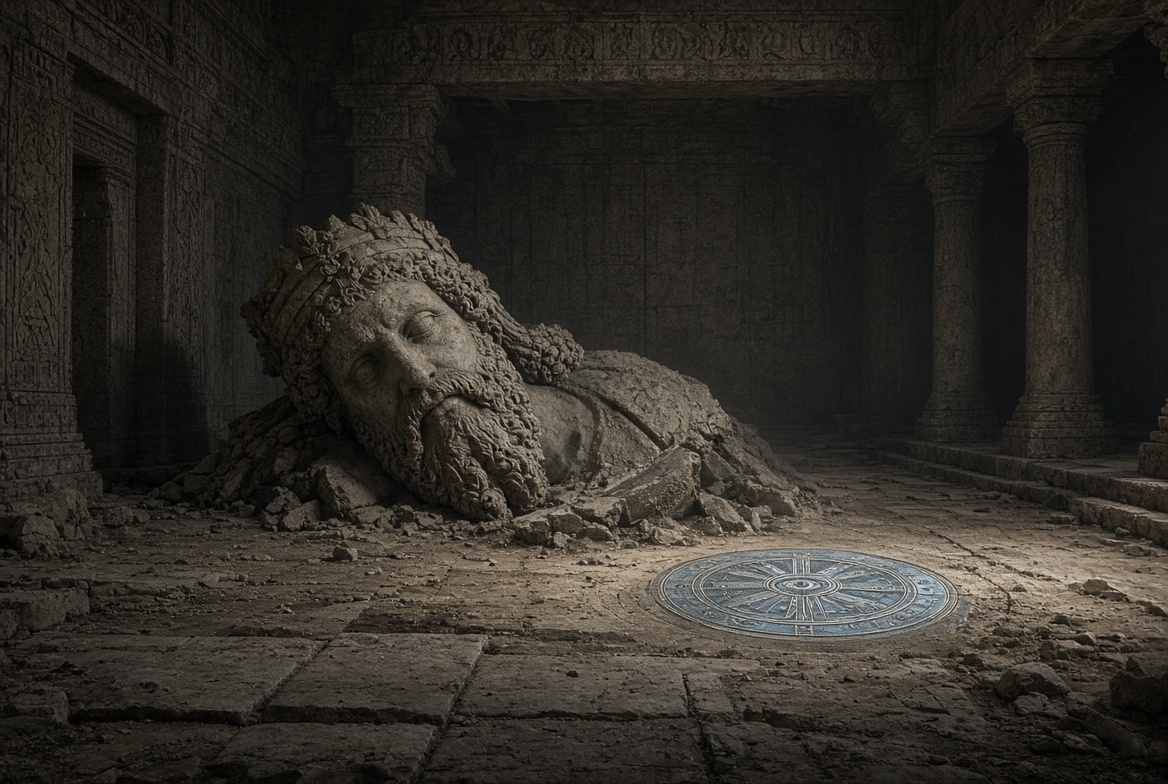
The second morning he is face down again, and this time his head and his hands are broken off on the threshold. Only the trunk remains.
That mutilation is not random damage. Severing head and hands was the standard ancient Near Eastern expression of total conquest, destroying an enemy’s capacity for future action and his wholeness in the afterlife at once. Judg 1:6-7 has Israelites doing precisely this to Adoni-bezek, who observes that he had done the same to seventy kings.
One scholar’s summary of the point is hard to improve on. You do not decapitate furniture.
Was Dagon a Real Power or a Dead Statue?
The text holds it ambiguous, and both readings assume he was real.
The Hebrew phrase for falling before something commonly indicates submission, which would make this Dagon bowing in worship. The same construction elsewhere consistently describes those who have fallen slain, which would make this Dagon dead.
Notice that neither option is the one modern readers expect. This is not the true God against a lifeless idol. It is a defeated god submitting, or a defeated god executed.
That fits the framework running through the Old Testament, where the gods of the nations are real rebel powers rather than nothing at all. Yahweh answers the Philistine claim from inside enemy territory, on their ground, with no army and nobody on his side, which is the whole argument of the chapter.
How Did Lovecraft Get Involved?
He published a story called Dagon in 1917 and built a mythology on the name.
The Deep Ones, the hybrid coastal populations, the Esoteric Order of Dagon, the whole submerged-horror architecture of his fiction runs from that root. And it runs specifically on the fish etymology, which he treated as settled because it was the one that served the story.
That is the same move this site keeps documenting. Take a real thing, pick the version with the strongest image, drop the qualifications, and let it harden.
Then the strange part. Real occult groups have formed around Lovecraft’s material, ritualising a deity their founder invented out of a name he half-borrowed and an etymology nobody has established.
Does This Mean Dagon Is Still Active?
That question is worth asking rather than dodging, and it needs its two halves kept apart.
Under a divine council reading, the powers behind the nations were defeated but not destroyed, and they remain active until the final reclamation. A rebel power on that model does not need a temple in Ashdod. It needs a foothold in the imagination, and fiction is excellent real estate.
So the category is coherent. Old powers reappearing in modern costume is exactly what the framework predicts, and the claim is not a stretch inside it.
What cannot be established is the specific link. Whether Dagon in particular stands behind the Lovecraft thread, or whether a name was simply borrowed by a writer looking for something that sounded ancient, is not demonstrable either way.
Keep the seam visible. The biblical Dagon and Lovecraft’s Dagon share a name and one contested etymology. Everything past that is inference, and it should be labelled as inference by whoever is making it, including me.
Why Does This Matter Beyond Trivia?
Because the fish god is a working example of the problem, and it is small enough to see whole.
A real deity, attested across three thousand years and several civilisations, with a genuinely uncertain name. Three explanations, one of which is memorable. The memorable one gets picked up by fiction, the fiction becomes more widely known than the scholarship, and the picture in most people’s heads is now a guess that a horror writer found useful.
Nobody lied. Every step was ordinary. That is how it usually goes.
Part of the series following the Old Testament timeline. See also what Raiders of the Lost Ark got right and where the ark actually went.
Continues from Part 14: What Happened After the Exile? Ezra to Malachi · Start at Part 1: What Happens in Genesis 1-11?
All 15 parts in this series
- Part 1What Happens in Genesis 1-11?
- Part 2Who Were the Patriarchs? Abraham to Joseph
- Part 3What Is the Book of Job About?
- Part 4What Was the Exodus from Egypt?
- Part 5What Happened in the Wilderness Wanderings?
- Part 6How Did Israel Conquer Canaan?
- Part 7What Was the Period of the Judges?
- Part 8Saul, David, and Solomon: The United Kingdom
- Part 9What Are the Wisdom Books of the Bible?
- Part 10Why Did Israel Split Into Two Kingdoms?
- Part 11How Did Judah Fall to Babylon?
- Part 12What Is the Book of Jonah Really About?
- Part 13What Was the Babylonian Exile?
- Part 14What Happened After the Exile? Ezra to Malachi
- Part 15Who Was Dagon? From Philistia to LovecraftYou are here
New field notes when they are ready, along with the research underneath them. No drip sequence, no course, nothing to buy.
Footnotes2
- The etymology being unresolved is the whole point and it is worth resisting the urge to resolve it. Three live options, no consensus, and the one with the best evidence behind it is the least interesting one. Any treatment that presents the fish reading as established has told you more about its own method than about Dagon.
- That real occult orders have formed around a fictionalised version of an ancient deity is worth more than a footnote, and it belongs to a larger pattern of invented traditions acquiring genuine practitioners. The Esoteric Order of Dagon exists because a story about it existed first.
Sources
David M. Howard Jr., in Peoples of the Old Testament World, 247. Supports the scope of Dagon's worship, his standing among the Amorites, and his position as father of Baal in Ugaritic material.
Craig S. Keener and John H. Walton, eds., NIV Cultural Backgrounds Study Bible (Zondervan, 2016), 469. Supports the three competing etymologies and the absence of consensus among them.
Bernon Lee Jackson, in Themelios 46:2. Supports the reading of the severed head and hands as ancient Near Eastern conquest symbolism and the argument that the mutilation indicates a defeated combatant rather than a broken object.
H. P. Lovecraft, Dagon (1917), and the later Deep Ones and Esoteric Order of Dagon material. Cited as the origin of the modern fish-god image, not as evidence about the ancient deity.
Where the sourcing stops: whether Dagon specifically stands behind the Lovecraft thread, as opposed to the name being borrowed, is not demonstrable and is labelled as inference in the post. The reading of the rebel powers as active rather than inert is a position within the divine council framework rather than a neutral summary.