
Series: The Old Testament Story · Part 5 of 15
Forty years for an eleven-day journey, and the reason is one decision made at the border.
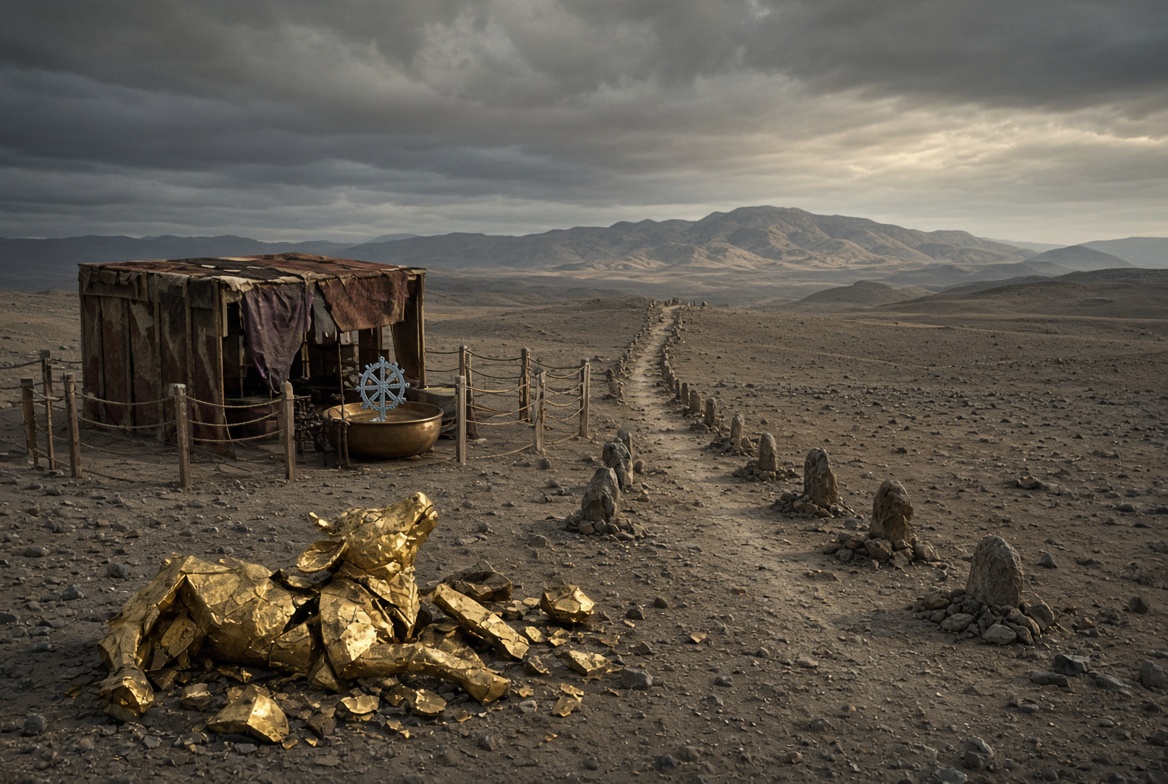
What Was the Tabernacle?

A portable dwelling, designed in detail, so that God could live among a moving people.
Exod 25-31 gives the blueprint and Exod 35-40 records the construction. The proportion of text devoted to it is striking: more chapters than the creation account.
The layout follows the standard temple plan of the region: a rectangle on an east-west axis, entrance at the east, most holy place at the west.
The structure moves inward through zones of increasing restriction. An outer courtyard with the altar and the basin, accessible to the people. The holy place with the lampstand, the table of bread, and the incense altar, for priests. And the most holy place behind a curtain, containing the ark, entered once a year by one man with blood.
The materials encode the same gradient. The most valuable metals and dyes sit nearest the ark and decline in value with distance from it. In that world a progression like that signalled degrees of holiness, so the building states its own rules in its fabric before anyone reads a regulation.
It is also doing two things at once. It is a scale model of God’s heavenly dwelling and a scale model of Eden, which means it addresses both a humanity alienated from God and a creation alienated from him.
The direction of that design is the point. Access is real and it is regulated, and the regulation says something about holiness that the later tearing of the temple curtain answers.
Exod 40 ends with the cloud covering the tent and the glory filling the tabernacle, so that Moses could not enter. The pattern set at creation, where God makes a place and then fills it, is being repeated.
What Was the Golden Calf?
Covenant breach within weeks of the covenant being made, while Moses was still on the mountain receiving it.
Exod 32. The people ask Aaron to make gods to go before them because Moses is delayed. Aaron collects gold, makes a calf, and announces a festival to the Lord.
That last detail is the important one. This is not a switch to a different god by name. Aaron identifies the calf with the God who brought them out of Egypt. It is a violation of the second commandment rather than the first, which makes it more insidious rather than less.
Moses comes down, breaks the tablets, and the covenant is formally shattered at the moment of its ratification.
Then Exod 32-34 becomes one of the most important passages in the Old Testament. Moses intercedes, refuses God’s offer to make a nation from him instead, asks to see God’s glory, and receives the declaration in Exod 34:6-7 about a God compassionate and gracious, slow to anger, abounding in love and faithfulness, forgiving wickedness, and yet not leaving the guilty unpunished.
That formula is quoted back to God repeatedly through the rest of the Old Testament. It is the closest thing the Hebrew Bible has to a self-description, and it is given immediately after the worst failure to that point.
What Happened to Nadab and Abihu?
Aaron’s sons offered unauthorised fire and were killed.
Lev 10:1-3. They offered fire before the Lord contrary to his command, and fire came out and consumed them. Aaron’s response is silence.
The text does not explain what was wrong beyond saying the fire was not commanded. Proposals include going too far into the sanctuary, bringing coals from outside the sacred area, preparing the incense improperly, or offering at the wrong time. The coals and the incense readings have the most contextual support.
What the text conspicuously does not do is discuss their motives, and one commentator draws the right conclusion from that silence. In the ritual sphere intention is not the issue. They crossed a boundary, and whether they meant well is not a question the passage thinks worth raising.
It is a hard passage and it should not be softened. The point being made, stated in the verse that follows, is about the seriousness of the holiness the priesthood was handling.
Why Did Israel Wander Forty Years?
Because they refused to enter, once, and the sentence matched the refusal.
Num 13-14. Twelve spies go into Canaan for forty days. All twelve report the land is good. Ten report that the inhabitants are too strong and include descendants of the Anakim, and the people are grasshoppers by comparison.
Caleb and Joshua dissent. The community responds by weeping all night, talking about returning to Egypt, and proposing to stone them.
The sentence in Num 14:34 is a year for each day the spies explored: forty years, until that generation dies in the wilderness. Only Caleb and Joshua of the adults will enter.
There is a grim exactness to it. They had said they would rather die in the wilderness, and God takes them at their word. The murmuring becomes the sentence, phrased in their own terms.
The journey from Egypt to Canaan takes eleven days. The wandering takes forty years, and the difference is entirely a refusal at the border.
What Was Korah’s Rebellion?
A challenge to Moses and Aaron’s authority from within the tribe of Levi.
Num 16. Korah, with Dathan, Abiram, and two hundred and fifty leaders, confronts Moses with the argument that the whole community is holy and that Moses and Aaron have set themselves above the assembly.
The argument is not obviously wrong on its face, which is what makes it dangerous. The stated principle is true. The application is a bid for the priesthood.
The ground opens and swallows the leaders and their households, and fire consumes the two hundred and fifty offering incense.
The following day the community blames Moses for the deaths, and a plague follows, stopped by Aaron running between the living and the dead with a censer.
What Was the Bronze Serpent?
A judgment and its remedy, and Jesus later applies it to himself.
Num 21:4-9. The people grow impatient and speak against God and Moses, complaining about the food. Venomous snakes come among them and many die.
They confess, and Moses is told to make a bronze snake and put it on a pole, so that anyone bitten who looks at it will live.
The remedy is a representation of the thing killing them, lifted up, and healing comes by looking rather than by doing.
John 3:14-15 has Jesus making the connection explicit: as Moses lifted up the snake in the wilderness, so the Son of Man must be lifted up, that everyone who believes may have eternal life.
The bronze serpent has a sequel. Centuries later, in 2 Kgs 18:4, Hezekiah destroys it because Israel had been burning incense to it. Serpents were widely worshipped in the surrounding religions, and the object appears to have been absorbed into that practice rather than replacing it.
The name Hezekiah gives it as he breaks it is the sharpest thing in the episode. Nehushtan, which means roughly bronze thing. That reads less as a formal designation than as a king’s contemptuous dismissal of what his people had been bowing to.
A genuine memorial of grace, commanded by God and effective, became an idol, and the reform required breaking it.
Who Was Balaam?
A foreign diviner hired to curse Israel who could not manage it.
Num 22-24. Balak of Moab sends for him. God tells him not to go, then permits it with conditions, and the journey includes the donkey seeing the angel and speaking.
Four times he attempts an oracle and four times a blessing comes out instead, including the prophecy of a star coming out of Jacob and a sceptre rising out of Israel.
He is not a hero. Num 31:16 and later references indicate he advised the strategy that succeeded where cursing failed: seduction into idolatry at Peor, which achieved by corruption what could not be achieved by curse. The New Testament refers to his error and his way as a warning.
What Is Deuteronomy?
Moses’s final addresses to the generation about to enter, delivered on the plains of Moab.
It is structured like an ancient covenant renewal document: historical review, stipulations, blessings and curses, witnesses, and provision for succession.
Deut 6:4-5 contains the Shema, which Jesus names as the greatest commandment. Deut 32 contains the Song of Moses with the division of the nations. Deut 34 records his death within sight of the land he could not enter, with God burying him and no one knowing the place.
The last verses say no prophet has risen in Israel like Moses, whom the Lord knew face to face. That sentence sets a bar the rest of the Old Testament measures against.
Part of a series following the Old Testament timeline.
Continues from Part 4: What Was the Exodus from Egypt? · Continues in Part 6: How Did Israel Conquer Canaan? · Start at Part 1: What Happens in Genesis 1-11?
All 15 parts in this series
- Part 1What Happens in Genesis 1-11?
- Part 2Who Were the Patriarchs? Abraham to Joseph
- Part 3What Is the Book of Job About?
- Part 4What Was the Exodus from Egypt?
- Part 5What Happened in the Wilderness Wanderings?You are here
- Part 6How Did Israel Conquer Canaan?
- Part 7What Was the Period of the Judges?
- Part 8Saul, David, and Solomon: The United Kingdom
- Part 9What Are the Wisdom Books of the Bible?
- Part 10Why Did Israel Split Into Two Kingdoms?
- Part 11How Did Judah Fall to Babylon?
- Part 12What Is the Book of Jonah Really About?
- Part 13What Was the Babylonian Exile?
- Part 14What Happened After the Exile? Ezra to Malachi
- Part 15Who Was Dagon? From Philistia to Lovecraft
New field notes when they are ready, along with the research underneath them. No drip sequence, no course, nothing to buy.
Footnotes2
- Exodus 34:6-7 functions as a formula throughout the Hebrew Bible, quoted or alluded to in Numbers, Nehemiah, the Psalms, Joel, Jonah, and elsewhere. Tracing its reuse is one of the more rewarding exercises in Old Testament study, particularly because different writers stop at different points in it.
- The fate of the bronze serpent is a compact case study in how a legitimate object becomes an idol. It was commanded by God, it worked, and roughly seven centuries later it had to be destroyed by a reforming king. The problem was never the object.
Sources
The biblical texts cited: Exod 25-40, Lev 10 and 16-27, Num 13-14, 16, 21, 22-24, 31:16, Deut 6:4-5, 32, 34, John 3:14-15, and 2 Kgs 18:4.
Daniel I. Block, For the Glory of God: Recovering a Biblical Theology of Worship (Baker Academic, 2014), 304. Supports the tabernacle as a standard regional temple plan and as a microcosm of both the heavenly dwelling and Eden.
Leland Ryken et al., Dictionary of Biblical Imagery (InterVarsity Press, 2000), 838. Supports the declining value of materials outward from the ark as a coding of graded holiness.
Richard Elliott Friedman, Commentary on the Torah (HarperOne, 2012). Supports the point that the text does not address the motives of Nadab and Abihu because intention is not the issue in the ritual sphere.
Mark F. Rooker, Leviticus, New American Commentary (Broadman & Holman, 2000), 3a:157. Supports the range of proposed explanations for the offence.
John Woodhouse, 2 Kings, Preaching the Word (Crossway), 444. Supports the reading of Nehushtan as Hezekiah's own dismissive name for the object.
Where the sourcing stops: the precise nature of the offence of Nadab and Abihu is not stated in the text and proposals about it are inference. The role of Balaam in the Peor incident is drawn from Num 31:16 and later New Testament references rather than from the Balaam narrative itself.