
Series: The Apostle Paul · Part 11 of 12
This is one of the strangest arguments Paul ever makes, and even sympathetic scholars have called it convoluted.
It runs through headship, creation, angels, nature, and then appears to undo itself in the final verse.
What Is the Passage Doing?
Regulating how men and women appear when praying and prophesying in the assembly.
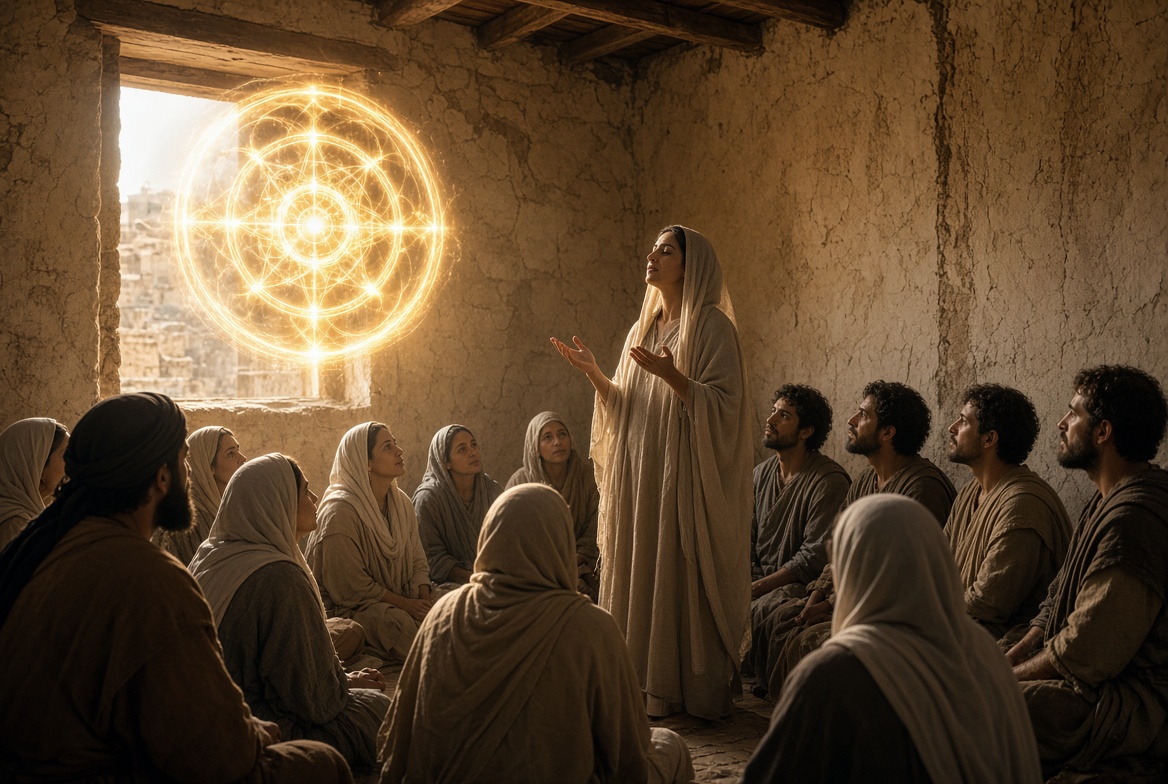
Note that first, because it governs everything else. The passage assumes women are praying and prophesying publicly. It is about how, not whether.
Paul’s argument runs through several moves. A headship order. The creation account. An instruction that a woman ought to have authority on her head because of the angels. A reminder that in the Lord neither is independent of the other. Then an appeal to nature, and finally an appeal to custom.
What Are the Ordinary Explanations?
Three, and each has genuine support.
Social respectability. In that world an uncovered head on a married woman in public carried associations no congregation wanted attached to it, ranging from disregard for her husband to something worse.
Distinction from the surrounding cults. Corinth had its own religious environment, and ecstatic worship with loosened hair was part of the visual vocabulary of some of it. A church that looked like that from the street was making a statement it did not intend.
Each of these accounts for part of the passage. None accounts for verse 10, and none accounts for the ending.
What Does Because of the Angels Mean?
The hardest phrase in the passage, and Heiser devotes a chapter of Reversing Hermon to it using Loren Stuckenbruck’s taxonomy of three options.
Angels as human messengers or church officials. Weak, and it can be set aside quickly. The word angeloi in Paul overwhelmingly denotes spirit beings.
Good angels present at worship, who must see proper order and glory. Possible, and Paul does elsewhere assume an unseen audience. What it does not explain is the anxiety in the phrasing. Verse 10 does not read like a note about decorum in front of dignified observers.
The transgression of the watchers. Gen 6 and 1 Enoch 6 have angels crossing a boundary with human women, and 1 Enoch 8 has the watchers teaching women cosmetics and seductive adornment. On this reading Paul is guarding the worship assembly against the kind of boundary violation that had happened before, and marking the women as under proper authority rather than displaying the illicit glory the watchers taught.
Heiser argues this is the most sensible of the three, and the passage’s own vocabulary supports it. Glory, authority, the creation order out of Gen 2, and covering all read coherently against that background. The woman’s covering is a symbol of authority, hers or the authority she stands under, precisely in the presence of beings who once transgressed.
It also explains the anxiety. You do not write because of the angels about spectators. You write it about a known incident.
Why Does 1 Corinthians 11:15 Undo the Argument?
Verse 15 appears to dismantle the argument.
Paul has spent fourteen verses saying a woman should cover her head. Then he says her hair is given to her instead of a covering.
Read straightforwardly, that means she already has one and the instruction is unnecessary. Interpreters have been trying to reconcile that for a very long time.
What Is the Testicle Proposal?
An argument that the word usually rendered covering is anatomical, and it comes from a specialist in Greek medical texts.
Troy Martin argued in the Journal of Biblical Literature in 2004 that peribolaion in verse 15 means testicle, so the line reads that a woman’s hair is given to her instead of a testicle.
The reasoning runs through ancient physiology rather than through modesty. Hippocratic medical texts treat hair as hollow and as part of the reproductive system, drawing fluid upward. On that understanding a woman’s long hair functions within her reproductive anatomy, and hair and genitals belong to one system.
A popular version of this circulates in a garbled form, usually as the claim that hair was thought to be tied to fertility and that covering it protected a woman’s fertility. That is pointing at the right neighbourhood and it is not quite what Martin argued.
Which would make Paul’s appeal to nature a literal appeal to nature as his era understood it, and would make uncovered hair in worship a genuine exposure problem rather than a matter of decorum.
Michael Heiser gave the argument a wide audience through the Naked Bible Podcast, which is where most people who know it have met it.
Has Martin’s Reading Been Accepted by Scholars?
It is contested and the exchange is on the record, which is the honest way to present it.
Mark Goodacre published a response in the same journal in 2011 arguing that the lexical basis is not strong enough. His central points are that there are no known uses of peribolaion meaning testicle, that the two texts Martin adduces use the word in metaphorical contexts, and that Paul had ordinary words available if he meant that, orchis being the obvious one.
Martin replied in 2013, defending the reading and arguing that context requires it in both passages.
Others have pressed a conceptual objection. A testicle is not a covering, does not function as one and does not look like one, so the metaphor is doing something a metaphor does not usually do.
What Is Worth Keeping From Martin’s Argument?
Two claims are buried in Martin’s argument and they can be separated. Most treatments, including the enthusiastic ones and the dismissive ones, run them together.
The lexical claim is that peribolaion in verse 15 means testicle and should be translated that way. I do not hold that. Goodacre’s objection looks right to me: the word is not attested in that sense, Paul had ordinary vocabulary available, and every major translation renders it covering.
The background claim is that ancient medicine understood hair as part of the reproductive system, and that this understanding was in the air when Paul wrote. That is a different proposition, it does not depend on the translation, and it is considerably harder to dismiss.
The second one is where the interest lies.
Why Does the Background Claim Matter Anyway?
Because the passage appeals to nature, and we do not share Paul’s physiology.
Whatever nature taught his readers about hair, it was not what a modern reader assumes when they hear the word. If hair carried associations that ran toward reproduction and sexuality in the medical thinking of that world, then uncovered hair in a mixed worship assembly was doing something a modern reader does not feel.
That would make the instruction intelligible without making it a rule about hats.
So the position I hold is narrower than Martin’s and wider than a flat rejection. The translation is not where I would put weight. The cultural and physiological background is real, it is genuinely interesting, and it is probably part of why the passage reads as strangely as it does.
Where Should Someone Start Reading on This?
With the three articles, in order, because the whole exchange is published and accessible.
Martin’s original in 2004, Goodacre’s response in 2011, and Martin’s reply in 2013. All three are in the Journal of Biblical Literature, and Goodacre has made his freely available on his own site.
Read them in sequence and you get something better than a verdict. You get to watch two specialists disagree in public over evidence you can check, which is a more useful thing to have seen than a conclusion handed to you.
That is worth an evening. What is not worth anything is the version that reaches you third-hand with only the first article in it, which is how most people meet this argument.
Where it leads after that is an open question and a live one. The physiology of the ancient body, what Paul’s readers understood nature to be teaching, and how much of that sits underneath passages we read as straightforward, is a large area and mostly unexplored at a popular level.
I would rather someone chase that and land somewhere different from me than take my summary and stop.
Part of a series on the apostle Paul. See also does Paul forbid women to teach.
Continues from Part 10: Does Paul Forbid Women to Teach or Preach? · Continues in Part 12: Why Does Acts Not Record Paul's Death? · Start at Part 1: Who Was Saul of Tarsus Before Damascus?
All 12 parts in this series
- Part 1Who Was Saul of Tarsus Before Damascus?
- Part 2The Damascus Road and Paul's Hidden Years
- Part 3Paul's First Missionary Journey and Acts 15
- Part 4Paul's Second Missionary Journey Explained
- Part 5Paul's Third Journey: 3 Years in Ephesus
- Part 6Why Was Paul Arrested in Jerusalem?
- Part 7Paul's Shipwreck and Voyage to Rome
- Part 8How Did the Apostle Paul Die?
- Part 9What Was Paul's Thorn in the Flesh?
- Part 10Does Paul Forbid Women to Teach or Preach?
- Part 11Why Did Paul Tell Women to Cover Their Heads?You are here
- Part 12Why Does Acts Not Record Paul's Death?
New field notes when they are ready, along with the research underneath them. No drip sequence, no course, nothing to buy.
Footnotes3
- That the passage assumes women praying and prophesying in the assembly is the thing most often lost when it is quoted. Whatever verses 2 to 16 are regulating, they are not regulating whether women speak in worship, because the regulation presupposes that they do.
- The Martin proposal is a useful test case for how a striking claim travels. It is a real argument, in a real journal, by a real specialist, and it also has a published rebuttal and a published reply. The version that circulates online is usually the first of those three without the other two.
- Separating a lexical claim from the background claim it rests on is worth doing generally, not only here. A translation argument can fail while the historical observation underneath it survives, and running them together means rejecting both or accepting both when the evidence for each is different.
Sources
Troy W. Martin, "Paul's Argument from Nature for the Veil in 1 Cor 11:13-15: A Testicle Instead of a Head Covering," Journal of Biblical Literature 123:1 (2004), 75-84. The original proposal.
Mark Goodacre, "Does peribolaion Mean Testicle in 1 Cor 11:15?" Journal of Biblical Literature 130:2 (2011), 391-396. The response, arguing the lexical basis is insufficient.
Troy W. Martin, "Peribolaion as Testicle in 1 Cor 11:15: A Response to Mark Goodacre," Journal of Biblical Literature 132:2 (2013), 453-465. Martin's reply.
Michael S. Heiser, Reversing Hermon: Enoch, the Watchers, and the Forgotten Mission of Jesus Christ (Defender Publishing, 2017), chapter 8. Supports the three-option taxonomy for because of the angels, the assessment of each, and the reading of the passage's vocabulary against the watchers background. In my library, and covered in the Reversing Hermon reading guide.
Loren Stuckenbruck, whose taxonomy of the three options Heiser uses.
Kenneth E. Bailey, Paul Through Mediterranean Eyes: Cultural Studies in 1 Corinthians (IVP Academic, 2011). Supports the structural treatment of the letter and the cultural background to the Corinthian situation. Supplied in full.
The biblical texts cited: 1 Cor 11:2-16 and Gen 6:1-4.
Where the sourcing stops: the Hippocratic physiology of hair is Martin's argument from Greek medical texts I have not read directly. Whether Paul held that view of the body is an inference from his appeal to nature rather than anything he states. The watchers reading of verse 10 is the one I find most persuasive and it remains a reading rather than a demonstrated result.