
Series: The Life of Jesus · Part 1 of 12
Almost every detail of the familiar Christmas picture is either uncertain, absent from the text, or imported from somewhere else.
That is not a demolition. What survives is stranger and better than the version on the greeting card.
What Year Was Jesus Born?
Somewhere around 6 to 4 BC, which means the calendar is off by a few years.
The anchor is Herod the Great, who is alive and murderous in Matthew’s account and who died in 4 BC. Jesus has to be born before that, and the massacre at Bethlehem targets boys two years old and under, which implies some interval.
The BC and AD system was calculated in the sixth century and the arithmetic was slightly wrong. Nobody has ever bothered to fix it, so Jesus was born a few years before the year traditionally assigned to his birth.
There is no year zero either. The calendar runs from 1 BC straight to AD 1.
Was Jesus Born on December 25?
Nothing in the Gospels gives a date or a season.
December 25 first appears as a fixed observance centuries later. The reasons proposed for it vary, and the argument that it was chosen to displace a Roman festival is one theory among several rather than an established fact.
The one hint in the text points a different direction. Shepherds are living out in the fields keeping watch over their flocks at night, which fits better with the warmer months, though it is not decisive since flocks near Bethlehem could be out in winter as well.
The honest answer is that the date is unknown and the church chose one later for its own reasons.
There are four serious attempts to recover it, and two of them are better than their reputations: the Rev 12 sky-sign argument that produces a September date, the nine-months-from-the-crucifixion calculation that produces December, the priestly course reconstruction working back from Zechariah’s temple duty, and the claim that December 25 was chosen to displace a Roman festival. Each rests on a different kind of evidence and they are worked through separately in the post on the date theories.
Was There No Room at the Inn?

Probably not, and this is the detail most worth reworking.
Luke 2:7 says there was no place for them in the kataluma. That word does not mean commercial inn. Luke uses it again in Luke 22:11 for the guest room where the Last Supper is held. When Luke wants to say inn, as in the Good Samaritan at Luke 10:34, he uses a different word entirely, pandocheion.
So the sentence more plausibly reads that there was no room in the guest quarters.
The cultural picture that follows is different from the familiar one. Joseph was returning to his ancestral town, where he had family. Middle Eastern hospitality would have made turning away a pregnant relative close to unthinkable. Ordinary village houses had a family room where animals were brought in at night, with feeding troughs cut into the floor at the edge of the raised living area.
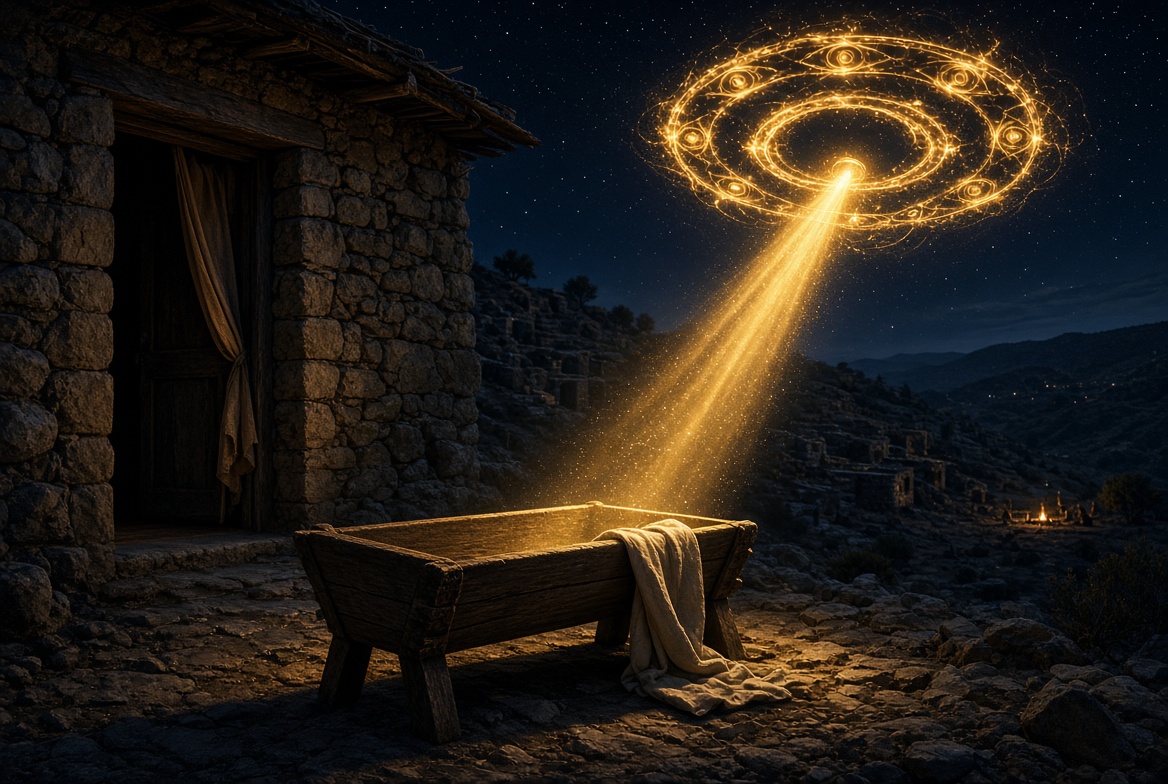
On that reading the family was taken in, the upper guest room was already occupied, and the birth happened in the main room of a crowded family home. The manger is not evidence of exclusion. It is evidence of an ordinary house.
Where Did the Stable and the Innkeeper Come From?
Largely from a second-century book that is not in anyone’s Bible.
The Protevangelium of James, written around AD 200, puts the birth in a cave outside Bethlehem, has Mary go into labour before they arrive, and adds a midwife. It is devotional fiction, and it does not know Palestinian geography well, describing the road from Jerusalem to Bethlehem as desert.
The innkeeper is not in Scripture at all. There is no innkeeper. He was invented to explain a mistranslation, and then given lines in every pageant since.
What Do Matthew and Luke Each Contribute?
They tell different halves and rarely overlap.
Luke gives the announcements to Zechariah and Mary, the visit to Elizabeth, the Magnificat, the birth of John, the shepherds, and the temple presentation with Simeon and Anna. His focus runs through the women and the poor.
Matthew gives Joseph’s dreams, the magi, Herod’s massacre, and the flight to Egypt. His focus runs through fulfilment of prophecy and the threat from power.
Only Matthew has magi. Only Luke has shepherds. They are never in the same room in the text, though they share a stage in every nativity play.
Who Were the Magi and When Did They Arrive?

Not kings, not necessarily three, and not at the birth.
Matthew calls them magi, a term for eastern astrologers or priestly scholars, most likely from Persia or Babylon. The number three is inferred from the three gifts. Nothing calls them kings.
And Matt 2:11 has them coming into a house, not a stable, and finding the child rather than a newborn. Herod’s order targets boys up to two years old based on what the magi told him about timing.
They arrive months or more after the birth. The nativity set has them at the manger because it is convenient, not because the text puts them there.
What Was the Presentation in the Temple?
The moment two elderly people recognised him when nobody else had.
Luke 2:22-38. The family comes for the purification offering, and Luke notes the offering they bring is the pair of birds, which was the provision for those who could not afford a lamb. That is a quiet statement about their means.
Simeon takes the child and says he can depart in peace, having seen the salvation prepared before all peoples, a light for revelation to the Gentiles and glory for Israel. Then he tells Mary that a sword will pierce her own soul too.
Anna, a widow of great age who never left the temple, gives thanks and speaks about the child to all who were waiting for redemption.
Two old people in the temple, and neither of them is in most nativity scenes either.
Why Does the Flight to Egypt Matter?
Because the story starts by repeating Israel’s story.
Matt 2:13-15 has the family fleeing to Egypt and returning after Herod’s death, and Matthew attaches Hos 11:1: out of Egypt I called my son.
That verse in Hosea is about Israel coming out of the exodus. Matthew is not misreading it. He is claiming that Jesus is retracing the national story from the beginning, going down into Egypt and coming back out, and he will follow that pattern through the wilderness testing next.
The infancy narrative is doing theological work before Jesus says a word.
Part of a series following the Life of Jesus timeline.
Continues in Part 2: What Did Jesus Do Before He Was 30?
All 12 parts in this series
- Part 1When Was Jesus Born? The Nativity ExplainedYou are here
- Part 2What Did Jesus Do Before He Was 30?
- Part 3Why Was Jesus Baptized and Tempted?
- Part 4The Early Judean Ministry of Jesus
- Part 5The Galilean Ministry of Jesus Explained
- Part 6Peter's Confession and the Transfiguration
- Part 7Jesus in Judea and Perea: The Final Year
- Part 8What Happened During Holy Week? Day by Day
- Part 9The Crucifixion of Jesus: What Happened
- Part 10The Resurrection Appearances of Jesus
- Part 11What Is the Ascension of Jesus?
- Part 12When Was Jesus Born? The Date Theories
New field notes when they are ready, along with the research underneath them. No drip sequence, no course, nothing to buy.
Footnotes2
- The lexical argument about kataluma is the strongest part of the case and it is checkable by anyone with a concordance. Luke had a word for commercial inn and used it elsewhere. He did not use it here.
- The offering of two birds in Luke 2:24 is easy to read past. Leviticus 12 prescribes a lamb, with the birds as the provision for those who cannot afford one. Luke is telling us something about the family's circumstances without commenting on it.
Sources
The biblical texts cited: Luke 1:5-2:52, Matt 1:18-2:23, Luke 10:34, Luke 22:11, and Hos 11:1.
Kenneth E. Bailey, Jesus Through Middle Eastern Eyes: Cultural Studies in the Gospels (IVP Academic, 2008), chapter 1. Supports the reading of kataluma as guest room rather than inn, the village house layout with animals brought inside, and the account of how the Protevangelium shaped the popular nativity. In print from IVP Academic.
Where the sourcing stops: the dating of Herod's death to 4 BC is standard and rests on Josephus, with a minority arguing for 1 BC. The reasons behind the choice of December 25 are debated and no single explanation is established.