
Series: The Parables · Part 10 of 26
The detail that governs the parable is one most retellings drop.
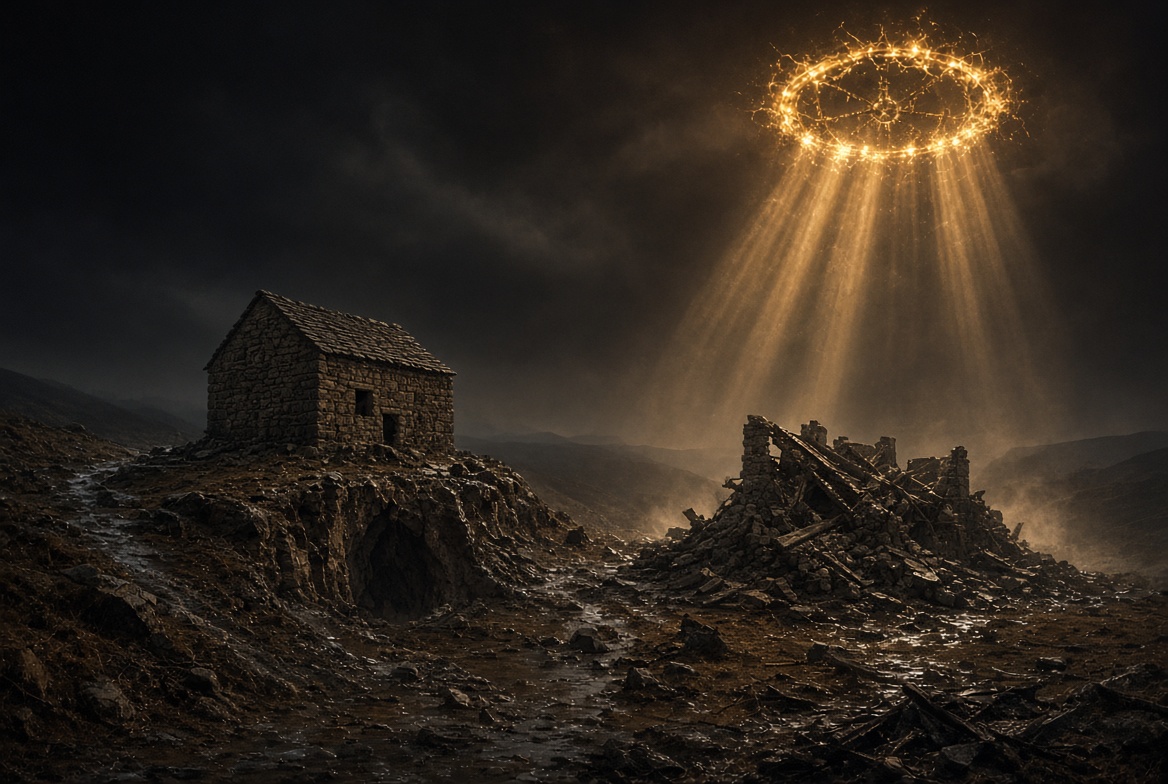
The storm hits both houses. Not one. The wise builder is not spared the weather, and any reading that treats faith as protection from difficulty has to explain why the flood arrives at both addresses.
What Does Digging Down to Rock Involve?
Serious labour, and Luke’s version says so where Matthew’s does not.
Luke has the wise builder dig deep and lay the foundation on rock. In that terrain that means going down through hard clay until you reach bedrock, by hand, before a single wall goes up.
The other man builds on the ground. His house goes up faster, costs less, and looks the same when it is finished. On a dry day nobody could tell the two apart, and for most of the year there is nothing to choose between them.
Bailey’s reading connects the digging to hearing and doing. The energy required to get through the clay is the picture of what obedience costs, and it is spent invisibly, before anything is standing.
Why Does the Storm Come to Both?
Because that is what the parable is claiming.
Rain falls, rivers rise, and wind beats against both houses. The difference is not the weather, it is what happens next. One stands and one falls, and Matthew says the fall was great.
So the promise is not immunity. It is that the house on the foundation survives the storm that comes anyway.
That distinction is worth holding, because the alternative reading is common and it fails people at exactly the moment they need it. A person taught that faith prevents the flood has been handed something that will break the first time weather arrives.
What Is the Foundation?
The person and the words of Jesus, and the claim in that is larger than it looks.
The parable closes the Sermon on the Mount. Everything that precedes it has been Jesus teaching, and the parable’s application is to hearing these words of mine and doing them.
Bailey notes what happens when that is set against Isaiah. The prophets call people to hear the word of the Lord. Jesus calls people to hear and do his word, and puts the security of a life on that footing.
He also observes that the foundation imagery in Isaiah points at a stone God lays, and that in this parable a person occupies the place a building would have. Bailey reads that as Jesus identifying himself as the foundation the prophets promised, over against both the temple and the leadership that ran it.
That is a substantial claim delivered as a story about construction, which is characteristic of how the parables work.
Is Hearing Enough?
No, and the parable is built to make that impossible to miss.
Both builders hear. Matthew has everyone who hears these words of mine and does them, and everyone who hears these words of mine and does not do them. The hearing is common ground.
Which means the parable is not about believers and unbelievers as usually framed. It is about two people inside the same audience, both of whom listened, and one of whom went and dug.
The crowd’s reaction in the next verse is that they were astonished at his teaching, because he taught as one with authority. They heard. The parable had just finished telling them that hearing was the easy part.
Part of a series working through the parables. See also the Good Samaritan.
Sources
Kenneth E. Bailey, Jesus Through Middle Eastern Eyes: Cultural Studies in the Gospels (IVP Academic, 2008), chapter 25. Supports the reading of the digging as the cost of hearing and doing, the point that the storm strikes both houses and that faith is not protection from it, and the christological reading of the foundation against Isaiah. Supplied in full.
The biblical texts cited: Matt 7:24-29 and Luke 6:46-49.
Where the sourcing stops: the identification of Jesus with the foundation stone of Isaiah is Bailey’s interpretive reading rather than a claim the parable states. The differences between the Matthew and Luke versions, including the digging detail, are noted here without settling which is closer to the original telling.
Footnotes
- That both houses face the same storm is stated plainly in both versions and is routinely dropped in retelling, usually because the retelling wants the parable to promise protection. The text promises survival, which is a different and more durable claim.
- The invisibility of the foundation work is worth dwelling on. The two houses are indistinguishable until the weather arrives, which means the parable is describing a difference nobody can see and nobody can verify in advance, including the builders’ neighbours and possibly the builders themselves.
Continues from Part 9: The Good Samaritan: What the Parable Answers · Continues in Part 11: The Persistent Widow and the Unjust Judge · Start at Part 1: How Do the Parables of Jesus Actually Work?
All 26 parts in this series
- Part 1How Do the Parables of Jesus Actually Work?
- Part 2The Parable of the Talents Explained
- Part 3The Pharisee and the Tax Collector Explained
- Part 4The Wedding Feast and the Man Without a Garment
- Part 5The Parable of the Unjust Steward Explained
- Part 6The Parable of the Rich Fool Explained
- Part 7The Parable of the Great Banquet Explained
- Part 8Lazarus and the Rich Man: What It Teaches
- Part 9The Good Samaritan: What the Parable Answers
- Part 10The Two Builders: Why the Storm Hits BothYou are here
- Part 11The Persistent Widow and the Unjust Judge
- Part 12The Serving Master: The Parable of the Watching Servants
- Part 13The Workers in the Vineyard: A Fair Wage?
- Part 14The Tenants in the Vineyard: Squatters Rights
- Part 15The Parable of the Pounds and the Hated King
- Part 16The Ten Bridesmaids: Why They Would Not Share
- Part 17The Two Debtors and the Woman at Simon's House
- Part 18The Lost Sheep and the Lost Coin Explained
- Part 19The Prodigal Son: What the Village Was Waiting For
- Part 20The Sheep and the Goats: Who Are the Brothers?
- Part 21The Unforgiving Servant and the Impossible Debt
- Part 22The Good Shepherd: A Claim to Be King
- Part 23The Parable of the Sower and the Four Soils
- Part 24The Mustard Seed and the Yeast Explained
- Part 25The Hidden Treasure and the Pearl of Great Price
- Part 26The Parable of the Weeds and Why God Waits
New field notes when they are ready, along with the research underneath them. No drip sequence, no course, nothing to buy.