
Series: The Parables of Jesus · Part 24 of 26
Both parables compare something small to something large, and both choose an image that does not quite fit.
The misfit is the point. A mustard bush is not the tree the Old Testament promised, and yeast is a picture of corruption everywhere else in Scripture.
What Is Being Compared?
A small beginning and an unexpected outcome.
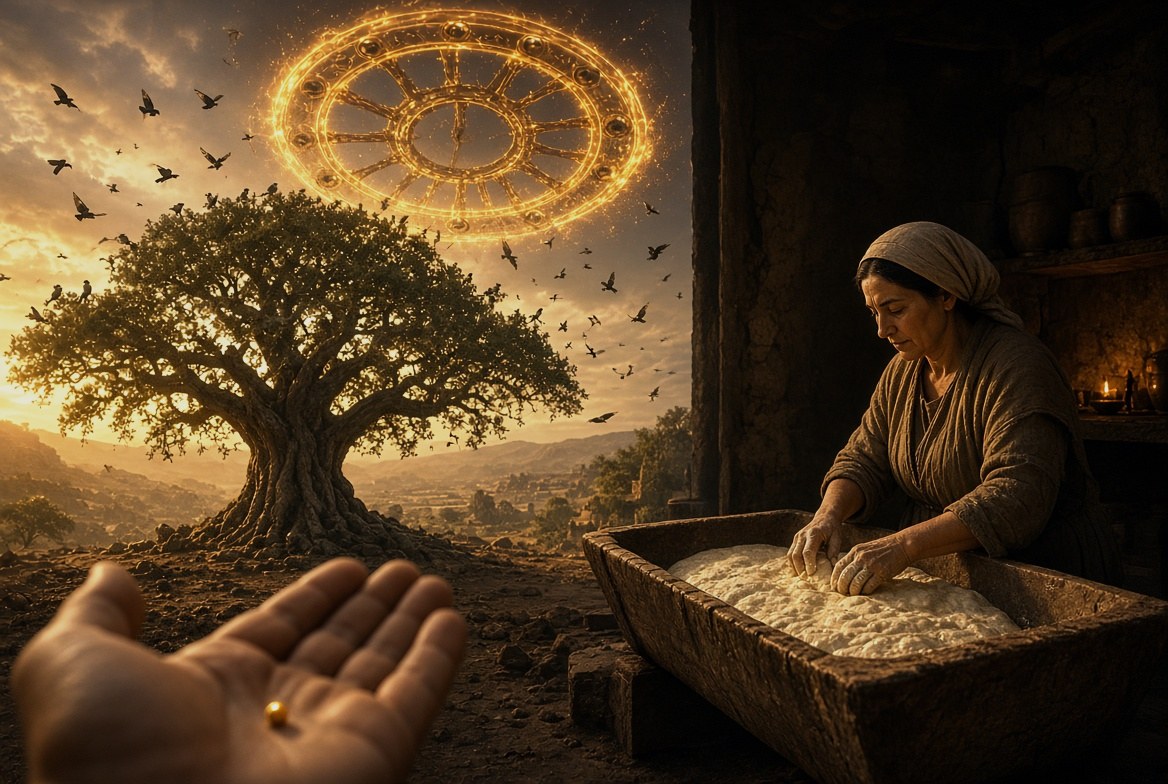
A seed and a bush. A lump of leaven and a mass of raised dough. The kingdom grows from beginnings that look insignificant to a size or an influence nobody watching would have predicted.
The setting explains why that needed saying. The kingdom, in its current form, was a small band of followers around an itinerant teacher, and it looked powerless. The parables tell people watching something unimpressive that the scale will change.
Is the Mustard Seed Really the Smallest?
No, and the objection is fair as far as it goes.
Orchid and cypress seeds are smaller. The claim is not accurate as botany.
What Jesus is speaking within is the frame of ordinary Jewish agricultural experience, where mustard was the smallest seed commonly planted in Palestinian fields. It functioned as a stock image for smallness, in the way a modern speaker might reach for a grain of sand without meaning to be measured against dust.
That is not evasion, and it is worth stating carefully rather than defensively. The sentence is a proverbial comparison inside a farming culture, not a claim entered in a botanical register.
What Do the Birds in the Branches Allude To?

Two Old Testament passages, and both are about kingdoms.
Dan 4 has a great tree, visible to the ends of the earth, with birds of the air nesting in its branches, and the tree is Nebuchadnezzar’s rule over the world.
Ezek 17 has God planting a sprig on a high mountain that becomes a noble cedar, with birds of every kind nesting in its shade, and that tree is God’s kingdom in Israel.
So the image is imperial. Birds sheltering in branches is what a world-spanning kingdom looks like in that literature.
Now notice what Jesus does with it. Ezekiel promises a cedar. Jesus offers a mustard bush.
A mustard plant is a large garden shrub. It is not a cedar of Lebanon and nobody in that audience would have confused the two. The parable takes the imperial tree imagery and attaches it to a common plant that grows fast in a field, which is either a deflation of the expectation or a redefinition of it.
Why Use Yeast as a Positive Image?
Because it is normally the opposite, and Jesus uses it that way himself.
Leaven, probably a piece of fermented dough kept back from the last batch, symbolised corruption because fermentation is a breakdown of organic material. Jesus warns elsewhere about the leaven of the Pharisees. Passover required its removal.
Here it is a life-giving agent, and the quantity is worth noticing. The woman works it into three measures of flour, which is enough bread for a hundred people or more.
The point of comparison is not moral quality. It is behaviour. Leaven works invisibly, through the whole mass, and cannot be extracted once it is in.
What Do the Two Have in Common?
Hiddenness, which may be the real subject.
Both the seed and the leaven work out of sight. Nothing appears to be happening while everything is happening, and the result arrives without anyone being able to point to the moment of change.
That is a different claim from mere growth, and it fits a kingdom that arrived without armies in a country expecting one. Read together, the pair says the kingdom is small, unimpressive, easy to overlook, working where nobody can watch it, and that none of that is a problem.
Part of a series working through the parables. See also the parable of the sower, which precedes these in Matt 13.
Continues from Part 23: The Parable of the Sower and the Four Soils · Continues in Part 25: The Hidden Treasure and the Pearl of Great Price · Start at Part 1: The Parables of Jesus: Complete List and Guide
All 26 parts in this series
- Part 1The Parables of Jesus: Complete List and Guide
- Part 2The Parable of the Talents Explained
- Part 3The Pharisee and the Tax Collector Explained
- Part 4The Wedding Feast and the Man Without a Garment
- Part 5The Parable of the Unjust Steward Explained
- Part 6The Parable of the Rich Fool Explained
- Part 7The Parable of the Great Banquet Explained
- Part 8Lazarus and the Rich Man: What It Teaches
- Part 9The Good Samaritan: What the Parable Answers
- Part 10The Two Builders: Why the Storm Hits Both
- Part 11The Persistent Widow and the Unjust Judge
- Part 12The Serving Master: The Parable of the Watching Servants
- Part 13The Workers in the Vineyard: A Fair Wage?
- Part 14The Tenants in the Vineyard: Squatters Rights
- Part 15The Parable of the Pounds and the Hated King
- Part 16The Ten Bridesmaids: Why They Would Not Share
- Part 17The Two Debtors and the Woman at Simon's House
- Part 18The Lost Sheep and the Lost Coin Explained
- Part 19The Prodigal Son: What the Village Was Waiting For
- Part 20The Sheep and the Goats: Who Are the Brothers?
- Part 21The Unforgiving Servant and the Impossible Debt
- Part 22The Good Shepherd: A Claim to Be King
- Part 23The Parable of the Sower and the Four Soils
- Part 24The Mustard Seed and the Yeast ExplainedYou are here
- Part 25The Hidden Treasure and the Pearl of Great Price
- Part 26The Parable of the Weeds and Why God Waits
New field notes when they are ready, along with the research underneath them. No drip sequence, no course, nothing to buy.
Footnotes2
- The seed-size objection is a good test of how a teacher handles difficulty. Denying it is dishonest, since smaller seeds exist. Conceding it as an error concedes more than necessary, since the sentence is proverbial. Stating the actual situation, that mustard was the smallest seed a Palestinian farmer sowed, costs nothing and is checkable.
- That yeast cannot be removed once worked into dough may be the sharpest half of the image and it is rarely drawn out. The comparison is not only that a small thing has a large effect, but that the effect is irreversible.
Sources
Anthony J. Saldarini, "Matthew," in Eerdmans Commentary on the Bible, ed. James D. G. Dunn and John W. Rogerson (Eerdmans, 2003), 1031. Supports the pairing of small beginning with great size, the Dan 4 background to the birds in the branches, the account of leaven as both corruption and life-giving force, and the theme of hiddenness common to both parables.
Craig Blomberg, Matthew, The New American Commentary (Broadman & Holman, 1992), 22:219-220. Supports the reading of the seed-size claim within ordinary Jewish agricultural experience and the allusion to Ezek 17:23.
Amy-Jill Levine, Short Stories by Jesus (Abingdon Press, 2018). Supports the observation that orchid and cypress seeds are smaller than mustard.
The biblical texts cited: Matt 13:31-33, Mark 4:30-32, Luke 13:18-21, Dan 4:10-12, and Ezek 17:23.
Where the sourcing stops: the reading of the mustard bush as a deliberate deflation of the cedar imagery is my own inference from the contrast between the two images, and it is not stated in the commentaries cited.